21
Then the chief priests of the Jews said to Pilate, "Do not write 'The king of the Jews,' but, 'He said, I am king of the Jews.'"
22
Pilate replied, "What I have written, I have written."
23
Then the soldiers, when they had crucified Jesus, took his clothing and made four shares--for each soldier a share--and the tunic. (Now the tunic was seamless, woven from the top {in a single piece}.)
24
So they said to one another, "Let us not tear it apart, but cast lots for it, [to see] whose it will be," so that the scripture would be fulfilled that says, "They divided my garments among themselves, and for my clothing they cast lots."
Thus the soldiers did these [things].
25
Now his mother and the sister of his mother, Mary the [wife] of Clopas, and Mary Magdalene were standing near the cross of Jesus.
26
So Jesus, seeing [his] mother and the disciple whom he loved standing there, said to [his] mother, "Woman, behold your son!"
27
Then he said to the disciple, "Behold your mother!" And from that hour the disciple took her into his own [home].
Jesus Dies on the Cross
28 After this, Jesus, knowing that now at last everything was completed, in order that the scripture would be fulfilled, said, "I am thirsty."
29
A jar full of sour wine was standing there, so [they] put a sponge full of the sour wine on a [branch of] hyssop [and] brought [it] to his mouth.
30
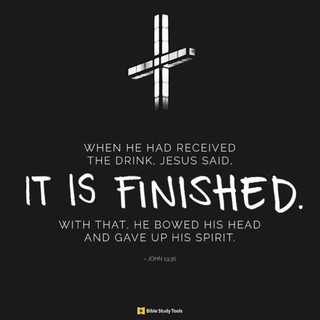
Then when he had received the sour wine, Jesus said, "It is completed," and bowing [his] head, he gave up [his] spirit.
31
Then the Jews, because it was the day of preparation, so that the bodies would not remain on the cross on the Sabbath (for that Sabbath was an important day), asked Pilate that their legs could be broken and they could be taken away.