Loading...

Change Translation

Loading...
  • Recent Translations
  • All Translations

Ecclesiastes 4:8-16

Listen to Ecclesiastes 4:8-16
8 There was a certain man without a dependent, having neither * a son nor a brother, yet there was no end to all his labor. Indeed, 1his eyes were not satisfied with riches and he never asked, "And 2for whom am I laboring and depriving myself of pleasure?" This too is vanity and it is a 3grievous task.
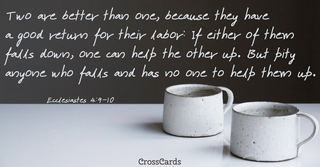
9 Two are better than one because they have a good return for their labor.
10 For if either of them falls, the one will lift up his companion. But woe to the one who falls when there is not another to lift him up.
11 Furthermore, if two lie down together they keep warm, but 4how can one be warm alone?
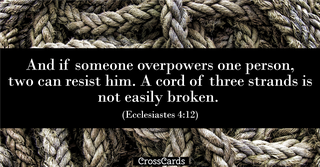
12 And if one can overpower him who is alone, two can resist * him. A cord of three strands is not quickly torn apart.
13 A 5poor yet wise lad is better than an old and foolish king who no longer knows how to receive instruction.
14 For he has come 6out of prison * to become king, even though he was born poor in his kingdom.
15 I have seen all the living under the sun throng to the side of the second lad who replaces * him.
16 There is no end to all the people, to all who were before them, and even the ones who will come later will not be happy with him, for this too is 7vanity and striving after wind.

Images for Ecclesiastes 4:8-16

Ecclesiastes 4:8-16 Meaning and Commentary

INTRODUCTION TO ECCLESIASTES 4

In this chapter the wise man reassumes the consideration of the case of the abuse of power, to show that there is no happiness in this world, in grandeur and authority enjoyed; since, as he had observed before, on the one hand, the oppressor shall be judged and condemned at the great day of account; so, on the other hand, the oppressed have their lives made so uncomfortable, that the dead are preferred unto them, and unborn persons to them both, Ec 4:1-3; Another vanity he observes, that whereas men expect to be happy by their diligence and industry, this brings upon them the envy of others, Ec 4:4; hence some, on the other hand, place their happiness in sloth and ease, which is another vanity, Ec 4:5,6; and others again in covetousness; who are described by their unsocial life, toilsome labour, unsatisfied desires, and withholding good things from themselves, Ec 4:7,8; upon which some things are said, to show the benefits of a social life, Ec 4:9-12. And the chapter is concluded with exposing the vanity of the highest instance of worldly power and grandeur, royal dignity, through the folly of a king; the effects of which are mentioned, Ec 4:13,14; and through the fickleness of the people, who are soon weary of a prince on the throne, and court his successor, Ec 4:15,16.

Unlock Deeper Insights: Get Over 20 Commentaries with Plus! Subscribe Now

Cross References 7

  • 1. Proverbs 27:20; Ecclesiastes 1:8; Ecclesiastes 5:10
  • 2. Ecclesiastes 2:21
  • 3. Ecclesiastes 1:13
  • 4. 1 Kings 1:1-4
  • 5. Ecclesiastes 7:19; Ecclesiastes 9:15
  • 6. Gen 41:14, 41-43
  • 7. Ecclesiastes 1:14

Footnotes 7

  • [a] Lit "second"
  • [b] Lit "they fall"
  • [c] Lit "a second"
  • [d] Lit "have warmth"
  • [e] Lit "he"
  • [f] Or "warning"
  • [g] Lit "stands in his stead"
Scripture quotations taken from the (NASB®) New American Standard Bible®, Copyright © 1960, 1971, 1977, 1995 by The Lockman Foundation. Used by permission. All rights reserved. www.Lockman.org

Study Tools

PLUS

Unlock Notes

This feature is for PLUS subscribers only. Join PLUS today to access these tools and more.

JOIN PLUS

Unlock Highlights

This feature is for PLUS subscribers only. Join PLUS today to access these tools and more.

JOIN PLUS

Unlock Bookmarks

This feature is for PLUS subscribers only. Join PLUS today to access these tools and more.

JOIN PLUS

Track Your Reading

Create a free account to start a reading plan, or join PLUS to unlock our full suite of premium study tools.

Already have an account? Sign in