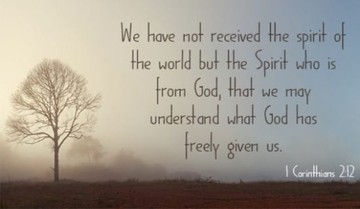
Thank God for ALL He has given us!
The apostle, in this chapter, pursues the same argument as before, that the Gospel needed not the wisdom and art of men: this he illustrates by his own example; and then he extols the Gospel above all the wisdom of men; and observes how it comes to be made known to men, even by the Spirit of God: hence it follows, that it is to be taught in his words, and not in the words of men; and that it can be only known and judged of by the spiritual, and not by the natural man. He instances in himself, and in his own ministry, when at Corinth, where he preached the Gospel in a plain and simple manner, without using the ornaments of speech, and human wisdom, 1Co 2:1 his reason was, because he had determined with himself to preach not himself, but a crucified Christ, 1Co 2:2. His manner of behaviour is more largely declared, 1Co 2:3 that he was so far from being elated with his human literature, and priding himself with that, and making use of it in an ostentatious way, that he was attended with much weakness, fear, and trembling; and his discourses were not adorned with the flowers of rhetoric, but were delivered with the power, evidence, and demonstration of the Spirit, 1Co 2:4. And his end and view in this method of preaching were, that the faith of his hearers should not be ascribed to human wisdom, but to a divine power, 1Co 2:5 but lest the Gospel should be thought meanly and contemptibly of, because of the plain dress in which it appeared, the apostle affirms it to be the highest wisdom, as those who had the most perfect knowledge of it could attest; a wisdom superior to the wisdom of this world, or of its princes, since that comes to nothing, 1Co 2:6 the excellency of which he expresses by various epithets, as the wisdom of God, mysterious wisdom, hidden wisdom, ancient wisdom, ordained before the world began, for the glory of the saints, 1Co 2:7 a wisdom unknown to the princes of the world, who otherwise would not have been concerned in the crucifixion of Christ, 1Co 2:8 and that this far exceeds the capacity of men, and could never have been found out by them, he proves, 1Co 2:9 by a testimony out of Isa 64:4 and then proceeds to show how it comes to be known by any of the sons of men, that it is by the revelation of the Spirit of God, 1Co 2:10 which is illustrated by the nature of the spirit of man within him, which only knows the things of a man; so in like manner only the Spirit of God knows the things of God, and can make them known to others, 1Co 2:11. And in this way he observes, that he and others became acquainted with these things; namely, by receiving not the spirit of the world, which at most could only have taught them the wisdom of the world, but the Spirit of God, whereby they knew their interest in the blessings of free grace, published in the Gospel, 1Co 2:12. And seeing the Gospel is made known by the Spirit of God, it should be delivered, not in the words of man's wisdom, but in the words of the Holy Spirit, as the apostle affirms he and other ministers did deliver it, returning to his former argument, 1Co 2:13. And also it follows from hence, that the things of the Gospel, which the Spirit reveals, cannot be known and received by the natural man, who has no discerning of them, and so no value for them, 1Co 2:14 and can only be discerned, judged, and approved of by spiritual men, 1Co 2:15 and who are not to be judged by natural and carnal men, because they have not the mind of Christ, and so cannot instruct them; but spiritual men have it, such as the apostle and others, 1Co 2:16.
apostle gives of himself is occasioned, either by what he had said in the latter part of the preceding chapter, concerning the choice God has made of the foolish, weak, base, and despicable things of the world, and of his calling them by his grace both to fellowship with the saints in common, and therefore he accommodated his ministry unto them, and in particular to the ministry of the word, of which he himself was a like instance and an example; or else by what he had declared in 1Co 1:17 of the same chapter, that he was sent to preach the Gospel,
\\not with wisdom of words\\; which he here reassumes, and affirms agreeably, that when he first came to Corinth, he
\\came not with excellency of speech, or of wisdom\\; for though he was not only versed in Jewish learning, being brought up at the feet of Gamaliel; but had also a good share of Grecian literature, and was capable, upon proper occasions, to cite the Greek poets, as he does Aratus, Ac 17:28 and Menander, Tit 1:12,13 and so could, had he thought fit, have adorned his discourses with pompous language, with the flowers of rhetoric, and the eloquence of the Grecians; yet he chose not such a high and florid style, and which savoured so much of human wisdom and art; for the subject he treated of required no such dress, nor any great swelling words of vanity, or a bombast style to set it off, and gain the applause and assent of men: for what he delivered were plain matters of fact, attested by God himself,
\\declaring unto you the testimony of God\\; that is, the Gospel, which bears a testimony to the love, grace, and mercy of God, his kindness and good will to the sons of men, in giving and sending his only begotten Son to be the Saviour and Redeemer of them; and in which God bears a testimony of his Son, of his sonship, deity, mediation, incarnation, obedience, sufferings, and death, of his resurrection, ascension to heaven, session at his right hand, intercession for his people, and his second coming to judgment, and of eternal life and salvation by him. All which being matter of fact, and depending upon the witness of God, which is greater than that of men, needed no art nor oratory of men to recommend it: it was enough in plain words, and easy language, to declare it, with the evidence by which it was supported. The Alexandrian copy, and some others, read, "the mystery" of God: and so the Syriac version ahlad azr, "the mystery of God" one of Stephens's copies reads, "the mystery of Christ"; and the Vulgate Latin version, "the testimony of Christ". 05252
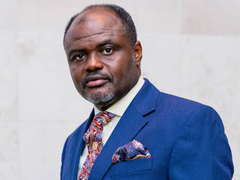
Did Moses ever actually say God would "rain bread from heaven" as validation of a ritual? Dr. Abel Damina points out that in John 6, Jesus directly corrected that assumption: "Moses gave you not that bread from heaven, but my Father giveth you the true bread from heaven." He argues the manna was only ever meant to point toward Christ — "they ate the bread and left the bread" — and that clinging to the sign instead of its meaning is exactly what modern attachment to religious elements repeats. In this message from Reintroducing Jesus, Beyond Religion, Dr. Damina traces this pattern from Exodus through John 6 to argue physical ritual has always been a communication device, never the substance.
Close your physicial eyes, open your spiritual eyes - and let God show you the majesty of His truth.
Why does Dr. Abel Damina call the New Testament "a testament of revelation" rather than ritual? He points out that Paul's prayers for every church — Ephesus, Colossae, Philippi — center on one request: "that ye may know," never on any physical practice believers are meant to perform. Tying this to Jesus's own words in Matthew 15 — "whatsoever entereth in at the mouth goeth into the belly... it doesn't go to the spirit" — he argues nothing eaten or drunk can affect a person spiritually; only words can. In this message from Reintroducing Jesus, Beyond Religion, Dr. Damina closes his extended Passover series by explaining what it actually means to "partake" of Christ now.
Jesus Christ reveals to us all who He is through our spiritual eyes. Make Him the meditations of your heart - and see the glorious life Christ has for you.
Why does Dr. Abel Damina say "the unleavened bread cannot be physical anymore"? He argues the New Testament is "a word testament" where the Holy Ghost teaches by "comparing spiritual things with spiritual" — meaning believers themselves, not bakery bread, are now the reality the Passover pointed to: "we are that bread... we are the body of Christ." In this message from Reintroducing Jesus, Beyond Religion, Dr. Damina makes the case that once Christ is seen clearly, physical elements lose their relevance entirely.
This feature is for PLUS subscribers only. Join PLUS today to access these tools and more.
JOIN PLUSThis feature is for PLUS subscribers only. Join PLUS today to access these tools and more.
JOIN PLUSThis feature is for PLUS subscribers only. Join PLUS today to access these tools and more.
JOIN PLUSCreate a free account to start a reading plan, or join PLUS to unlock our full suite of premium study tools.