What Train Up a Child in the Way He Should Go Really Means
Share

“Train up a child in the way he should go: and when he is old, he will not depart from it.” (Proverbs 22:6)
I am from a culture where, as a child, I often heard “Train up a child in the way he should go.” Usually, I would hear the verse right before I was disciplined for getting into some mischief. To my childish ears, it seemed to indicate that I needed training – and lots of it. It was not a favorite verse, yet I could quote it verbatim. In my mind, I was a good child who didn’t require much discipline. I thought there was an obvious disconnect between the intention of this verse and its application.
What Does Proverbs 22:6 Mean?
Proverbs 22:6 teaches parents to intentionally guide children toward wisdom, faith, character, and the path God has designed for them, while still trusting God with their response. When I became a parent, I vowed that I would do better than my parents and not quote this verse as a behavioral corrective to my children. But when a child of mine misbehaved, I found myself thinking about it as I punished my child. I knew the verse had to be about more than discipline. As I started to mull over this verse, I saw its intent.
Proverbs 22:6 is instrumental in laying a foundation, but it was never meant to be bandied about like a threat because Colossians 3:21 cautions parents not to provoke their children to wrath, lest they become discouraged. Proverbs 22:6 should not be used to shame parents whose children struggle or stray; it is a call to faithful training, not a guarantee that parents can control a child’s heart.
Here are 7 things you should know about this popular parenting verse and what "train up a child" really means.
Photo Credit: ©Unsplash/Bence Halmosi
1. Training Up a Child Is More Than Discipline

In case there’s any confusion, parents must train. Parents are responsible for their children, for shaping and molding their character. A child left to his own devices will fail miserably. Children need parents to help them develop. And this involves more than punishing bad behavior. Training is consistently modeling behaviors that we want our children to adopt.
Training is:
- Listening
- Talking
- Having Fun
- Refereeing
- Practicing Good Behavior
- Reinforcing Good Behavior
- Introducing New Experiences
2. Training Up a Child Is More Than Discipline
In the context of following God’s Word, we train our children with the intent that they will grow up to see the benefit of serving God.
Training encompasses discipleship, which involves teaching and modeling biblical precepts while guiding others to live righteously. We hear the term, discipleship, often in church circles, but when we look closely at what it involves, it is the essence of training our children. We are modeling behaviors that we want our children to have. We are acting in a capacity similar to Jesus' mentoring of his original disciples.
Photo Credit: ©Unsplash/Sai De Silva
3. Training Up a Child Is More Than Discipline
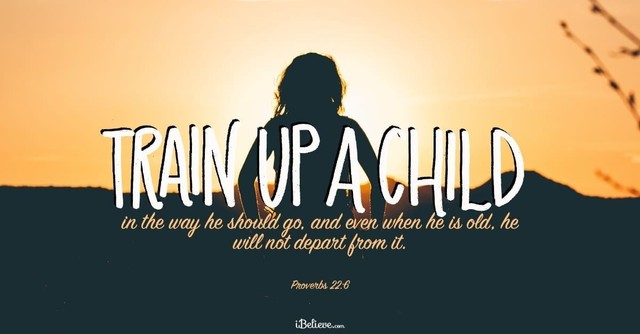
“Train up a child in the way he should go...” (Proverbs 22:6)
But what is the way each child should go?
First and foremost, it’s in a godly direction. The book of Proverbs points out the folly of fools and the wisdom of God. God’s way is wisdom and the overriding should.
Secondly, this verse seems to take into account the temperament of each child.
Parenting is hard. It would be easier if parents could apply the same principles to each child and get the same result. But since each child is different, some adjustments will be made.
4. Train Children with Their Gifts and Temperaments in Mind
Our children aren’t carbon copies of us parents. We must train them in the way they should go.
When my son was a toddler, we discovered that he had a keen ear for music. So we did our best to nurture this leaning by enrolling him in piano lessons. Unfortunately, he never took advantage of his piano lessons. It was a frustrating experience for him and for us. Some “shoulds” are easier than others. I have a daughter who expresses herself best in writing, which was easy for me to foster in her but was frustrating for my husband.
Design Credit: Rachel Dawson
5. Train Children with Their Gifts and Temperaments in Mind

There is a definite time for training, especially when a child is young and has no knowledge of godly ways. But as a child grows, our training looks different. It’s a lifelong process for the child and the parent. In each of my four children, this trajectory was different. My husband and I modeled a godly lifestyle, but each child chose to follow God at different ages and stages.
There is sometimes a waiting period between training our children in the way they should go and their being older, not departing from it. Sometimes, the hardest part for us parents is the time in between. It is in this stage that praying may be the most important training we can employ.
6. Proverbs 22:6 Is Wisdom, Not a Formula
After our training, the choice to follow God is up to our children. There is a point when a child becomes an adult and makes choices for themselves. As Paul said, “When I was a child, I spoke as a child, but when I became an adult, I put away childish things” (1 Corinthians 13:11). The influence of training a child in God’s Word may seem to disappear from a child’s life, depending on their choices. But the Word of God is always at work in each person.
“So is my word that goes out from my mouth: It will not return to me empty, but will accomplish what I desire and achieve the purpose for which I sent it.” - Isaiah 55:11
As parents, we don’t know when a child will choose not to depart from the godly training we taught and modeled. They may never stray too far from it, or God may use circumstances to bring them to Himself.
Photo Credit: ©Unsplash/Roberto Nickson
7. Parents Are Responsible to Train but Not to Control the Outcome

I’ve known Christian parents who are resentful of this verse because they felt they did everything right, yet their children end up living in a way contrary to their godly upbringing. These parents are forgetting two things.
- The timing is not up to the parents. Parents do not control the timeframe of when a child will respond to godly instruction. The responsibility is ours to train, but it is his sovereignty, his working in their lives, that will cause them to remember the instruction they received.
- We can’t train up a child without seeking God’s wisdom and grace for ourselves. Proverbs provides instruction for life, but it also shows the folly of following our own ways. Even in parenting as Christians, we need to submit all to him so that he can direct our paths (Proverbs 3:5-6). This is not a guarantee that we will parent perfectly, but that with His help, we can parent wisely.
As parents, we try to train our children in line with their temperament, but this requires wisdom and discretion. A child may lean towards self-sufficiency at an early age, but he will still benefit from learning to work with others if he wants to thrive. Or a child may be very creative, but she will still need to learn the dull, tedious basics of life.
Of course, none of this guarantees that our efforts will yield the intended results.
I finally learned the deep truths of this verse, and my children and I were better for it. I learned not to focus solely on behavior modification but on the whole child. I realized that God was with me on my parenting journey, providing the wisdom to raise those he had entrusted to me. I was reassured that he was with me each step of the way and that I could wholeheartedly trust him with my children’s lives.
Pray Intentionally for Your Children
Keep bringing your children before God with 30 days of focused prayers for their faith, protection, growth, and future. Download the prayer challenge and start praying today.
Frequently Asked Questions about Proverbs 22:6
- What does “train up a child in the way he should go” mean?
It means parents are called to intentionally guide, teach, disciple, correct, encourage, and prepare children in the way of wisdom and faith. - Is Proverbs 22:6 a promise that children will never stray?
Proverbs 22:6 is best understood as wisdom rather than a mechanical guarantee. Parents are responsible for faithfully training their children, but each child must ultimately respond to God for themselves. - Does training up a child only mean discipline?
No. Discipline is part of parenting, but training also includes modeling godly character, teaching Scripture, listening, practicing good behavior, praying, encouraging gifts, and walking with children through life. - How did Jesus model training and discipleship?
Jesus trained His disciples by teaching them, walking with them, correcting them, modeling obedience to the Father, and preparing them to follow Him after He was no longer physically with them. - What should parents do when adult children walk away from their faith?
Parents can keep praying, keep loving, keep speaking truth with grace when appropriate, and keep trusting God. A child’s response is not fully within a parent’s control.
For Further Reading
- Is Proverbs 22:6 “Train Up a Child” a Promise or Just a Proverb?
- 7 Questions to Ask As You Raise Up Your Child
- How to Walk the Line Between Grace and Discipline as a Parent
- How to Parent with the Holy Spirit
- How Do I Disciple My Children When They Don’t Listen to Me?
Nylse is a Christian wife and a mother of four who loves life and inspiring others. She likes to have fun but is very clear on who she is and whose she is. A prolific thinker, she blogs to encourage others from a Christian perspective at www.lifenotesencouragement.com. She can be found online on Facebook, Twitter, and Pinterest.
Photo Credit: ©Unsplash/Brooke Lark