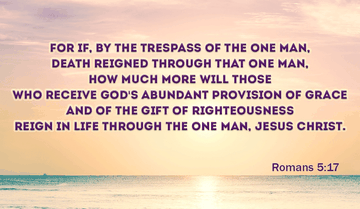
How Much More
The Apostle having clearly stated, and fully proved the doctrine of justification by the righteousness of faith, proceeds to observe the comfortable fruits and effects of this great blessing, known and enjoyed by the believer; as also the source and spring of it, the love of God, which appears in the death of Christ, in the room and stead of his people, which is the foundation on which it stands; and likewise gives an illustration of this benefit, by comparing the two heads, Adam and Christ, together. The first fruit and effect of justification, as a benefit perceived and enjoyed by faith, is peace with God through Christ, Ro 5:1. The next is access through the Mediator to the throne of grace, where justified ones stand with a holy boldness and confidence, and the third is a cheerful hope of eternal glory, Ro 5:2, yea, such not only have joy in the hope of what is to come, but glory even in present afflictions; which prevents an objection that might be made to the above mentioned fruits and effects of justification, taken from the tribulations which saints are exercised with: and what occasions glorying even in these, is the sanctified use, or happy produce of afflictions, these being the means of exercising and increasing patience; by means of which a larger experience of divine things is gained; and through that, hope is confirmed, and all influenced by a plenteous discovery of the love of God to the soul, by the Spirit, Ro 5:4,5, an instance of which love is given, Ro 5:6, in Christ's dying for men; which love is enhanced by the character and condition of the persons for whom Christ died, being ungodly, and without strength; and by the time of it, being due time: then follows a further illustration of this love, by comparing it with what instances of love are to be found among men, Ro 5:7, by which it appears to be unparalleled; since scarcely for a righteous man, peradventure for a good man, one would die, yet no man dies for the ungodly, as Christ did: hence as his, so his Father's love is highly commended, by giving him up to death for persons while in such a state and condition, and under such a character, Ro 5:8, and justification now springing from this love, and being founded on the death of Christ, hence follow a security from wrath to come, Ro 5:9, a certainty of salvation, Ro 5:10, which is strongly argued from the different characters those Christ died for bear, before and after reconciliation, and from the death to the life of Christ, Ro 5:10, and also a rejoicing and glorying: in God through Christ, full expiation being made by his blood for sin, and this received by faith, Ro 5:11, and then the apostle proceeds to compare the two heads, Adam and Christ, together; the design of which is to show the largeness and freeness of the love and grace of God; how righteousness for justification comes by Christ; and how the persons, before described as sinners and ungodly, came to be in such a condition; and that is through the sin of the first man, in whom they all were, and in whom they all sinned and died, Ro 5:12, wherefore there must be a law before the law of Moses, or there could have been no sin, Ro 5:13, but that sin was in being, and was reckoned and imputed to the posterity of Adam, is clear from this single instance, death's power even over infants, from the times of Adam to Moses, Ro 5:14 who therefore must be a public head, representing all his posterity; so that they were involved in the guilt of his sin, which brought death upon them; and in this he was a type of Christ, as is asserted in the same verse; that so as Adam was but one, and by one sin of his conveyed death to all his seed; so Christ, the Mediator, is but one, and by his one obedience conveys righteousness and, life to all his seed: and yet in some things there is a dissimilitude; sin and death, through the first man, are conveyed in a natural way to his offspring, but righteousness and life from Christ in a way of grace, Ro 5:15, It was one offence of Adam's, which brought condemnation and death upon all his posterity; but the righteousness of Christ is not only a justification of his seed from that one offence, but from all others, Ro 5:16, the one is unto death, the other unto life; and greater is the efficacy in the one to quicken, than in the other to kill, Ro 5:17, where a repetition is made of what is said in Ro 5:15, with an explanation, and the similitude between the two heads is clearly expressed, Ro 5:18, where condemnation on account of the sin of Adam, and justification through the righteousness of Christ, are opposed to each other; and both as extending to the whole of their several respective offspring, condemnation through Adam's offence to all his natural seed, and justification of life through Christ's righteousness to all his spiritual seed; which is still more fitly and clearly expressed in Ro 5:19, where the way and manner in which the one become sinners, and the other righteous, is plainly directed to; that it is, by the imputation of Adam's disobedience to the one, and by the imputation of Christ's righteousness to the other: in Ro 5:20, an objection is obviated, which might be formed thus; if justification is by the grace of God, and through the obedience and righteousness of Christ, then the law is of no use; what purpose does that serve? what occasion was there for its entrance? The apostle replies, that though justification is not by it, yet a good end is answered by its entrance; for hereby sin is more known to be what it is, both original and actual; and the grace of God appears more abundant in justification from it, and in the pardon of it; and this grace is further illustrated in Ro 5:21, by comparing sin and grace together, and the different effects of their empire over the sons of men; the one reigning unto death, the other reigning through righteousness to eternal life by Christ.
This feature is for PLUS subscribers only. Join PLUS today to access these tools and more.
JOIN PLUSThis feature is for PLUS subscribers only. Join PLUS today to access these tools and more.
JOIN PLUSThis feature is for PLUS subscribers only. Join PLUS today to access these tools and more.
JOIN PLUSCreate a free account to start a reading plan, or join PLUS to unlock our full suite of premium study tools.