2
My soul1thirsts for God, for the 2livingGod; When shall I come and 3appearbeforeGod?
3
My 4tears have been my foodday and night, While they 5say to me allday long, "Where is your God?"
4
Thesethings I remember and I 6pour out my soulwithin me. For I 7used to goalong with the throng and lead them in procession to the house of God, With the voice of 8joy and thanksgiving, a multitudekeepingfestival.
5
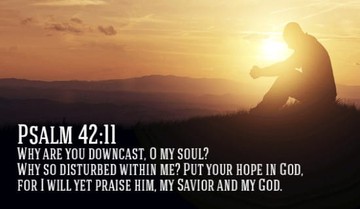
9Why are you 10in despair, O my soul? And why have you become11disturbedwithin me? 12Hope in God, for I shall againpraise Him For the 13help of His presence.
6
O my God, my soul is in despairwithin me; Therefore* I 14remember You from 15the land of the Jordan And the peaks of 16Hermon, from MountMizar.
7
Deepcalls to deep at the sound of Your waterfalls; All Your 17breakers and Your waves have rolledover me.
8
The LORD will 18command His lovingkindness in the daytime; And His song will be with me 19in the night, A prayer to 20the God of my life.
9
I will say to God21my rock, "Why have You forgotten me? Why do I go22mourning because of the 23oppression of the enemy?"
10
As a shattering of my bones, my adversariesrevile me, While they 24say to me allday long, "Where is your God?"
11
25Why are you in despair, O my soul? And why have you becomedisturbedwithin me? Hope in God, for I shall yetpraise Him, The help of my countenance and my God.
To the chief Musician, Maschil, for the sons of Korah. Of the word "Maschil," See Gill on "Ps 32:1," title. Korah was he who was at the head of a conspiracy against Moses and Aaron, for which sin the earth opened its mouth, and swallowed alive him and his company, and fire devoured two hundred and fifty more; the history of which is recorded in Numbers 16:1; yet all his posterity were not cut off, Numbers 26:11; some were in David's time porters, or keepers of the gates of the tabernacle, and some were singers; see 1 Chronicles 6:33; and to the chief musician was this psalm directed for them to sing, for they were not the authors of it, as some {b} have thought; but most probably David himself composed it; and it seems to have been written by him, not as representing the captives in Babylon, as Theodoret, but on his own account, when he was persecuted by Saul, and driven out by men from abiding in the Lord's inheritance, and was in a strange land among the Heathen, where he was reproached by them; and everything in this psalm agrees with his state and condition; or rather when he fled from his son Absalom, and was in those parts beyond Jordan, mentioned in this psalm; see 2 Samuel 17:24; so the Syriac inscription, the song which David sung in the time of his persecution, desiring to return to Jerusalem.
{b} So R. Moses in Muis, Gussetius, Ebr. Comment. p. 918, & others.