What Is a Bible Lexicon and How to Use It
Share

Some resources for studying the Bible seem simple, like a Bible dictionary. Others sound highly technical, like a lexicon or concordance.
Taking a closer look shows that many of these resources are not as mysterious as they seem. Let’s take a look at what a Bible lexicon is, what it is not, and how to use it.
What Is a Bible Lexicon?
A Bible lexicon is an organized reference tool that explains the meanings of the original Hebrew, Aramaic, and Greek words used in the Bible. The name comes from the Greek word lexikos, which means “of words” or “for words.”
A lexicon is different from a dictionary because it takes a deeper look at the language. Dictionaries explore all of the currently used words in a currently spoken language, giving an introductory knowledge of what each word means. A good lexicon will give all of the nuances, from the multiple things a word can mean to which root words it is based on.
Therefore, a Bible lexicon is a collection of the languages in which the Bible was originally written. Every language has nuances that do not fully translate into other languages. To give one popular example, English has one word for “love,” covering everything from “I love my spouse” to “I love my mother” to "I love the outdoors." Ancient Greek had six words for “love,” each specific to a particular kind of love. Which means that when Jesus turned to Peter and asked, “Peter, do you love me?” (John 21:17), we can only really know what love Jesus was talking about by looking at the original language in a lexicon.
How to Use a Bible Lexicon
Lexicons organize words alphabetically, based on the language’s alphabet. Each entry will have:
- A list of the word’s variations
- A transliterated version (a written version of the word translated from one language into another)
- A list of the root words
- An explanation of the word’s meaning
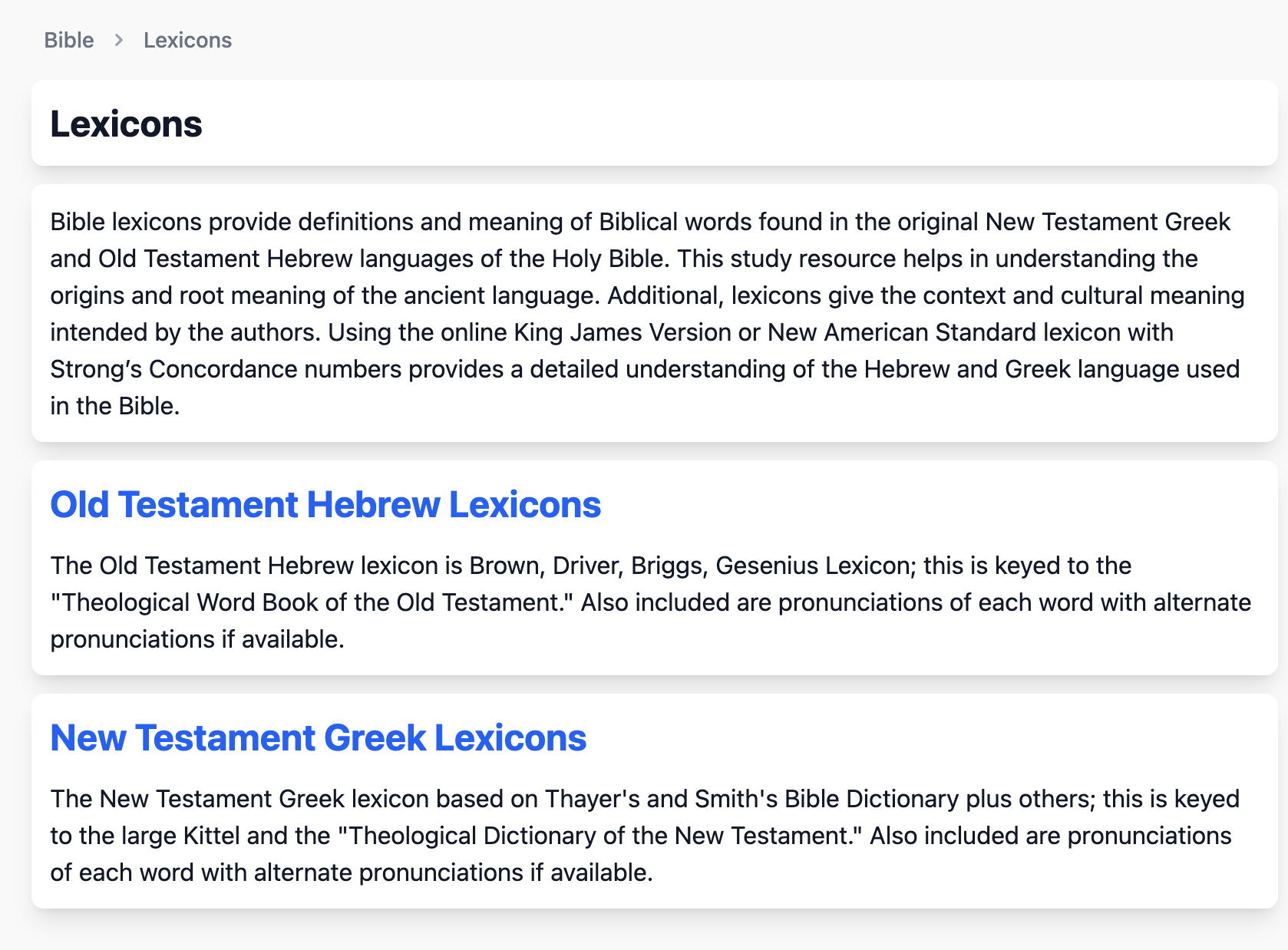
As you can see in the image below, you can find two main categories of lexicons on Bible Study Tools—one for the Old Testament and one for the New Testament. If you click on either of those lexicons, you will be presented with two lexicons for each testament—one based on the King James Bible translation and one based on the New American Standard Bible translation.
Lexicons also have several abbreviations for each word, pointing to other helpful resources. Most lexicons will have one of these abbreviations:
- Strong’s (for Strong’s Concordance)
- TDNT (for the Theological Dictionary of the New Testament by Gerard Kittel)
- EDNT (for the Exegetical Dictionary of the New Testament edited by Horst Balz and Gerhard Schneider)
- NIDNTTE (for the New International Dictionary of New Testament Theology and Exegesis first edited by Colin Brown)
These other resources exist because many people find it easier to look at a concordance and Bible dictionary first to get a sense of the word before taking down a lexicon.
Why Are There Different Bible Lexicons for the Old and New Testament?
You may find combined Bible lexicons for the Old and New Testaments, or ones that focus on one Testament. The Bible was written in several languages, then translated into several others at different times.
The Old Testament was originally written in ancient Hebrew, later translated into Greek for a collection called the Septuagint because most Jewish people switched from Hebrew to Greek. The New Testament was written in ancient Greek and Aramaic.
During the medieval period, both testaments were translated into Latin in a translation called the Vulgate. Later, the Protestant Reformers worked on translations into more common languages, like German, and English translations also followed. The best Bible translations go back to the original ancient Hebrew and ancient Greek, rather than using the Vulgate or Septuagint.
Many people confuse lexicons with concordances, which are more general tools that can help with some Bible study tasks. But there are some things only a lexicon can do, as we will see in the next section.
How Is a Bible Lexicon Different from a Bible Dictionary or Concordance?
One of the biggest peeves that biblical scholars have is when people use a concordance like a lexicon. It is not uncommon to meet people who go to something like Strong’s Concordance when someone asks, “What does this word in this Bible verse mean?”
As the Biblical Hermeneutic Stack Exchange explains, a concordance is a list of all the words in a particular translation, showing how many times each specific word is used throughout that translation. A concordance also offers a basic definition of the word and the words it is based on. The most famous and detailed concordance, The Exhaustive Concordance of the Entire Bible by James Strong, shows all of the Hebrew and Greek root words used in the King James Bible. When Strong wrote his book, the King James Bible was still the most widely read Bible translation in the Western world.
A Bible concordance helps you do certain things. Knowing how many times a word is used in a particular translation helps if you are trying to find other Bible verses that use the same concept. Knowing how many times it is used tells you whether the word fits a major or minor concept in the Bible. However, that does not tell you much about what the word means.
A Bible dictionary goes a layer further, giving you a general definition of the root word. That can give you a working knowledge of what the word is used for in the Bible, but not a detailed sense of the word.
A lexicon gives you a detailed look at the entire language, not just what the words used in a particular Bible translation could mean. This helps you understand what the word means when it is used in a particular verse, the other ways it can be used, and helps to build a working knowledge of the root language.
For example, consider the John 21 passage mentioned earlier, where Jesus asks the apostle Peter, “Do you love me?”
A concordance based on the King James Bible will tell you what word Jesus used for “love,” the ancient Greek word agape. It will tell you how many times the King James Bible uses the word agape, including reference to God loving the world (John 3:16), and to Christians coming together to have communion and fellowship, or “love feasts” (2 Peter 2:13, Jude 1:12). That information indicates that this kind of love is a major topic in the Bible.
A Bible dictionary will tell you that ancient Greek has several words for love, which implies agape has a particular meaning in context. That can help you see whether agape usually means something different from the other words, like eros, storge, or philia.
A lexicon will tell you what agape means in context. It does not mean romantic love (eros), or the kind of love friends share (philia), or that parents feel towards their children (storge). Rather, agape means the kind of love that God feels for his creations, a deep sacrificial love with no strings attached. That means that when Jesus is talking to Peter, he is asking whether Peter loves him enough to follow him sacrificially, with no substitutes. The fact that Jesus asks Peter this after Peter had betrayed him in the Garden of Gethsemane tells us several things, including the fact that Jesus did not think Peter’s mistakes disqualified him from serving God. Jesus felt agape for Peter and believed Peter was still capable of feeling agape for him.
It also suggests that when 2 Peter and Jude call Christians coming together to eat “love feasts,” they see Christians coming together to share communion and fellowship as a sacred time. When Christians come together to break bread, they become part of a deeply sacrificial group, the Body of Christ.
Should I Update my Bible Lexicon?
Since fresh copies of the 66 books of the Bible are often found by archeologists, updated Bible translations appear every few years to incorporate nuances revealed by these new documents. A good Bible lexicon should include those updates as well.
However, these updates are about fine details. The foundations of ancient Hebrew and ancient Greek have been established for years, and the hard part of learning any language is mastering the foundation. This means you can build a working knowledge of biblical languages through a lexicon published years earlier, even one based on a very old translation like the King James Bible. However, if you want a refined, nuanced sense of the biblical languages, it pays to find a reputable online lexicon featuring the latest updates. As a result, Bible translators often refresh and update their knowledge of biblical languages, to see if new findings offer new nuances.
Is a Theological Lexicon Different from a Bible Lexicon?
Some people may get confused by the fact that there are theological lexicons and Bible lexicons.
As discussed already in this article, a Bible lexicon defines the words that appear in the Bible. That tells you what words the authors of the Bible used to describe their ideas.
Over time, Christians began using words to summarize concepts that recur throughout the Bible. For example, no book of the Bible uses the word “trinity” in its original language. Different books speak of God the Father, God the Son, and God the Holy Spirit in different places. "Trinity" is a theological term that summarizes this key Christian teaching: we worship a god who is three in one. That concept will appear in a theological lexicon, but not in a Bible lexicon.
A theological lexicon helps you build not just a sense of what the Bible teaches, but the concepts the church has developed to explain biblical ideas. It helps to have both in your library if you want a detailed knowledge of how the church has studied the Bible across time and to enhance your own study of Scripture.
Photo credit: ©iStock/Getty Images Plus/Rawf8