How to Use a Bible Dictionary: A Simple Guide for Beginners
Share

The Bible is full of words most of us don’t know, and when we read God’s Word, we want to enjoy its fullness as much as possible so we can grow in the grace and knowledge of Jesus (2 Peter 3:18). That’s where an aid such as a Bible dictionary comes in.
A Bible dictionary functions the same way as a regular dictionary, such as Merriam-Webster or Oxford English, except it focuses on words, topics, and cultures specific to the Bible. Writer Kelly Mathews tells us, “Bible dictionaries offer encyclopedic entries containing definitions and background information on key terms found in and related to the Bible. They identify people, biblical and cultural concepts, doctrines, animals, groups, places—even plants. Words are arranged alphabetically and cross-referenced with related words and with verses in which they appear.”
When starting to use a Bible dictionary, rest assured, the writers of Bible dictionaries have more than a passing knowledge of the Word. Many editors have dedicated much of their lives to imparting biblical knowledge to the saints.
How Do I Use a Bible Dictionary?
We’ll start by looking at an example of Scripture. After we do this, we’ll delve into the reasons why we should use a Bible dictionary.
Example Passage:
In his first letter to the Corinthians, the Apostle Paul says, “To the church of God at Corinth, to those sanctified in Christ Jesus, called as saints, with all those in every place who call on the name of Jesus Christ our Lord — both their Lord and ours” (1 Corinthians 1:2).
For new Christians, the words "sanctified" and "saints" may be unfamiliar. The word “church” is used in a different manner than what unbelievers consider it to be. And “Corinth” is also a word to know so the context is made clearer.
Looking up each word in Easton’s Bible Dictionary reveals these things (in order of appearance in the verse):
The church is not a building. The church is the people who are drawn to Christ by the Lord God and who are believers in Him (John 6:44; 20:31). According to Easton’s Bible dictionary, the church is, “All the Christians in a particular city, whether they assembled together in one place or in several places for religious worship, were an ecclesia. Thus, all the disciples in Antioch, forming several congregations, were one church (Acts 13:1); so also we read of the "church of God at Corinth" (1 Corinthians 1:2), "the church at Jerusalem" (Acts 8:1), "the church of Ephesus" (Revelation 2:1), etc.
Corinth is “a Grecian city, on the isthmus which joins the Peloponnesus to the mainland of Greece. It is about 48 miles west of Athens.”
Sanctified (as in sanctification), “involves more than a mere moral reformation of character, brought about by the power of the truth: it is the work of the Holy Spirit bringing the whole nature more and more under the influences of the new gracious principles implanted in the soul in regeneration. In other words, sanctification is the carrying on to perfection the work begun in regeneration, and it extends to the whole man.”
A saint is “one separated from the world and consecrated to God; one holy by profession and by covenant; a believer in Christ” (Psalm 16:3; Romans 1:7; 8:27; Philippians 1:1; Hebrews 6:10). This passage affirms saints are called by God and not according to any tradition or authority of man.
Isn’t it amazing what we learn from just one passage of Scripture when we use a Bible dictionary?
But we need to remember this is just one step toward understanding the meaning of the passages we are studying.

Why Should I Use a Bible Dictionary?
The Apostle Peter gives us one apt reason for us to use a Bible dictionary: “He speaks about these things in all his letters. There are some things hard to understand in them. The untaught and unstable will twist them to their own destruction, as they also do with the rest of the Scriptures” (2 Peter 3:16; cf. 1 Timothy 1:3-4).
Peter is speaking of Paul and his letters to the churches, which even then, in their context, were sometimes hard to comprehend. God tells us in His Word that, “His divine power has given us everything required for life and godliness through the knowledge of Him who called us by His own glory and goodness” (2 Peter 1:3).
The Holy Spirit gives life (John 6:63; Romans 8:10), and He gives understanding of Scripture (John 14:26; John 16:13; 1 Corinthians 2:12-14). Only Christians are able to understand the words of the Bible (1 Corinthians 2:14). And only Christians have the mind of Christ (1 Corinthians 2;16), not only in His Word—the Bible—but as He sanctifies us (Hebrews 2:11), He takes us from one degree of glory to another (2 Corinthians 3:18), and we become more like Him (2 Corinthians 3:18). We then become more and more able to know Him and, as Peter says, grow in His grace and knowledge. We have ears to hear what the Spirit says through the Scriptures (Revelation 2:11). We must do our best to grasp the meaning of the text we are reading.
Consider the following verses:
“All Scripture is inspired by God and is profitable for teaching, for rebuking, for correcting, for training in righteousness, so that the man of God may be complete, equipped for every good work” (2 Timothy 3:16-17).
“Above all, you know this: No prophecy of Scripture comes from the prophet’s own interpretation, because no prophecy ever came by the will of man; instead, men spoke from God as they were carried along by the Holy Spirit” (2 Peter 1:21).
The Apostle Paul says, “For whatever was written in the past was written for our instruction, so that we may have hope through endurance and through the encouragement from the Scriptures” (Romans 15:4, cf. 1 Corinthians 10:11).
It is imperative that we glean the proper interpretation of the passage(s) we study, for while lessons abound, only one interpretation of Scripture is correct. As we saw above, Peter said, “The untaught and unstable will twist them [Paul’s intended meaning] to their own destruction, as they also do with the rest of the Scriptures.
The principles of correct biblical hermeneutics (the science of biblical interpretation) are of great importance as we study the Bible. Therefore, we should never go solo in our study of God’s Word. Yes, consult dictionaries, concordances, commentaries, and other solid resources. But double-check your findings against respected, trusted sources, including pastors, theologians, and seminary professors.
Where Can I Find Bible Dictionaries?
Depending on your preferred method of study and reading, Bible dictionaries are available in print, as digital offerings, and online. Also, Bible dictionaries may be general or focus on particular topics, such as names, cultures, etc.
-Dedicated Christian websites such as BibleStudyTools.com offer a number of dictionaries to choose from, some of which are listed below.
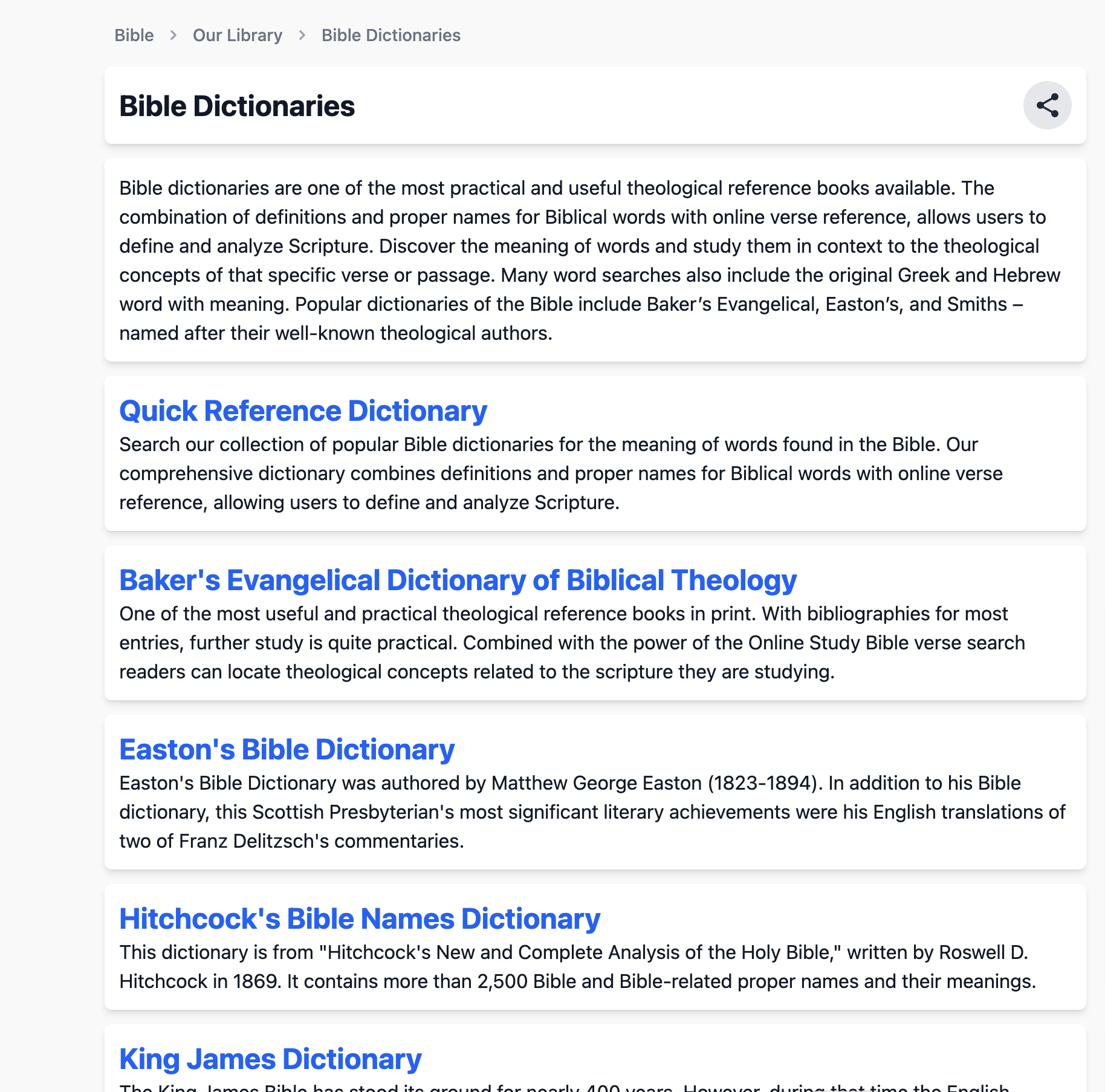
-You can purchase digital or print copies of Bible dictionaries from Amazon for use on a Kindle or Barnes and Noble for use on a Nook. Other suppliers carry digital Bible dictionaries, but the previous ones are the most popular.
-Library apps such as Hoopla and Libby both offer Bible dictionaries as loans. *You must have a library card to use these services. Check your library’s website to see if they offer either or both.
-A great online dictionary written from a Christian worldview is the Webster’s 1828 version.
Just as with Bible translations, it’s always good to consult at least a few resources. Different translations use different words and take the nuances of the biblical languages (Hebrew, Aramaic, and Greek) into account.
The most important resource for learning what the Bible says and the words it contains is what happens as we gather with our church on the Lord’s Day. That is where we are discipled—when we fellowship, worship together with hymns, hear the Word—the Gospel proclaimed—and where we enjoy the Lord’s grace poured out upon us through the ordinary means of grace—prayer, the Lord’s Supper, and baptisms (when they occur).
Our elders are here to serve us in many ways, one of which is to answer our questions about the Bible and its language. They are, we can say, living Bible dictionaries—called to their vocation as teachers, shepherds, and overseers (see 1 and 2 Timothy, and Titus). I pray you enjoy using Bible dictionaries. And I pray your journey into the Word increases with every word’s meaning you discover.