5 Things Everyone Should Know before Reading Isaiah
Share
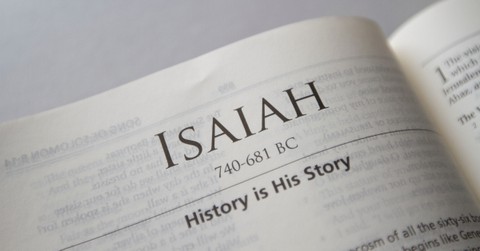
Even if you’ve never read the Book of Isaiah, there is a good chance that you’re familiar with at least parts of it. Maybe you’ve heard about Isaiah’s calling, where he says, “Here am I. Send me!” But even if you haven’t heard about that one, you’ve likely heard about the baby born of a virgin who will be called Immanuel.
But then when you crack open the book, you find it to be filled with kings you don’t know anything about. Countries like Assyria and Babylon and messages of judgment. It doesn’t exactly feel like a Christmas book. If you hang on for about forty chapters, you’ll get a few chapters of comfort. But overall, it’s a big book that covers a lot of ground.
But it’s actually, unsurprisingly, a great book. And a very important one for understanding the New Testament. It helps to know a few things and get your bearings before you start reading. I’ll give you five that can help.
Photo credit: ©Sparrowstock
1. Isaiah Is Speaking to More Than One Generation

One of the more important things to know about Isaiah is its historical context. The first part of the book (the first 39 chapters) take place in the 8th century BC. Assyria is the major world power and they are swallowing up nations. The northern kingdom of Israel will eventually be in that long list of nations that succumbs to Assyrian power. Judah is threatened too.
Kings like Ahaz and Hezekiah must decide what to do when an enormous empire is sitting nearby and seems bent on destroying you. You don’t have to know all of these names or dates yet — but that background is vital. Isaiah is going to keep talking about trusting God and not foreign nations. Many of the kings were trusting in either their own power or their political savvy to earn favor with the other nations. As you might expect, that strategy doesn’t work so well. That’s why there are so many chapters about judgment.
But then something strange happens in Isaiah 40.
Suddenly the book starts talking about comfort. But that’s not all. Isaiah isn’t talking to the people who’ve been conquered by Assyria. He’s talking to people living much later. Jerusalem has experienced judgment. And now Babylon is the important world power. God’s people are in exile and need to know whether He has forgotten them.
It’s such a massive shift that it’s caused some scholars to believe that what we have in Isaiah 40 onward should be called something like Second Isaiah. And many of those scholars don’t believe it’s the same Isaiah who writes that part. Personally, I’m not convinced by those arguments. I think there are good reasons to see Isaiah as a unified book coming from the same prophet.
You don’t have to solve that debate, but you do need to acknowledge that shift.
Isaiah isn’t only speaking to the people standing right in front of him. He’s preparing another generation for what will happen when judgment comes to them. And by the final chapters of Isaiah, it seems like he’s talking to an even more future generation. We find that coming home from the Babylonian exile isn’t enough. God’s people will still need an even deeper change of address.
That helps us make sense of the whole book. Isaiah starts with Judah facing Assyria, then it looks ahead to exile in Babylon, and goes even further looking at when God will make all things right.
Photo credit: Unsplash/Matthias Wagner
2. God’s Holiness Is Behind Both the Judgment and the Hope

Many years ago, I went to this event at a bowling alley where they had black lights. I very ignorantly decided to wear a black shirt and jeans that I assumed were clean. But that blacklight will expose every mustard stain you’ve ever had on your pants, and apparently my black shirt had enough lint on it to knit an entirely new sweater.
That’s what God’s holiness is like. It exposes what is truly there.
And that’s what happens to Isaiah in chapter 6. He sees the Lord “high and exalted” and hears the seraphim calling out, “Holy, holy, holy is the LORD Almighty.” Isaiah’s response is, “Woe to me! I am ruined!” Isaiah had already spent five chapters talking about the sin of everybody else. Then he gets this vision of the holiness of God and immediately turns toward himself. He too is unclean.
That’s a microcosm of what we see throughout Isaiah. God’s holiness is searching. Yes, the nations are corrupt, but so are the people of God. Religious people have a way of comforting themselves by not being quite as bad as the guy down the street. But the blacklight of God’s holiness exposes our idolatry for the treachery it is.
But Isaiah 6 doesn’t end with “woe is me.” It also shows God providing cleansing. A coal touches Isaiah’s lips and he hears, “Your guilt is taken away and your sin atoned for.” The man who moments earlier wanted to disappear is soon saying, “Here am I. Send me!”
That’s a pretty good picture of what Isaiah will keep doing. The holiness of God exposes just how bad things are, but God does not expose His people simply to destroy them. The exposing is meant to clean and restore. And then to send.
Photo credit: Unsplash/blakecheekk
3. Keep Asking Who They Are Trusting

Imagine for a moment that you’re one of God’s people that has been thrust into exile. Your sin got you there. And now you’re wondering if it’s possible to ever be restored again. The situation is dire. Then someone pulls out the book of Isaiah.
In Isaiah, you’re going to hear about the downfall of the Northern Kingdom. You’re also going to see little pointers to the downfall of the Southern Kingdom (that’s what you’re living in). But you’ll also be told of hope and God’s big plan of redeeming people. That’s going to be quite comforting. But it will also give you an overarching question — am I going to trust this story or my own circumstances?
That is a thread that runs throughout this whole book. You can see it vividly with King Ahaz in Isaiah 7 and beyond. He’s in Judah (that’s where Isaiah is from too) and he’s being threatened by Israel and Aram. Isaiah tells him that these two kings are not going to destroy Judah and even invites him to ask God for a sign.
Ahaz refuses. On the surface his answer sounds spiritual: “I will not ask; I will not put the LORD to the test.” But he’s really spiritually bypassing. He’s not actually trusting God, he’s already decided where he’ll turn for help — Assyria. And that is a picture of humanity, isn’t it? Our alliance reveals what we actually believe about God.
When Assyria looked powerful and God’s promises looked less certain, they preferred the thing they could see. That happens all throughout Isaiah. And it’s still happening today. We always build idols for ourselves. Assyria for them, might be money for us. They trusted in Egypt, we trust in our own politicians.
When Isaiah starts talking about Egypt or Assyria or any of the other nations they start trusting in, don’t just assume that is background noise. It is, at least in some way, the fundamental problem of the book. They put their trust in everything but God, it seems. Will the people in exile do the same thing? Will we do the same?
Photo credit: Ben White/Unsplash
4. Pay Attention to the Servant

There is one character in Isaiah who isn’t a scrub like all the other people — the Servant of the Lord. If you know the New Testament, you will quickly identify this with Jesus.
But there is another move you need to make before taking that beeline to Jesus. Often the servant is identified with Israel. They were supposed to fulfill that role. They were supposed to show the world what it looked like to live under the rule of God. They should have been the ones trusting in God and His promises. But they didn’t.
That is why there are sections where Isaiah describes God’s servant as blind and deaf. Through one lens the Servant needs rescuing just as much as everyone else does. And that can get a little confusing if you immediately replace the Servant with the name “Jesus.”
What this is doing, though, is highlighting a massive problem: If Israel is the servant, but Israel itself needs rescue, how is the servant ever going to accomplish God’s purposes? That’s where we begin to see another character emerge. The servant with an upper-case S. He is the Servant of the Lord. And He is faithful where Israel failed. He brings justice, He is a light to the nations. And ultimately this Servant will suffer for the sins of others.
It is the uppercase Servant, the faithful Servant, that the New Testament writers are pointing to. Isaiah has spent a ton of time showing the failure of God’s servant Israel. And then he shows us a Servant who finally does what Israel couldn’t do. Jesus isn’t fulfilling some isolated prediction in Isaiah 53; it’s part of a massive story.
So when you see the word “servant” in Isaiah, slow down a little. Ask who is being described and what that servant is doing. The answer won’t always be the same.
Photo credit: ©Getty Images/carlosphotos
5. Isaiah’s Picture of Salvation Keeps Getting Bigger

If you’re trapped in a cave you might pray, “God save me!” What you mean, of course, is that God would provide a rescuer to come into the cave and pull you out into the sunlight. For those living in Isaiah’s time, “God save us” likely meant “Help us not be destroyed by the [insert foreign enemy] army.”
But God’s plan is so much bigger than what we can see in the immediate. That doesn’t mean that God doesn’t care about rescuing people from caves or foreign enemies. But it does mean that His promise is so much bigger than that. God’s promise of the exodus from Egypt wasn’t just about that one event. Nor was His plan to gather people from the exile just about that miraculous work.
As Isaiah begins talking about what God is going to do amongst His people, you might assume that God’s goal is for a remnant to survive judgment. But God keeps going. Eventually we see the nations coming to worship before the Lord. Deserts bloom and justice reaches all the places ruined by sin. Isaiah even points to death itself being swallowed up.
By the end of the book, Isaiah is talking about “new heavens and a new earth.” That’s so much bigger than getting safely through an Assyrian invasion — or even an exile.
This, I believe, is one of the main reasons Isaiah is important for understanding the rest of the Bible. God’s plan isn’t just about getting a group of people back to a certain stretch of land. A physical home isn’t going to fix the deepest problem. The same sinful inclinations will keep breaking God’s world. What is needed is a full restoration, with sin being dealt with and creation itself being restored.
There are many places in the New Testament that keep going back to Isaiah. John the Baptist uses it to explain what he is doing in the wilderness. Jesus reads from it at the start of His ministry. And the early church turned to Isaiah to give understanding to the suffering and death of Christ. Even the last book of the Bible, Revelation, uses Isaiah as background to talk about everything being made new.
So when you’re reading Isaiah, be sure that you keep the big picture in mind. God is, through Christ, taking us somewhere beautiful.
Photo credit: ©Getty Images/shuang paul wang