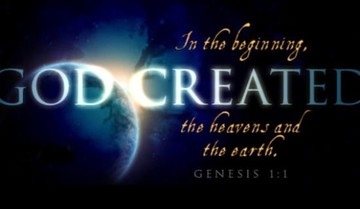
Genesis 1:3
This book, in the Hebrew copies of the Bible, and by the Jewish writers, is generally called Bereshith, which signifies "in the beginning", being the first word of it; as the other four books of Moses are also called from their initial words. In the Syriac and Arabic versions, the title of this book is "The Book of the Creation", because it begins with an account of the creation of all things; and is such an account, and so good an one, as is not to be met with anywhere else: the Greek version calls it Genesis, and so we and other versions from thence; and that because it treats of the generation of all things, of the heavens, and the earth, and all that are in them, and of the genealogy of men: it treats of the first men, of the patriarchs before the flood, and after it to the times of Joseph. It is called the "first" book of Moses, because there are four more that follow; the name the Jewish Rabbins give to the whole is hrwt yvmwx hvmx, "the five fifths of the law", to which the Greek word "pentateuch" answers; by which we commonly call these books, they being but one volume, consisting of five parts, of which this is the first. And that they were all written by Moses is generally believed by Jews and Christians. Some atheistical persons have suggested the contrary; our countryman Hobbes {a} would have it, that these books are called his, not from his being the author of them, but from his being the subject of them; not because they were written by him, but because they treat of him: but certain it is that Moses both wrote them, and was read, as he was in the Jewish synagogues, every sabbath day, which can relate to no other writings but these, Joh 1:45-47, Ac 15:21. And Spinosa, catching at some doubts raised by Aben Ezra on De 1:1 concerning some passages which seemed to him to have been added by another hand, forms objections against Moses being the author of the book of Genesis; which are sufficiently answered by Carpzovius {b}. Nor can Ezra be the author of the Pentateuch, as Spinosa suspects; since it is plain these writings were in being before his time, in the times of Josiah, Amaziah, yea, of David, and also of Joshua, 2Ch 34:14 \2Ch 25:4 1Ki 2:3 Jos 8:34\ nay, they are even referred to in the book of Ezra as the writings of Moses, Ezr 3:2, 6:18 to which may be added, in proof of the same, De 31:9,24. Nor are there any other writings of his authentic; what are ascribed to him, as the Analepsis of Moses, his Apocalypse, and his Last Will and Testament, are apocryphal. That this book of Genesis particularly was written by him, is evident from the testimony of Philip, and even of our Lord Jesus Christ, who both testify that he wrote concerning the Messiah, Joh 1:45, 5:46 as he did in this book, where he speaks of him as the seed of the woman that should break the serpent's head; as the seed of Abraham, in whom all the nations of the earth should be blessed; and as the Shiloh, to whom the gathering of the people should be, \Ge 3:15 22:18 49:10\. Nor is there any reason to believe that he wrote this book from the annals of the patriarchs, since it does not appear, nor is it very probable, that they had any; nor from traditions delivered down from one to another, from father to son, which is more probable, considering the length of the lives of the patriarchs: but yet such a variety of particulars respecting times, places, persons, their genealogies and circumstances, so nicely and exactly given, can scarcely be thought to be the fruit of memory; and much less is it to be imagined that he was assisted in it by Gabriel, when he lived in solitude in Midian: but it is best of all to ascribe it to divine inspiration, as all Scripture is by the apostle, 2Ti 3:16 for who else but God could have informed him of the creation, and the manner and order in which every creature was brought into being, with a multitude of things recorded in this book? the design of which is to lead men into the knowledge and worship of the one true God, the Creator of all things, and of the origin of mankind, the fall of our first parents, and their posterity in them; and to point at the means and method of the recovery of man by the Messiah, the promised seed; and to give an account of the state and case of the church of God, in the times of the patriarchs, both before and after the flood, from Adam, in the line of Seth, to Noah; and from Noah to the times of Joseph, in whose death it ends: and, according to Usher {c}, it contains an history of two thousand, three hundred, and sixty nine years.
{a} Leviath. par. 3. c. 33. {b} Introduct. ad Libr. Bib. V. T. c. 4. sect. 2. {c} Annal. Vet. Test. p. 17.
\\INTRODUCTION TO GENESIS 1\\
This chapter contains an account of the creation of the universe, and all things in it; asserts the creation of the heaven and earth in general, and describes the state and condition of the earth in its first production, Ge 1:1-2 and then proceeds to declare the work of each of the six days of creation, and to give an account of light, its separation from darkness and the names of both, the work of the first day, Ge 1:3-5 of the firmament, its use and name, the work of the second day, Ge 1:6-8 of the appearance of the earth, and the production of grass, herbs, and trees in the earth, the work of the third day, Ge 1:9-13 of the sun, moon, and stars, their situation, and use, the work of the fourth day, Ge 1:14-19 of the fowls of the air, and the fishes of the sea, the work of the fifth day, Ge 1:19-23 of all kinds of cattle, and beasts, and creeping things, Ge 1:24-25 and then of man, created male and female, after the image of God, having a grant of dominion over the rest of the creatures, the fruit of divine consultation, Ge 1:26-28 and of a provision of food for man and beast, Ge 1:29-30. And the chapter is concluded with a survey God took of all his works, and his approbation of them; all which were the work of the sixth day, and closes the account of the creation in that space of time, Ge 1:31.
The Lord is not a random God but a God of purpose. The actions of God are not random but are working toward an end purpose. And His purpose is guided by his character of lovingkindness, judgment and righteousness. As a result, God is looking for us to be a faithful, believing people so that his will can come forth in us and in the world.Click here for slide from this message

Today on a Daily Walk we take you back to the beginning and the creation account recorded for us in Genesis. The first verses in our Bibles speak of God’s creative work. Pastor John Randall attracts our attention to this, as he introduces us to the book of Genesis.

Dr. Baruch Korman presents a detailed analysis, interpretation and understanding of verses 1 through 5 in the book of Genesis, Chapter 1. About Baruch: R. Baruch is the senior lecturer at the Zera Avraham Institute based in Israel. He also appears on the Israeli Television program Pdut L'amo where he teaches each week from the Bible (This program is in Hebrew). A similar Bible Study program in English is broadcast on numerous television networks across the United States, Europe, and Africa. Many of his lectures are available in the forms of video, audio and written on Pdut.org (Hebrew) and LoveIsrael.org (English). Baruch holds a PhD in Jewish Studies. His dissertation was in the translation techniques of the Septuagint. Baruch has been married for 30 years to his wife, Rivka, and they have three adult children. The Kormans live in Israel. Our Beliefs: http://www.loveisrael.org/statement-of-faith To donate to LoveIsrael.org: http://www.loveisrael.org/donate
Today on a Daily Walk we turn back to the beginning. Maybe like a lot of people you’re wondering how in the world we got here? Was there some sort of an explosion caused by random chance that sprung creation into existence or is there a creator behind it all? Genesis has the answer we’re looking for, and we’d invite you to join us there as we begin a new chapter by chapter study of this first book of the Bible.
This feature is for PLUS subscribers only. Join PLUS today to access these tools and more.
JOIN PLUSThis feature is for PLUS subscribers only. Join PLUS today to access these tools and more.
JOIN PLUSThis feature is for PLUS subscribers only. Join PLUS today to access these tools and more.
JOIN PLUSCreate a free account to start a reading plan, or join PLUS to unlock our full suite of premium study tools.