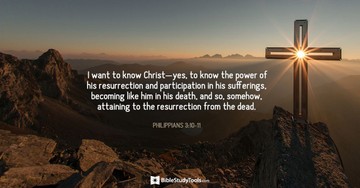
Philippians 3:10-11
In this chapter the apostle cautions the Philippians against false teachers, whom he describes as evil men, and exhorts them to walk as they had him, and other faithful ministers for an example. And whereas these judaizing teachers were for drawing them off from Christ, and weakening their joy and glorying in him, he exhorts them in the first place to rejoice in Christ, Php 3:1, and to beware of them, whom he describes as dogs, as evil workers, as the concision, Php 3:2, and opposes to them the characters of real saints, who are truly what they vainly boasted of, really circumcised persons in a Gospel sense, spiritual worshippers of God, joyful believers in Christ, and such as placed no confidence in outward things, Php 3:3, This the apostle illustrates in his own case, who had as much reason for trusting in such things as any man whatever, Php 3:4, of which he gives an enumeration in several particulars, Php 3:5,6, upon which he passes his judgment, and shows of what account, and in what esteem they were with him before, and now; that formerly they were reckoned gain, but now loss, Php 3:7, and which he explains as referring to every thing short of Christ, and in comparison of the knowledge of him, and which he preferred to everything; and this he confirms by his willingness to suffer the loss of all things for him; his ends in which were, that he might win him, and be found in him, without his own righteousness, that legal one the false teachers extolled, and with the righteousness of God which faith receives, and is the only justifying one; and that he might know more of him, feel more of his power, have more fellowship with him, and conformity to him, Php 3:8-10. His view in all which was, that he might attain to that glorious and happy state of the resurrection of the dead in Christ, Php 3:11, and to prevent mistakes, and anticipate an objection that might be made to him, as if he ascribed perfection to himself in the present state, he owns he had not arrived to it: all he meant was, that it was his desire to enjoy that which Christ had laid hold on him for; in order to which he buried in oblivion what was past, looking and pressing to things before hint, even to Christ, and the glory he was called unto, which was with him, Php 3:12-14. Next follow various exhortations, as to be of the same mind with the apostle in pressing after spiritual and heavenly things, to which he exhorts those that had a greater knowledge of them than others; and who, though otherwise minded, the apostle was persuaded would have, the same revealed to them, Php 3:15, and both he exhorts, according to their different attainments, to walk by the same rule and mind the same thing, Php 3:16, and to be followers of him, and of them that walked after his example, Php 3:17, giving this as a reason, because there were men who walked otherwise, to the grief of him, to the dishonour of Christ, and to their own shame and destruction, whom he describes as sensual and earthly minded men, Php 3:18,19, and to engage them to follow him, and others, and not such persons, he draws a character of them opposite unto them; that whereas the minds of those others were carnal and earthly, their minds were spiritual and heavenly; their conversation was in heaven, and they were waiting for Christ from hence, Php 3:20, and the blessedness they expect from him then, is the resurrection of their bodies, which is illustrated by the efficient cause of it, Christ; the subject of it, their vile bodies, as in this lifts, and in the grave; the exemplar and pattern of it, the glorious body of Christ; and the means by which it will be effected, the energy and power of Christ, who is omnipotent, Php 3:21.

You’ve heard the saying, “Seeing is believing.” But to see some important things the reverse is true, believing is seeing. We’ll hear about those most important things and how to access them on today’s Study The Word with pastor Thom Keller. We’ll do that as we continue in Philippians chapter three.

We are encouraged to press intentionally toward God's call, supported by fellow believers, while remembering that God's goodness and mercy are pursuing us.
Our salvation is complete in and because of Jesus. And yet many still strive for God’s approval even though they already have it. What’s the answer? We’ll hear about it on today’s Study The Word with pastor Thom Keller. That answer is found in Philippians chapter three. And we’ll learn it’s not by a change in location. Something more is needed.
This powerful message from Philippians 3:8-11 invites us into a radical understanding of what it means to truly pursue God. At its core, we discover three essential movements in our spiritual journey: losing, gaining, and knowing. The apostle Paul's declaration that he counts everything as loss—even as rubbish or dung—for the excellence of knowing Christ challenges our modern sensibilities. We live in a culture that celebrates accumulation and achievement, yet here we're confronted with a different calculus entirely. The pursuit of Christ demands that we recalibrate what we value, recognizing that knowing Jesus intimately surpasses every earthly pursuit, position, or pleasure. The sermon draws a compelling parallel to romantic pursuit—how we naturally count other relationships and activities as secondary when we're pursuing someone we love. This same passionate, all-consuming pursuit should characterize our relationship with Christ. What's particularly striking is the acknowledgment that this pursuit carries real cost: social rejection, lost opportunities, even persecution. Yet Paul declares it worth it all. The message doesn't shy away from the reality that following Jesus might mean standing alone, losing friends, or facing opposition. But in that loss, we discover gain—not the self-righteousness of religious performance, but the righteousness that comes through faith in Christ. This is transformative faith, not treadmill faith that runs but never moves forward.
You’ve heard the saying, “Seeing is believing.” But to see some of the most important things – the reverse is true – believing is seeing. We’ll hear about those most important things and how to access them on today’s Study The Word with pastor Thom Keller. We’ll do that as we continue in Philippians chapter three.
Our salvation is complete in and because of Jesus. And yet many still strive for God’s approval even though they already have it. What’s the answer? We’ll hear about it on today’s Study The Word with pastor Thom Keller. That answer is found in Philippians chapter three. And we’ll learn it’s not by a change in location. Something more is needed.
This feature is for PLUS subscribers only. Join PLUS today to access these tools and more.
JOIN PLUSThis feature is for PLUS subscribers only. Join PLUS today to access these tools and more.
JOIN PLUSThis feature is for PLUS subscribers only. Join PLUS today to access these tools and more.
JOIN PLUSCreate a free account to start a reading plan, or join PLUS to unlock our full suite of premium study tools.