
Change Translation
- Recent Translations
- All Translations
1
Estas son las palabras de Jeremías hijo de Jilquías. Jeremías provenía de una familia sacerdotal de Anatot, ciudad del territorio de Benjamín.
2
La palabra del SEÑOR vino a Jeremías en el año trece del reinado de Josías hijo de Amón, rey de Judá.
3
También vino a él durante el reinado de Joacim hijo de Josías, rey de Judá, y hasta el fin del reinado de Sedequías hijo de Josías, rey de Judá; es decir, hasta el quinto mes del año undécimo de su reinado, cuando la población de Jerusalén fue deportada.
Llamamiento de Jeremías
4 La palabra del SEÑOR vino a mí:
5
«Antes de formarte en el vientre,ya te había elegido;antes de que nacieras,ya te había apartado;te había nombrado profeta para las naciones».
6
Yo le respondí:«¡Ah, SEÑOR mi Dios! ¡Soy muy joven, y no sé hablar!»
7
Pero el SEÑOR me dijo:«No digas: “Soy muy joven”, porque vas a ir adondequiera que yo te envíe, y vas a decir todo lo que yo te ordene.
8
No le temas a nadie, que yo estoy contigo para librarte». Lo afirma el SEÑOR.
9
Luego extendió el SEÑOR la mano y, tocándome la boca, me dijo:«He puesto en tu boca mis palabras.
10
Mira, hoy te doy autoridad sobre naciones y reinos,»para arrancar y derribar,para destruir y demoler,para construir y plantar».
11
La palabra del SEÑOR vino a mí, y me dijo:«¿Qué es lo que ves, Jeremías?»«Veo una rama de almendro», respondí.
13
La palabra del SEÑOR vino a mí por segunda vez, y me dijo:«¿Qué es lo que ves?»«Veo una olla que hierve y se derrama desde el norte», respondí.
14
Entonces el SEÑOR me dijo:«Desde el norte se derramará la calamidad sobre todos los habitantes del país.
15
Yo estoy por convocar a todas las tribus de los reinos del norte —afirma el SEÑOR—.»Vendrán, y cada uno pondrá su tronoa la entrada misma de Jerusalén;vendrán contra todos los muros que la rodean,y contra todas las ciudades de Judá.
16
Yo dictaré sentencia contra mi pueblo,por toda su maldad,porque me han abandonado;han quemado incienso a otros dioses,y han adorado las obras de sus manos.
17
»Pero tú, ¡prepárate! Ve y diles todo lo que yo te ordene. No temas ante ellos, pues de lo contrario yo haré que sí les temas.
18
Hoy te he puesto como ciudad fortificada, como columna de hierro y muro de bronce, contra todo el país, contra los reyes de Judá, contra sus autoridades y sus sacerdotes, y contra la gente del país.
19
Pelearán contra ti, pero no podrán vencerte, porque yo estoy contigo para librarte», afirma el SEÑOR.
Jeremías 1 Commentary
Chapter 1
Jeremiah was a priest, a native of Anathoth, in the tribe of Benjamin. He was called to the prophetic office when very young, about seventy years after the death of Isaiah, and exercised it for about forty years with great faithfulness, till the sins of the Jewish nation came to their full measure and destruction followed. The prophecies of Jeremiah do not stand as they were delivered. Blayney has endeavoured to arrange them in more regular order, namely, ch. 1-20; 22; 23; 25; 26; 35; 36; 45; 24; 29; 30; 31; 27; 28; 21; 34; 37; 32; 33; 38; 39; (ver. 15-18, 1-14.) 40-44; 46-52. The general subject of his prophecies is the idolatry and other sins of the Jews; the judgments by which they were threatened, with references to their future restoration and deliverance, and promises of the Messiah. They are remarkable for plain and faithful reproofs, affectionate expostulations, and awful warnings.
Jeremiah's call to the prophetic office. (1-10) A vision of an almond-tree and of a seething-pot, Divine protection is promised. (11-19)
Verses 1-10 Jeremiah's early call to the work and office of a prophet is stated. He was to be a prophet, not to the Jews only, but to the neighbouring nations. He is still a prophet to the whole world, and it would be well if they would attend to these warnings. The Lord who formed us, knows for what particular services and purposes he intended us. But unless he sanctify us by his new-creating Spirit, we shall neither be fit for his holy service on earth, nor his holy happiness in heaven. It becomes us to have low thoughts of ourselves. Those who are young, should consider that they are so, and not venture beyond their powers. But though a sense of our own weakness and insufficiency should make us go humbly about our work, it should not make us draw back when God calls us. Those who have messages to deliver from God, must not fear the face of man. The Lord, by a sign, gave Jeremiah such a gift as was necessary. God's message should be delivered in his own words. Whatever wordly wise men or politicians may think, the safety of kingdoms is decided according to the purpose and word of God.
Verses 11-19 God gave Jeremiah a view of the destruction of Judah and Jerusalem by the Chaldeans. The almond-tree, which is more forward in the spring than any other, represented the speedy approach of judgments. God also showed whence the intended ruin should arise. Jeremiah saw a seething-pot boiling, representing Jerusalem and Judah in great commotion. The mouth or face of the furnace or hearth, was toward the north; from whence the fire and fuel were to come. The northern powers shall unite. The cause of these judgments was the sin of Judah. The whole counsel of God must be declared. The fear of God is the best remedy against the fear of man. Better to have all men our enemies than God our enemy; those who are sure they have God with them, need not, ought not to fear, whoever is against them. Let us pray that we may be willing to give up personal interests, and that nothing may move us from our duty.
Unlock Deeper Insights: Get Over 20 Commentaries with Plus! Subscribe Now
Jeremías 1 Commentaries
Footnotes 1
- [a] En hebreo, las palabras que corresponden a "almendro " y "yo estoy alerta " tienen un sonido parecido.
Chapter Summary
INTRODUCTION TO JEREMIAH
The title of the book in the Vulgate Latin version is, "the Prophecy of Jeremiah"; in the Syriac and Arabic versions, "the Prophecy of the Prophet Jeremiah". According to a tradition of the Jews {a}, this book stands the first of the Prophets, the order of which is, Jeremiah, Ezekiel, Isaiah, and the twelve. Kimchi makes mention of it in a preface to his comment on this book; and Dr. Lightfoot from hence concludes, that this is the reason why a passage in Zechariah is cited under the name of Jeremy, Mt 27:9, because he standing first in the volume of the Prophets gave name to the whole; just as the book of Psalms, being the first of the Hagiographa, they are called the Psalms from it, Lu 24:44. The name of the writer of this book, Jeremiah, signifies, "the Lord shall exalt", or "be exalted"; or, "exalting the Lord"; being composed of Mry, "he shall exalt", and hy, "Jehovah", according to Hillerus {b}. Though others {c} take it to be a composition of hy, and hmry, "the Lord shall cast down"; as he did his enemies, and also himself, he being greatly afflicted; and which suits with the argument of his book, foretelling the casting away of the people of the Jews. His style of writing, according to the opinion of Jerom {d}, is more rustic than that of Isaiah and some other prophets, and which he attributes to his being born and brought up in a country village; and Abarbinel to his age, being a child when he began to prophesy. The duration of his prophesying was forty years and upwards. He began to prophesy in the thirteenth year of Josiah's reign; in 3375 A.M. or before the era of Christ 629, according both to Bishop Usher {e} and Mr. Whiston {f}, and the Universal History {g}; and according to Mr. Bedford {h} 627. If any credit can be given to Epiphanius {i}, or to the writer that bears his name, he was stoned to death by the people at Taphnas in Egypt, and was buried where Pharaoh dwelt. Abulpharagius, an Arabic writer {k}, says, that he went to Egypt, where some of the Jews took him and put him into a well, and afterwards took him out and stoned him, so that he died, and he was buried in Egypt; and was from thence removed by Alexander, in his time, to Alexandria, and buried there. And both Tertullian {l} and Jerom {m} affirm that he was stoned by the people. This prophecy contains several discourses delivered to the people of the Jews; charging them with many sins they were guilty of; exhorting them to repentance; threatening them with the destruction of their city and temple, and with captivity in Babylon; and comforting the saints, not only with a promise of deliverance from thence, but of spiritual redemption by the Messiah. And it also has in it several predictions of judgments upon other nations; and gives a particular account of the destruction of Jerusalem, and of the carrying of the Jews captive into Babylon; which he lived to see, as the fulfilment of his prophecies.
{a} T. Bab. Bava Bathra, fol. 14. 2. {b} Onomastic. Sacr. p. 326, 508. {c} Schmidt in loc. {d} Praefat. in Hieremiam, tom. 3. fol. 9. B, {e} Annales Vet. Test, A. M. 3375. {f} Chronological Tables, cent. 9. {g} Vol. 21. p. 56. {h} Scripture Chronology, p. 673. {i} De Vit. Prophet. c. 8. Vid. Isidor. Hispalens. de Vit. & Mort. Sanct. c. 38. {k} Hist. Dynast. p. 46. Vid. Elmacin. Hist. Eccl. p. 128, Apud Hottinger. Thesaur. Phil. p. 478. {l} Scorpiace, c. 8. {m} Adv. Jovinian. l. 2, tom. 2. fol. 32. I.
\\INTRODUCTION TO JEREMIAH 1\\
This chapter contains the title or inscription of the book; the call of the prophet to his office, and the encouragement he had to enter upon it. In the inscription the prophet is described by his name, by his descent, by the place of his birth, and the time of his prophesying, Jer 1:1-3, the appointment and ordination of him to his office, which was very early, and the signification of it to him, are in Jer 1:4,5, his excuse, on account of his childhood and weakness, Jer 1:6, the encouragement given him, notwithstanding this, from the mission and command he had from the Lord, and the promise of his presence with him, Jer 1:7,8, and not only is he encouraged by words, but also by signs; by the Lord's touching his mouth with his hand, as a symbol of putting his words into his mouth, and setting him over nations and kingdoms, to publish in a prophetic way their destruction, Jer 1:9,10, and by a vision of an almond tree, signifying the quick and hasty performance of the word of the Lord by him, Jer 1:11,12, and by another vision of a seething pot northwards, intimating the coming of the Chaldeans from the north against Jerusalem, and their taking it, and carrying the Jews captive because of their wickedness, which was a principal part of the message he was sent with, Jer 1:13-16 and the chapter is concluded with an exhortation to him to take heart, and be of good courage, and not be dismayed; since he was made a defenced city, an iron pillar, and brasen wall, against the whole land of Judea, its kings, princes, priests, and people; who, though they should fight against him, should not prevail, because God was with him, Jer 1:17-19.
Taken from John Gill's Exposition of the Bible
Unlock Deeper Insights: Get Over 20 Commentaries with Plus! Subscribe Now





Images for Jeremías 1
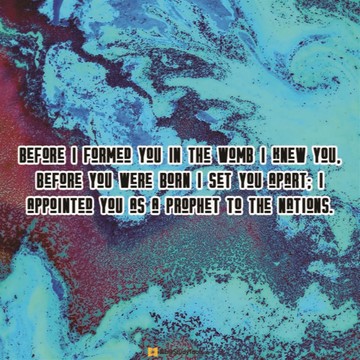
Your Daily Verse - Jeremiah 1:5
Share

Jeremiah 1:5
Share


La Santa Biblia, Nueva Versión Internacional® NVI®
Copyright © 1999 by Biblica, Inc.®
Used by permission. All rights reserved worldwide.
Study Tools
PLUSUnlock Notes
This feature is for PLUS subscribers only. Join PLUS today to access these tools and more.
JOIN PLUSUnlock Highlights
This feature is for PLUS subscribers only. Join PLUS today to access these tools and more.
JOIN PLUSUnlock Bookmarks
This feature is for PLUS subscribers only. Join PLUS today to access these tools and more.
JOIN PLUSTrack Your Reading
Create a free account to start a reading plan, or join PLUS to unlock our full suite of premium study tools.
Already have an account? Sign in