
Change Translation
- Recent Translations
- All Translations
Parábola de los viñadores
1 »Así mismo el reino de los cielos se parece a un propietario que salió de madrugada a contratar obreros para su viñedo.
4
Les dijo: “Vayan también ustedes a trabajar en mi viñedo, y les pagaré lo que sea justo”.
5
Así que fueron. Salió de nuevo a eso del mediodía y a la media tarde, e hizo lo mismo.
6
Alrededor de las cinco de la tarde, salió y encontró a otros más que estaban sin trabajo. Les preguntó: “¿Por qué han estado aquí desocupados todo el día?”
7
“Porque nadie nos ha contratado”, contestaron. Él les dijo: “Vayan también ustedes a trabajar en mi viñedo”.
8
»Al atardecer, el dueño del viñedo le ordenó a su capataz: “Llama a los obreros y págales su jornal, comenzando por los últimos contratados hasta llegar a los primeros”.
9
Se presentaron los obreros que habían sido contratados cerca de las cinco de la tarde, y cada uno recibió la paga de un día.
10
Por eso cuando llegaron los que fueron contratados primero, esperaban que recibirían más. Pero cada uno de ellos recibió también la paga de un día.
11
Al recibirla, comenzaron a murmurar contra el propietario.
12
“Estos que fueron los últimos en ser contratados trabajaron una sola hora —dijeron—, y usted los ha tratado como a nosotros que hemos soportado el peso del trabajo y el calor del día”.
13
Pero él le contestó a uno de ellos: “Amigo, no estoy cometiendo ninguna injusticia contigo. ¿Acaso no aceptaste trabajar por esa paga?
14
Tómala y vete. Quiero darle al último obrero contratado lo mismo que te di a ti.
15
¿Es que no tengo derecho a hacer lo que quiera con mi dinero? ¿O te da envidia de que yo sea generoso?”[c]
16
»Así que los últimos serán primeros, y los primeros, últimos.
Jesús predice de nuevo su muerte
17 Mientras subía Jesús rumbo a Jerusalén, tomó aparte a los doce discípulos y les dijo:
18
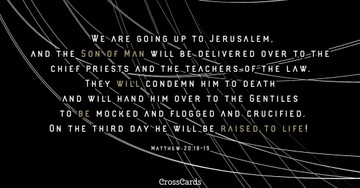
«Ahora vamos rumbo a Jerusalén, y el Hijo del hombre será entregado a los jefes de los sacerdotes y a los maestros de la ley. Ellos lo condenarán a muerte
19
y lo entregarán a los gentiles para que se burlen de él, lo azoten y lo crucifiquen. Pero al tercer día resucitará».
La petición de una madre
20 Entonces la madre de Jacobo y de Juan,[d] junto con ellos, se acercó a Jesús y, arrodillándose, le pidió un favor.
21
—¿Qué quieres? —le preguntó Jesús.—Ordena que en tu reino uno de estos dos hijos míos se siente a tu derecha y el otro a tu izquierda.
22
—Ustedes no saben lo que están pidiendo —les replicó Jesús—. ¿Pueden acaso beber el trago amargo de la copa que yo voy a beber?—Sí, podemos.
23
—Ciertamente beberán de mi copa —les dijo Jesús—, pero el sentarse a mi derecha o a mi izquierda no me corresponde concederlo. Eso ya lo ha decidido[e] mi Padre.
24
Cuando lo oyeron los otros diez, se indignaron contra los dos hermanos.
25
Jesús los llamó y les dijo:—Como ustedes saben, los gobernantes de las naciones oprimen a los súbditos, y los altos oficiales abusan de su autoridad.
26
Pero entre ustedes no debe ser así. Al contrario, el que quiera hacerse grande entre ustedes deberá ser su servidor,
27
y el que quiera ser el primero deberá ser esclavo de los demás;
28
así como el Hijo del hombre no vino para que le sirvan, sino para servir y para dar su vida en rescate por muchos.
Dos ciegos reciben la vista
29 Una gran multitud seguía a Jesús cuando él salía de Jericó con sus discípulos.
30
Dos ciegos que estaban sentados junto al camino, al oír que pasaba Jesús, gritaron:—¡Señor, Hijo de David, ten compasión de nosotros!
31
La multitud los reprendía para que se callaran, pero ellos gritaban con más fuerza:—¡Señor, Hijo de David, ten compasión de nosotros!
32
Jesús se detuvo y los llamó.—¿Qué quieren que haga por ustedes?
33
—Señor, queremos recibir la vista.
34
Jesús se compadeció de ellos y les tocó los ojos. Al instante recobraron la vista y lo siguieron.
Mateo 20 Commentary
Chapter 20
The parable of the labourers in the vineyard. (1-16) Jesus again foretells his sufferings. (17-19) The ambition of James and John. (20-28) Jesus gives sight to two blind men near Jericho. (29-34)
Verses 1-16 The direct object of this parable seems to be, to show that though the Jews were first called into the vineyard, at length the gospel should be preached to the Gentiles, and they should be admitted to equal privileges and advantages with the Jews. The parable may also be applied more generally, and shows, 1. That God is debtor to no man. 2. That many who begin last, and promise little in religion, sometimes, by the blessing of God, arrive at a great deal of knowledge, grace, and usefulness. 3. That the recompense of reward will be given to the saints, but not according to the time of their conversion. It describes the state of the visible church, and explains the declaration that the last shall be first, and the first last, in its various references. Till we are hired into the service of God, we are standing all the day idle: a sinful state, though a state of drudgery to Satan, may be called a state of idleness. The market-place is the world, and from that we are called by the gospel. Come, come from this market-place. Work for God will not admit of trifling. A man may go idle to hell, but he that will go to heaven, must be diligent. The Roman penny was sevenpence halfpenny in our money, wages then enough for the day's support. This does not prove that the reward of our obedience to God is of works, or of debt; when we have done all, we are unprofitable servants; but it signifies that there is a reward set before us, yet let none, upon this presumption, put off repentance till they are old. Some were sent into the vineyard at the eleventh hour; but nobody had hired them before. The Gentiles came in at the eleventh hour; the gospel had not been before preached to them. Those that have had gospel offers made them at the third or sixth hour, and have refused them, will not have to say at the eleventh hour, as these had, No man has hired us. Therefore, not to discourage any, but to awaken all, be it remembered, that now is the accepted time. The riches of Divine grace are loudly murmured at, among proud Pharisees and nominal Christians. There is great proneness in us to think that we have too little, and others too much of the tokens of God's favour; and that we do too much, and others too little in the work of God. But if God gives grace to others, it is kindness to them, and no injustice to us. Carnal worldlings agree with God for their penny in this world; and choose their portion in this life. Obedient believers agree with God for their penny in the other world, and must remember they have so agreed. Didst not thou agree to take up with heaven as thy portion, thy all; wilt thou seek for happiness in the creature? God punishes none more than they deserve, and recompenses every service done for him; he therefore does no wrong to any, by showing extraordinary grace to some. See here the nature of envy. It is an evil eye, which is displeased at the good of others, and desires their hurt. It is a grief to ourselves, displeasing to God, and hurtful to our neighbours: it is a sin that has neither pleasure, profit, nor honour. Let us forego every proud claim, and seek for salvation as a free gift. Let us never envy or grudge, but rejoice and praise God for his mercy to others as well as to ourselves.
Verses 17-19 Christ is more particular here in foretelling his sufferings than before. And here, as before, he adds the mention of his resurrection and his glory, to that of his death and sufferings, to encourage his disciples, and comfort them. A believing view of our once crucified and now glorified Redeemer, is good to humble a proud, self-justifying disposition. When we consider the need of the humiliation and sufferings of the Son of God, in order to the salvation of perishing sinners, surely we must be aware of the freeness and richness of Divine grace in our salvation.
Verses 20-28 The sons of Zebedee abused what Christ said to comfort the disciples. Some cannot have comforts but they turn them to a wrong purpose. Pride is a sin that most easily besets us; it is sinful ambition to outdo others in pomp and grandeur. To put down the vanity and ambition of their request, Christ leads them to the thoughts of their sufferings. It is a bitter cup that is to be drunk of; a cup of trembling, but not the cup of the wicked. It is but a cup, it is but a draught, bitter perhaps, but soon emptied; it is a cup in the hand of a Father, Joh. 18:11 . Baptism is an ordinance by which we are joined to the Lord in covenant and communion; and so is suffering for Christ, ( Ezekiel 20:37 , Isaiah 48:10 ) . Baptism is an outward and visible sign of an inward and spiritual grace; and so is suffering for Christ, for unto us it is given, ( Philippians 1:29 ) . But they knew not what Christ's cup was, nor what his baptism. Those are commonly most confident, who are least acquainted with the cross. Nothing makes more mischief among brethren, than desire of greatness. And we never find Christ's disciples quarrelling, but something of this was at the bottom of it. That man who labours most diligently, and suffers most patiently, seeking to do good to his brethren, and to promote the salvation of souls, most resembles Christ, and will be most honoured by him to all eternity. Our Lord speaks of his death in the terms applied to the sacrifices of old. It is a sacrifice for the sins of men, and is that true and substantial sacrifice, which those of the law faintly and imperfectly represented. It was a ransom for many, enough for all, working upon many; and, if for many, then the poor trembling soul may say, Why not for me?
Verses 29-34 It is good for those under the same trial, or infirmity of body or mind, to join in prayer to God for relief, that they may quicken and encourage one another. There is mercy enough in Christ for all that ask. They were earnest in prayer. They cried out as men in earnest. Cold desires beg denials. They were humble in prayer, casting themselves upon, and referring themselves cheerfully to, the Mediator's mercy. They showed faith in prayer, by the title they gave to Christ. Surely it was by the Holy Ghost that they called Jesus, Lord. They persevered in prayer. When they were in pursuit of such mercy, it was no time for timidity or hesitation: they cried earnestly. Christ encouraged them. The wants and burdens of the body we are soon sensible of, and can readily relate. Oh that we did as feelingly complain of our spiritual maladies, especially our spiritual blindness! Many are spiritually blind, yet say they see. Jesus cured these blind men; and when they had received sight, they followed him. None follow Christ blindly. He first by his grace opens men's eyes, and so draws their hearts after him. These miracles are our call to Jesus; may we hear it, and make it our daily prayer to grow in grace and in the knowledge of the Lord and Saviour Jesus Christ.
Unlock Deeper Insights: Get Over 20 Commentaries with Plus! Subscribe Now
Mateo 20 Commentaries
Footnotes 5
- [a] "la paga de un día de trabajo" . Lit. "un denario por el día" ; también en vv. 9,10,13.
- [b] "las nueve de la mañana" . Lit. "la hora tercera" ; en v. 5 "la hora sexta y novena" ; en vv. 6 y 9 "la hora undécima" .
- [c] "¿O " "… " "generoso? " Lit. "¿O es tu ojo malo porque yo soy bueno?"
- [d] "de Jacobo y de Juan" . Lit. "de los hijos de Zebedeo" .
- [e] "concederlo. Eso ya lo ha decidido" . Lit. "concederlo, sino para quienes lo ha preparado" .
Related Articles




Images for Mateo 20
Matthew 20:18-19
Share
La Santa Biblia, Nueva Versión Internacional® NVI®
Copyright © 1999 by Biblica, Inc.®
Used by permission. All rights reserved worldwide.
Study Tools
PLUSUnlock Notes
This feature is for PLUS subscribers only. Join PLUS today to access these tools and more.
JOIN PLUSUnlock Highlights
This feature is for PLUS subscribers only. Join PLUS today to access these tools and more.
JOIN PLUSUnlock Bookmarks
This feature is for PLUS subscribers only. Join PLUS today to access these tools and more.
JOIN PLUSTrack Your Reading
Create a free account to start a reading plan, or join PLUS to unlock our full suite of premium study tools.
Already have an account? Sign in