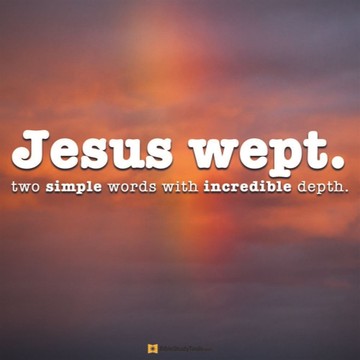
Your Daily Verse - John 11:35
Jesus wept.
] As he was going along to the grave, see ( John 11:28 ) ; as he was meditating upon the state of his friend Lazarus, the distress his two sisters were in, and the greater damnation that would befall the Jews then present, who, notwithstanding the miracle, would not believe in him. This shows him to be truly and really man, subject to like passions, only without sin.

In this episode, Dr. Robyn Kassas and Dr. Nathan Kassas explain that tears communicate a need for connection, using the infant who cries and learns safety from a caregiver. They say suppressing tears carries a biological cost, and link it to the body turning on itself. They address why men struggle to cry, pointing to David, Jeremiah, Lamentations and Jesus weeping over Lazarus, then describe testosterone's effect on the corpus callosum and the need for a healthy male role model, sharing the example of Dr. Nathan's son Levi. They say pain becomes wisdom and wounds become testimony, and from Psalm 84 that provision requires participation: you dig the well and God sends the rain. They also remind men that strength in Psalm 84 is found in the Lord, not in being macho, and that tears need not be explained away by godly reasoning.
In this deeply revelatory episode of First Love, Dr. Robyn Kassas and Dr. Nathan Kassas build on last week’s exploration of time—one of life’s most misunderstood forces—and step into the sacred space that time creates: tension. This is not the tension we avoid, but the tension God uses.With prophetic clarity, they uncover how tension is the divine movement between trauma and transformation—the stretch between what was and what is becoming. It is the place where God resists premature healing, not to withhold freedom, but to ensure it is complete. Because when trauma is revisited outside of God’s timing, the wound is relived… but when held within His tension, it is redeemed.Through powerful insight, they reveal how our desire for immediate relief can sabotage lasting transformation. The human tendency to rush resolution often leads to reaction instead of renewal—but God works differently. He uses tension to break cycles, retrain desire, and expose what lies beneath the surface, bringing not just answers, but identity-level change.This episode invites you to embrace the holy tension of not knowing, of waiting, of being stretched—because it is in this space that God reframes your story, silences accusation, and replaces shame with truth. Even Jesus Himself stepped into tension, weeping before resurrection, embracing humanity before victory—showing us that transformation requires both surrender and process.If you’ve ever felt caught between pain and promise, this message will awaken you to the purpose of the in-between. Tension is not your breaking point—it is your becoming.Return to your first love, not as one escaping the process, but as one transformed by it—emerging into a mature love that has been stretched, refined, and made whole.
This feature is for PLUS subscribers only. Join PLUS today to access these tools and more.
JOIN PLUSThis feature is for PLUS subscribers only. Join PLUS today to access these tools and more.
JOIN PLUSThis feature is for PLUS subscribers only. Join PLUS today to access these tools and more.
JOIN PLUSCreate a free account to start a reading plan, or join PLUS to unlock our full suite of premium study tools.