
Your Daily Verse - Psalm 34:8 - July 9th



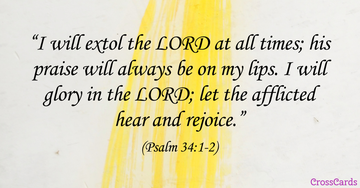
\\<<[A Psalm] of David, when he changed his behaviour before Abimelech\\; \\who drove him away, and he departed>>\\. The author of this psalm is expressed by name; and the time and occasion of it are plainly intimated: it was composed by David, "when he changed his behaviour before Abimelech"; not Ahimelech the priest, sometimes called Abimelech, 1Ch 18:16; to whom David went alone for bread, pretending he was upon a private business of the king's; to which sense the Syriac version inclines, rendering the words, "when he went to the house of the Lord, [and] gave the firstfruits to the priests". But this Abimelech was king of Gath, the same with Achish, 1Sa 21:10; who either had two names; or this of Abimelech, as it should seem, was a common name to all the kings of the Philistines; see Ge 20:2, 26:8; as Pharaoh was to the Egyptian kings, and Caesar to the Roman emperors: the name signifies a "father king", or "my father king", or a "royal father"; as kings should be the fathers of their country: before him "David changed his behaviour", his taste, sense, or reason: he imitated a madman; behaved as if he was out of his senses, scrabbling on the doors of the gates, and letting his spittle fall down upon his beard; for he being known and made known by the servants of the king, he was in great fear of losing his life, being in the hands of an enemy, and who he might justly fear would revenge the death of their champion Goliath; wherefore he took this method to get himself despised and neglected by them, and escape out of their hands: and which succeeded; for Abimelech, or Achish, seeing him behave in such a manner, treated him with contempt, was displeased with his servants for bringing him into his presence, and ordered them to take him away, or dismiss him; which is here expressed by this phrase, "who drove him away", with scorn and indignation; "and he departed" to the cave of Adullam, glad at heart he had escaped such danger: upon which, under a sense of divine goodness, and by the inspiration of the Spirit of God, he composed the following psalm; see 1Sa 21:10-15, 22:1.
The Brenton translation of the Septuagint is in the public domain.
This feature is for PLUS subscribers only. Join PLUS today to access these tools and more.
JOIN PLUSThis feature is for PLUS subscribers only. Join PLUS today to access these tools and more.
JOIN PLUSThis feature is for PLUS subscribers only. Join PLUS today to access these tools and more.
JOIN PLUSCreate a free account to start a reading plan, or join PLUS to unlock our full suite of premium study tools.