Loading...

Change Translation

Loading...
  • Recent Translations
  • All Translations

Psalm 42

Listen to Psalm 42
1 As the hart earnestly desires the fountains of water, so my soul earnestly longs for thee, O God.
2 My soul has thirsted for the living God: when shall I come and appear before God?
3 My tears have been bread to me day and night, while they daily said to me, Where is thy God?
4 I remembered these things, and poured out my soul in me, for I will go to the place of thy wondrous tabernacle, even to the house of God, with a voice of exultation and thanksgiving and of the sound of those who keep festival.
5 Wherefore art thou very sad, O my soul? and wherefore dost thou trouble me? hope in God; for I will give thanks to him; he is the salvation of my countenance.
6 O my God, my soul has been troubled within me: therefore will I remember thee from the land of Jordan, and of the Ermonites, from the little hill.
7 Deep calls to deep at the voice of thy cataracts: all thy billows and thy waves have gone over me.
8 By day the Lord will command his mercy, and manifest it by night: with me is prayer to the God of my life.
9 I will say to God, Thou art my helper; why hast thou forgotten me? wherefore do I go sad of countenance, while the enemy oppresses me?
10 While my bones were breaking, they that afflicted me reproached me; while they said to me daily, Where is thy God?
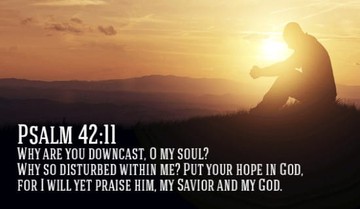
11 Wherefore art thou very sad, O my soul? and wherefore dost thou trouble me? hope in God; for I will give thanks to him; he is the health of my countenance, and my God.

Images for Psalm 42

Psalm 42 Meaning and Commentary

To the chief Musician, Maschil, for the sons of Korah. Of the word "Maschil," See Gill on "Ps 32:1," title. Korah was he who was at the head of a conspiracy against Moses and Aaron, for which sin the earth opened its mouth, and swallowed alive him and his company, and fire devoured two hundred and fifty more; the history of which is recorded in Numbers 16:1; yet all his posterity were not cut off, Numbers 26:11; some were in David's time porters, or keepers of the gates of the tabernacle, and some were singers; see 1 Chronicles 6:33; and to the chief musician was this psalm directed for them to sing, for they were not the authors of it, as some {b} have thought; but most probably David himself composed it; and it seems to have been written by him, not as representing the captives in Babylon, as Theodoret, but on his own account, when he was persecuted by Saul, and driven out by men from abiding in the Lord's inheritance, and was in a strange land among the Heathen, where he was reproached by them; and everything in this psalm agrees with his state and condition; or rather when he fled from his son Absalom, and was in those parts beyond Jordan, mentioned in this psalm; see 2 Samuel 17:24; so the Syriac inscription, the song which David sung in the time of his persecution, desiring to return to Jerusalem.

{b} So R. Moses in Muis, Gussetius, Ebr. Comment. p. 918, & others.
Unlock Deeper Insights: Get Over 20 Commentaries with Plus! Subscribe Now

The Brenton translation of the Septuagint is in the public domain.

Study Tools

PLUS

Unlock Notes

This feature is for PLUS subscribers only. Join PLUS today to access these tools and more.

JOIN PLUS

Unlock Highlights

This feature is for PLUS subscribers only. Join PLUS today to access these tools and more.

JOIN PLUS

Unlock Bookmarks

This feature is for PLUS subscribers only. Join PLUS today to access these tools and more.

JOIN PLUS

Track Your Reading

Create a free account to start a reading plan, or join PLUS to unlock our full suite of premium study tools.


Already have an account? Sign in