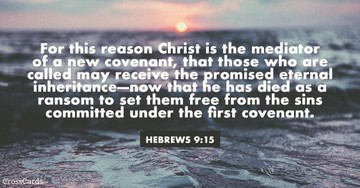
Your Daily Verse - Hebrews 9:15
The apostle having, in the former chapter, taken notice of the first covenant, in this proceeds to show what belonged to it, that it had service performed under it, and a place in which it was performed, Heb 9:1 and he begins with the latter, which he distinguishes into two parts, and shows what was in each of them; in the first, which was the holy place, were a candlestick, table, and shewbread; in the second, which was the holiest of all, were a golden censer, the ark of the covenant, the golden pot of manna, Aaron's rod, the tables of the covenant, and the cherubim of glory overshadowing the mercy seat, Heb 9:2-5. And next he speaks of the service performed in these places; in the first, the holy place, the common priests entered every day, doing service, as offering sacrifice Heb 9:6 and in the second, the holy of holies, only the high priest entered into, and that but once a year, with blood of slain beasts, which he offered for his own sins, and the sins of the people, Heb 9:7 and this being shut up, and entered into but once a year, was an indication from the Holy Ghost, that the way into the holiest of all, which this was then a figure of, was not yet made manifest, while the tabernacle or temple was standing, in which sacrifices were offered, which could not perfect the offerer of them, or remove guilt from his conscience, Heb 9:8,9 which shows the imperfection of that priesthood, it consisting of meats, drinks, baptisms, and carnal ordinances imposed on the Jewish nation until the times of the Messiah, Heb 9:10 which are now come, and in which there is an accomplishment of all those types and figures; Christ was typified by the high priest; and he is come as such, and the good things, the law was a shadow of, are come by him; who came into the world by the assumption of human nature, a more perfect tabernacle than the type of it was; and now having obtained eternal redemption for his people, he is gone into heaven, the most holy place, not as the high priest, with the blood of slain beasts, but with his own blood, Heb 9:11,12 the efficacy of which blood is argued from the lesser to the greater, that if the blood of beasts, and water of separation, sanctified and purified externally, then much more must the blood of Christ purge the conscience from sin, that it may serve God, since Christ offered himself to God without spot, through the eternal Spirit, Heb 9:13,14. The necessity of Christ's shedding his blood, or of his death, is proved from his being the Mediator of the new covenant, which required the redemption of transgressions under the first testament, that called ones might have the promise of the eternal inheritance, Heb 9:15. And this is reasoned from the nature of testaments or wills among men, which make the death of the testator necessary, they being of no force while he lives, only after his death, Heb 9:16,17. And this is further illustrated by the first testament being dedicated by blood, and everything belonging to it purged by it, the book, the people, the tabernacle, and all the vessels of it; nor is there any remission of sin, whether typical or real, without shedding of blood, Heb 9:18-22 wherefore, as it was necessary that the patterns and types of heavenly things should be purified in this manner; it must be more so, that the antitypes should be purified with better sacrifices, even with the sacrifice of Christ, Heb 9:23 and accordingly Christ is entered into heaven itself, of which the holy places in the tabernacle were figures, there to present and plead his sacrifice on account of his people, Heb 9:24 not that it was necessary that he should offer up himself again, or often, as the high priest, his type, went every year into the holy place with the blood of others; for then he must have often suffered since the world began, of which there was no need, since his appearing once in the end of the world, to put away sin by the sacrifice of himself, is sufficient, Heb 9:25,26 for as it is the appointment of God, that men should die but once, and then come to judgment, so it was only necessary that Christ should be offered once to bear the sins of all his people, and then appear a second time without any sin at all upon him, to the salvation of those that look for him, Heb 9:27,28.

To our way of thinking, the Old Testament method for dealing with sin seems foreign, confusing and severe. Why would man’s forgiveness require sacrificing an animal? Today, Mike Fabarez explores the “why” of animal sacrifice and “why” it’s no longer needed! We’ll see how Christ Changed Everything.
At one point, close to a quarter of a million lambs were killed during the Jewish Passover. As modern-day believers, we may ask “why?” Today, Mike Fabarez explains how the pictures of animal sacrifice point us to the true Lamb of God. It’s an important perspective on Old Testament traditions.
At first glance, chapter nine of Hebrews is not an encouraging passage of Scripture. It’s all about blood, death and sacrifice—rather gloomy topics. But today on Focal Point, Mike Fabarez explains why these somber illustrations serve as important reminders of sin and the remarkable work of Jesus!
Have you noticed that God is big on pictures, parables or illustrations? One example of that, among many, would be all of those animal sacrifices we find in Old Testament times. It was a picture of Christ who would later come to give His own blood, and solve our sin problem through substitution. Let’s see together how we should respond to this as we join Mike Fabarez in Hebrews on Focal Point.
There are those that love to point to the killing of animals in the Bible and conclude that Christians and God are cruel. Maybe you’ve wondered yourself, “Why did they sacrifice animals back in Old Testament times?” We’ll discover in a moment it was an important reminder of sin and an experience of substitution. Which brings up another question: why don’t we do this anymore? We’ll seek to answer that and other tough questions today on Focal Point as Pastor Mike Fabarez resumes his series, “Christ Changed Everything.”
This feature is for PLUS subscribers only. Join PLUS today to access these tools and more.
JOIN PLUSThis feature is for PLUS subscribers only. Join PLUS today to access these tools and more.
JOIN PLUSThis feature is for PLUS subscribers only. Join PLUS today to access these tools and more.
JOIN PLUSCreate a free account to start a reading plan, or join PLUS to unlock our full suite of premium study tools.