Sunday School Lesson: Mary and Martha
Share
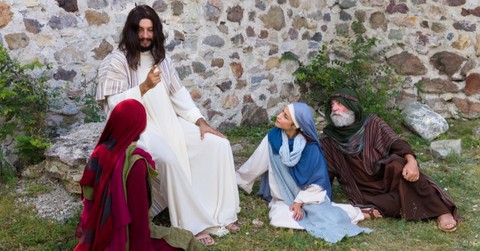
The Main Takeaway: Jesus wants us to serve others well, but the first thing he wants us to do is listen to him, trusting in him and not fretting over small things we think will give us peace if we control them.
The Chief Objective: Students will read Luke 10:38-42 and reflect on its message to trust God over all things and avoid worrying, along with an activity to help them think through their own worries.
Who Were Mary and Martha?
Mary, Martha, and their brother Lazarus were friends of Jesus who lived in Bethany. The Gospels mention several friends of Jesus who lived in Bethany, including Simon the Leper, who he stayed with when an unnamed woman anointed him with expensive oil (Mark 14, Matthew 26). It is unclear whether Mary, Martha, and Lazarus were connected to a group that financially supported Jesus’ ministry (Luke 3:8). Since John 12:1-8 mentions Mary anointing Jesus with expensive perfume (maybe the same story, maybe a different incident since anointing was a common activity), we assume the family had money. However they were connected to Jesus’ ministry, they were close to him and his followers.
One story involving Lazarus emphasizes how close the three siblings were to Jesus. John 11 details how Lazarus became sick and Jesus delayed traveling to Bethany for two days, arriving after the sickness had killed Lazarus and he had been buried. Jesus’ disciples are deeply saddened by the death, with Thomas saying, “Let us also go, that we may die with him” (John 11:16). The details suggest Mary, Martha, and Lazarus were not just acquaintances but old and close friends with Jesus and his circle. When Jesus does arrive in Bethany, he cries when he sees Mary and Martha grieving (John 11:33-35), and turns their grief to joy by opening Lazarus’ tomb and raising him from the dead.
An equally famous story focuses on Mary and Martha.
What Happens to Mary and Martha When Jesus Visits?
Luke 10 describes a time when Jesus came to Bethany and visited the house of Mary and Martha. Keeping friendships close was especially valued in Ancient Near Eastern cultures like Israel, so it was very common to stay with friends when visiting their town (if they were close friends, it was considered bad manners not to visit). Hospitality was also highly valued, which made it very important to make visitors feel welcome, especially a visitor like Jesus who was known as a spiritual sage. Luke 10:38-42 describes a particular visit where Martha prepared a meal while Jesus sat with his disciples and taught. Mary sat near Jesus and listened while Martha set up the meal.
Martha eventually gets frustrated and tells Jesus, “Lord, don’t you care that my sister has left me to do the work by myself? Tell her to help me!” (Luke 10:40).
Jesus gives a surprising answer: “Martha, Martha… you are worried and upset about many things, but few things are needed—or indeed only one. Mary has chosen what is better, and it will not be taken away from her” (Luke 10:41-42).
Why Jesus’ Answer Surprised Martha
Jesus’ response would have shocked his audience, for reasons we may miss today. In ancient Israel, sitting at a teacher’s feet meant sitting close to them like a student hearing a tutor’s message. Men could sit at a teacher’s feet, but women were rarely given the same educational opportunities. A woman sitting at Jesus’ feet implied she was permitted close access to him as a trusted teacher. Mary’s posture would have shocked people. When Jesus kept teaching without sending her away, it communicated that Jesus saw her as a student, on the same level as his male disciples. He let her break social boundaries that women were not supposed to cross.
Mary sitting at Jesus’ feet while her sister prepared a meal was equally scandalous. Being a good host was often connected to gaining honor (or receiving shame if the dinner went badly). Mary choosing to listen instead of help her sister with the meal could have been considered shameful. By not helping, she kept the visit from going well, making her sister lose face with her guests. Most people in Jesus’ day would have seen it as normal for Martha to rebuke Mary for not assisting with the meal. Martha’s words to Jesus would have been seen as proper, a reminder for her sister to be a good host.
Instead, Jesus affirms Mary’s choice to listen, and encourages Martha to think about what worries her. Without shaming Martha, Jesus explains that her vision of what matters is not his vision. Martha worries about getting many things right. Jesus tells her not to worry about many things, but to remember the one thing that matters, and pursue it. That one thing is listening to God’s message, and Mary is willing to listen to that message, even when she runs the risk of looking undignified.
Main Point for Mary and Martha Lesson
The story of Mary and Martha offers a surprising lesson: good things can become a problem if we place them above following God.
Jesus tells Martha it is not good that she is “worried and upset about many things,” and that it is a good thing that Mary seeks to hear God’s Word above all else. Jesus does not say being a good host is bad. There are many passages in the Bible where he encourages Christians to be hospitable and kind (1 Peter 4:9). What he does say is that hospitality should never become more important than listening to God, and that worrying over many things is not helpful or required.
Christians are called not to put their identity in anything other than God (Psalm 81:1-2), and worry tempts us to put our identity in smaller things we think we can control. It is perhaps especially difficult to realize we are putting our identity in smaller things when those things are good in themselves. Being a good host can be a great blessing. Being a host at the expense of listening to God is a problem.
In all things, we must seek God’s heart, listen for his guidance, and remember that even good things can become stumbling blocks if we are not careful.
Activity Ideas and Scripture for Mary and Martha Lesson
If working with small children, give students pieces of drawing paper and crayons or markers. Have them draw or write:
- One thing that worries them
- One picture of Jesus as a good teacher
If students are comfortable, have them share some things that worry them and ask how they think Jesus can help them learn to trust him with their worries.
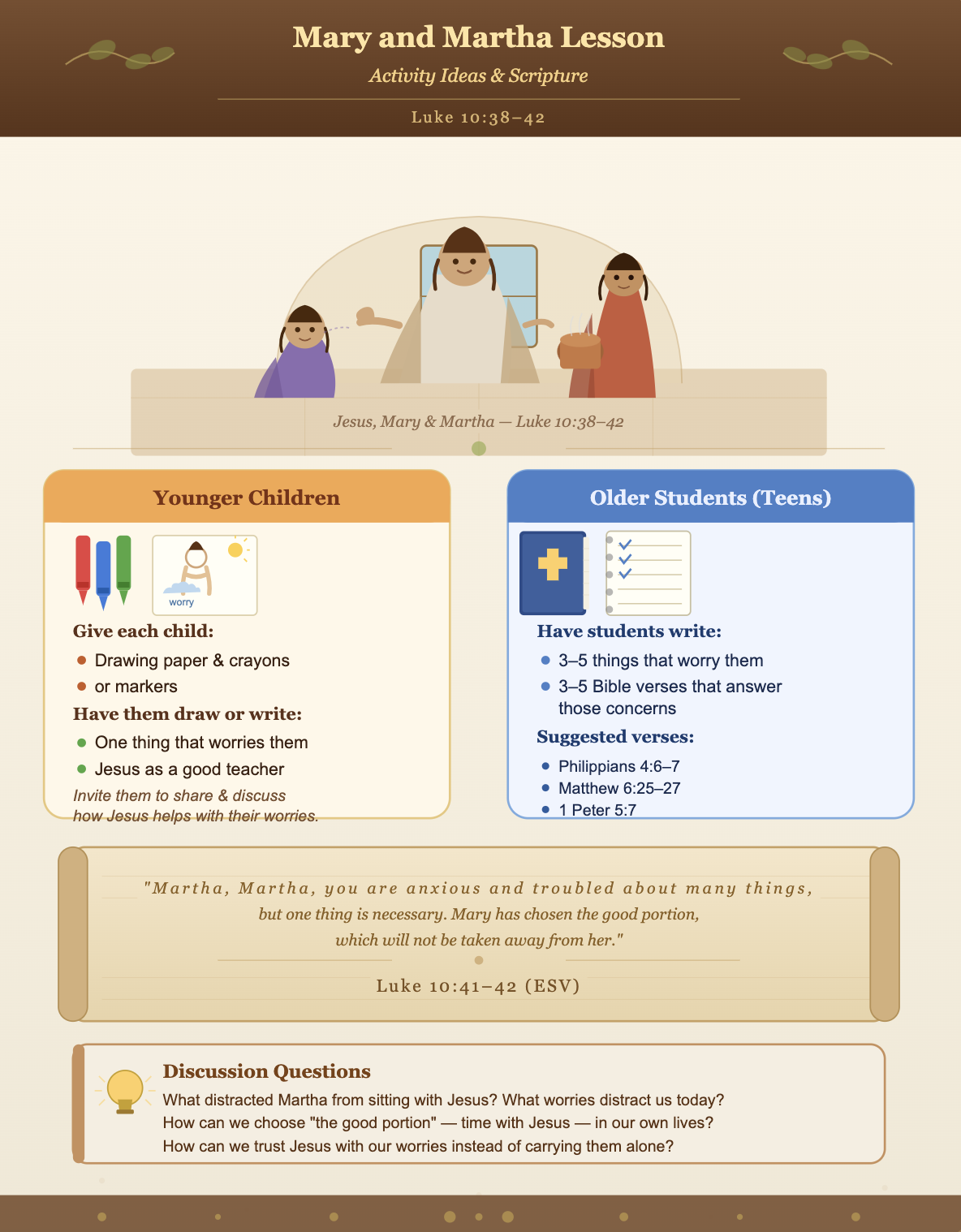
If working with older students (teenagers), have them write a list of 3-5 things that worry them, and 3-5 Bible verses that remind them how Jesus answers those concerns. Then talk to the students about replacing our worries with truth, or taking thoughts captive and submitting them to God (2 Corinthians 10:5). Useful Bible verses for this lesson may include:
- “Set your minds on things above, not on earthly things. For you died, and your life is now hidden with Christ in God. When Christ, who is your life, appears, then you also will appear with him in glory.” (Colossians 3:2-4 NIV)
- “Some trust in chariots and some in horses, but we trust in the name of the Lord our God.” (Psalm 20:7 NIV)
- “Trust in the Lord with all your heart and lean not on your own understanding; in all your ways submit to him, and he will make your paths straight.” (Proverbs 3:5-6 NIV)
Prayer for Mary and Martha Lesson
If working with small children, lead them in a version of this prayer:
Jesus,
Help me to trust you when I am scared, and remember to always listen to you.
Amen.
If working with older students, lead them in a version of this prayer:
Jesus,
I am reminded in the story of Mara and Martha that it is so easy to put my trust in little things that I assume I can control. Sometimes these are things I can use for good, but only if I submit them to you and always listen for what you want. Help me to put my trust in you first, replace my fears with your truth, and always listen for your guidance.
Amen.
Photo credit: Getty Image/Studio-Annika