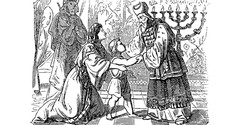
The Bible Story of the Prophet Samuel
June 12, 2026
From his miraculous birth to his calling as a boy, Samuel’s faithful life demonstrated God’s power and faithfulness.
Latest writing
June 12, 2026
From his miraculous birth to his calling as a boy, Samuel’s faithful life demonstrated God’s power and faithfulness.

June 10, 2026
Being a dad is hard enough sometimes, but being a God-honoring father who leads his family to know and love God can feel like a monumental task. Thankfully, Scripture provides many examples of imperfect yet godly Fathers who can encourage you to find the strength to lead your family is wisdom.

June 4, 2026
“I don’t drink, cuss, smoke, chew, or run around with women who do.”
Growing up in the local church, we used to say this line all the time, especially in Sunday School class as a teen, trying to help us kids say “no” to the culture that would tempt us with such things. As narrow and somewhat legalistic as those statements might have been, they weren’t necessarily wrong or bad. I was offered various substances by “friends” throughout high school. Fortunately for me, my church community was also loving and encouraging, and that combination helped me to be friends with others while rejecting some of their recreational activities.
And I definitely tried to stay away from the girls who did that stuff.
I learned that avoiding certain things didn’t keep me from having fun, probably the opposite, and kept me out of more trouble than I already got into.
The Bible doesn’t say anything about smoking or chewing. Of course, there are mentions of talking and having honorable speech and whole Proverbs passages about staying away from certain kinds of women.
But what about alcohol? Wine was a staple in the ancient world. Therefore, we get several occasions where the drinking of alcohol is addressed. How does the Bible speak of wine and alcohol? Important for the discussion is the example of Jesus. Wine shows up several times in the Gospel narratives. Did Jesus drink wine?
Photo credit: Unsplash/kmellis

June 3, 2026
When life leaves you feeling empty or overwhelmed, Jesus meets you right there. This devotional reminds you that He draws near in your need, bringing healing, restoration, and hope where you feel most lacking.

June 1, 2026
What do Paul's strict warnings about the works of the flesh mean for us today?

May 31, 2026
Looking further into the term "Gehenna" and how the New Testament uses it, we can see the real message Scripture communicates about hell, free from cultural distractions.

May 27, 2026
When Christ said, “You will know them by their fruit,” what did he mean? Let’s first look at the context.

May 23, 2026
This king and priest, Melchizedek, continues to bring insight to believers regarding the redemptive story God is telling, revealing God had a messianic plan from the very beginning.

May 22, 2026
Definitions matter. In a conversation, our mutual understanding hinges on having the same definition for the words we use. Otherwise, the interaction creates more misunderstanding and division than unity or comprehension. If two people discuss love, for instance, and its importance, then they require a shared definition of love to have any hope of real communication.
Religions have distinct belief systems. Some people may argue that all regions are basically the same, yet this claim proves false when you examine their respective claims. Some overlap in morality or value might exist—murder is wrong, for example—but the source of the morality and aim can be vastly different.
What about Christianity? A variety of interpretations and beliefs exist, but a person can’t believe anything they want and be defined as a Christian. There are a few non-negotiable beliefs at the core of Christianity. To believe differently creates a separate religion.
The Church in the first two centuries dealt with this as more bishops, leaders, and theologians wrote about God and what it meant to be a Christian, often seriously contradicting one another. They wanted to allow some freedom while maintaining a core aspect of the faith. Therefore, these early leaders developed the Apostle’s Creed.
Photo Credit: Image created using AI technology and subsequently edited and reviewed by our editorial team.

May 21, 2026
Olympic athletes train for years to compete at the highest levels. They discipline their minds and bodies, rearranging their whole schedule to reach that pinnacle of sport. But even those with the greatest talents can develop bad habits. Poor time management, insufficient training, and distractions of life keep an athlete from the goal. Great talent requires great discipline for a person to become their best.
The Bible compares the Christian life to an Olympic athlete, part of the Greek and Roman culture, even then. The apostle Paul writes that we must “run in such a way to get the prize,” developing discipline and self-control (1 Corinthians 9). The metaphor breaks down a bit, since athletes train for a crown which will fade, but Christians seek a heavenly one. In Hebrews 12:1, the writer encourages us to “throw off everything that hinders and the sin that so easily entangles” so we can run the race before us with perseverance.
While we might agree with these ideas, some habits sneak in on us. Hebrews points out a difference between things that hinder and outright sin. With believers, the Devil often tempts us with neutral things, distractions, instead of outright sin. We then develop habits that might seem innocuous, yet they keep us from fulfilling our calling in Christ.
Here are eight sneaky habits that stunt our spiritual growth.
Photo Credit: ©GettyImages/TongTa

May 19, 2026
We are saved by grace alone in that only God’s power becomes the source of our salvation, not our own. But “grace alone” doesn’t mean grace works apart from faith, Christ, truth, or hope. Grace doesn’t save apart from Jesus, revealed through faith and God’s written Word.

May 16, 2026
Covenant theology reminds us how the Christian life doesn’t depend upon us or what we do, but on what God has promised and will accomplish.

May 12, 2026
Beginning with Martin Luther’s 95 Theses, the Protestant Reformation began. Protestants like Luther, John Calvin, and Ulrich Zwingli critiqued the Catholic Church practices like indulgences. These reformers sparked religious wars and divisions across Europe, challenging the Catholic Church’s authority and leading to the establishment of various Protestant denominations.
Many of those Protestant denominations developed into modern Evangelicalism, which has swept much of America. Through extensive mission work, Evangelicalism has become one of the major Christian representations, perhaps the most vocal and extensive.
These two branches of Christianity (Catholic and Protestant) became separate and sometimes hostile towards each other over the centuries, to the point where many Protestants and Evangelicals may not fully understand the differences between what they believe and how Catholicism is different. In many ways, these two groups have similarities, but there are significant differences.
Here are 7 ways Catholicism is different from Christianity.
Photo Credit: @Getty Images/Liudmila Chernetska
May 11, 2026
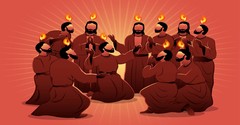
Pentecost wasn't just a moment in history. Learn how it bridges Old Testament promises with New Testament power.