The Bible Story of the Prophet Samuel
Share
A prophet heard God’s voice as a child, anointed Israel’s first two kings, and helped establish the line that would eventually bring the Christ into the world. Few people in the Old Testament shaped history as much as Samuel.
Samuel lived during a transitional period between the time of the judges and the kings. God raised him up as a prophet and deliverer to guide Israel through this time. From his miraculous birth to his calling as a boy, Samuel’s faithful life demonstrated God’s power and faithfulness.
Samuel’s story reveals how God raises up faithful men and women to change the course of history.
Samuel’s Story Begins with a Mother’s Prayer
Samuel’s story began before he became a judge. His mother, Hannah, desperately wanted a child, but she remained unable to conceive. In those times, childlessness brought deep sorrow and shame, as if cursed by God to some degree, and Hannah experienced both. To make it worse, Peninnah, the other wife of Hannah’s husband, Elkahah, did have children and mocked Hannah for having none.
Every year, Hannah went to Shiloh with her family, where the Tabernacle stood. During one visit, her sorrow overwhelmed her. She poured out her heart before God, weeping bitterly as she prayed. She cried out to the Lord for a child.
In her prayer, Hannah made a vow. She knew only God gives life. She promised that if God gave her a son, she would dedicate him to the Lord’s service for his whole life. As she prayed with great emotion, only moving her lips, the priest Eli thought she was drunk. Hannah explained her sorrow, and Eli blessed her, encouraging her to trust God.
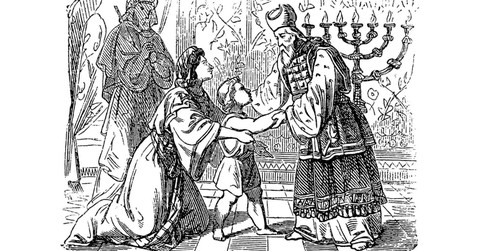
God answered Hannah’s prayer. She conceived and bore a son. She named him Samuel, which means either "asked of God" or "heard by God," pointing to the Lord’s miraculous provision. Hannah never forgot her promise. As soon as the boy was weaned, she brought him to Eli, and Samuel grew up in the Tabernacle, serving the Lord and Eli.
What Happened When Samuel Heard God’s Voice as a Boy?
While Samuel grew up under the care of Eli, the boy experienced a powerful encounter with the Lord. The Bible tells us that God’s word was rare in those days. After the cycle of rebellion and idolatry through the book of Judges, visions and prophetic messages didn’t come very often. Israel needed leadership and a new deliverer, and God chose young Samuel.
One night, Samuel lay down to sleep when he heard someone call him: “Samuel!”
Believing Eli needed him, the boy ran to the priest and said, “Here I am, for you called me.” Eli responded that he hadn’t called and sent the boy back to bed.
The same thing happened two more times. Each time Samuel heard his name, he hurried to Eli. Finally, Eli realized perhaps the Lord himself was calling Samuel. Eli told the boy to go back to bed, and if it happened again, he should respond, “Speak, Lord, for Your servant hears.”
When God called Samuel again, the child answered as Eli told him. The Lord then delivered a prophetic message about Eli’s household. Eli’s sons worked in the Tabernacle, too, as Levites and priests, and they had continually sinned and dishonored God. Because of this, God would bring judgment upon their family. Even though the message disturbed Samuel, he faithfully repeated it to Eli the next morning.
Interestingly, Eli affirmed the truth of God’s message.
After this, God spoke to Samuel regularly, and Samuel kept communicating God’s word to the people. As he grew up, all Israel recognized him as a prophet. When Eli died, Samuel became a judge and leader of Israel.
Samuel as Prophet and Judge
Samuel led Israel through one of Israel’s most pivotal periods.
As a prophet, Samuel acted as God’s spokesman. The Lord revealed his will to Samuel, and Samuel faithfully delivered the messages to the people. He also challenged Israel to return to God. The nation had dealt with idolatry and rebellion against God, leading to consequences of being oppressed by the Philistines. Samuel called them to repent and remove their foreign gods. At Mizpah, he gathered the nation for prayer and a renewed dedication to the Lord. The people responded, and God blessed them.
Before the time of the kings (Saul, David, etc.), God would raise up “judges,” deliverers who led Israel for a time through whatever crisis was at hand. Samuel was the last of these. As a judge, Samuel gave practical leadership and justice. While some judges only led specific tribes or regions in Israel, Samuel led the whole nation. He traveled through the whole country—between Bethel, Gilgal, Mizpah, and Ramah. In these locations, he settled disputes and maintained order.
Samuel’s leadership brought military victory and deliverance, as was often the case with a judge. When the Philistines attacked Israel during the meeting at Mizpah, Samuel prayed for the nation and offered a sacrifice to God. The Lord acted and threw the Philistine army into confusion, giving Israel a major victory. Samuel later raised up a memorial stone and declared, “This far the Lord has helped us.”
Unfortunately, the people later rebelled and asked for a king.
Samuel and Israel's Demand for a King
The people stated two reasons when they asked for a king. However, the Bible reveals three.
First, Israel pointed to a failure in Samuel’s leadership. Samuel grew old, and his sons acted corruptly; ironically, like Eli’s sons. Samuel had served Israel faithfully for a long time, but his sons didn’t follow that example. They accepted bribes and perverted justice. Concerned about what would happen after Samuel’s death, Israel’s leaders asked Samuel to anoint and appoint a king to lead them.
Secondly, the elders wanted a king “like all the other nations.” The other nations around Israel each had kings to lead armies and rule over them. But God was Israel’s king. Rather than recognizing their unique place in the world as God’s covenant people—their calling, they wanted to be like everyone else. They thought a king would give them more security and a stronger military. The twelve tribes often had conflicts with each other, as we see in the book of Judges, and a king might unify them.
These two reasons rejected the system of judges and Samuel as a leader, to some degree, since his sons couldn’t take charge after his death.
Yet God revealed the deeper issue to Samuel. The Lord told him the people hadn’t really rejected Samuel; they had rejected God as their king, a major rebellion. Israel found it difficult to trust an invisible king who called them to faith and purpose. They wanted a human ruler they could see, follow, fight for, and probably even manipulate.
Samuel warned the people about the consequences of their decision. A king would force their sons into military service, take their daughters for work in the palace, claim crops and taxes, and increase their burdens through control and even oppression. Samuel properly and faithfully laid out the high cost.
Despite these harsh warnings, the people still chose to have a king. God ultimately granted their request and had Samuel choose Israel’s first king.
How Did Samuel Shape the Future of Israel Through Saul and David?
When Israel demanded a king, God told Samuel to anoint Saul, a man from the tribe of Benjamin. Although Samuel knew the dangers of the people’s request, he obeyed God and recognized Saul as Israel’s first king.
Samuel mentored Saul during the early years of his reign and taught him how a king must remain dedicated and accountable to God’s authority. A true king of Israel couldn’t be like the kings of other nations, since no other people group had been chosen to be holy and reveal God’s will to the world. Israel’s king must be humble, obey God’s command, and follow the Mosaic Law.
Unfortunately, as Saul united the twelve tribes and achieved greater success, he began to put his own judgment above God’s direction. He unlawfully offered a sacrifice instead of waiting for Samuel, and later he refused to carry out God’s judgment against the Amalekites. Both decisions showed a heart that prioritized personal success and feared man more than God. Samuel ended up confronting Saul, reminding him that “to obey is better than sacrifice.”
As part of the consequence for Saul’s behavior, the Lord would remove the throne from Saul’s family. God would choose a man after his own heart to be king.
Next, God sent Samuel to the little town of Bethlehem with a new purpose. Samuel visited the house of Jesse to anoint the next king. Jesse showed the prophet several strong and handsome sons, but God rejected each one. Finally, Samuel asked if Jesse had any more sons, and Jesse reluctantly called for his youngest son, David, who had been tasked with watching the sheep. While everyone else had focused on the outward appearance, God looked at the heart and found David the right choice. Samuel anointed David, and the Spirit of the Lord was with the boy from then on.
This decision changed the course of Israel’s history and the history of the world. Although David lived in exile for a time, he eventually became king of the tribe of Judah and then all of Israel. He established the new capital in Jerusalem, after he conquered it. David expanded Israel’s influence and became the ultimate standard for every king after him. God later established a covenant with David and his household. One of his descendants would reign over Israel forever. This promise found fulfillment in the Messiah prophecy and led to Jesus and to salvation for all people.
Although Samuel died before David became king, his influence continued after his death. By anointing Saul, Samuel launched Israel’s monarchy. By anointing David, he helped establish the royal line that ultimately led to the Lord Jesus Christ, the Messiah, the central figure in God’s redemptive plan. Salvation for all who would believe.
Photo credit: ©Getty Images/Zdenek Sasek












.800w.tn.jpg)