82% of Young Adults Read the Bible on Their Phones – Here's What They Look Up Most
Share

Right now, someone in their twenties is reading the Bible on their phone. Not at a desk, not in a pew, but in a parking lot or maybe on a lunch break.
We know this because we can see it. Every year, millions of people come to BibleStudyTools.com looking for a verse, a chapter, a commentary, or a word for a hard day. And more than 8 in 10 of the young adults among them are reading on a phone.
What they look up tells a story worth paying attention to.
Young adults are the largest group reading the Bible here
There is a familiar version of the story about this generation and faith, and it usually ends with them walking away. Our numbers tell a different one.
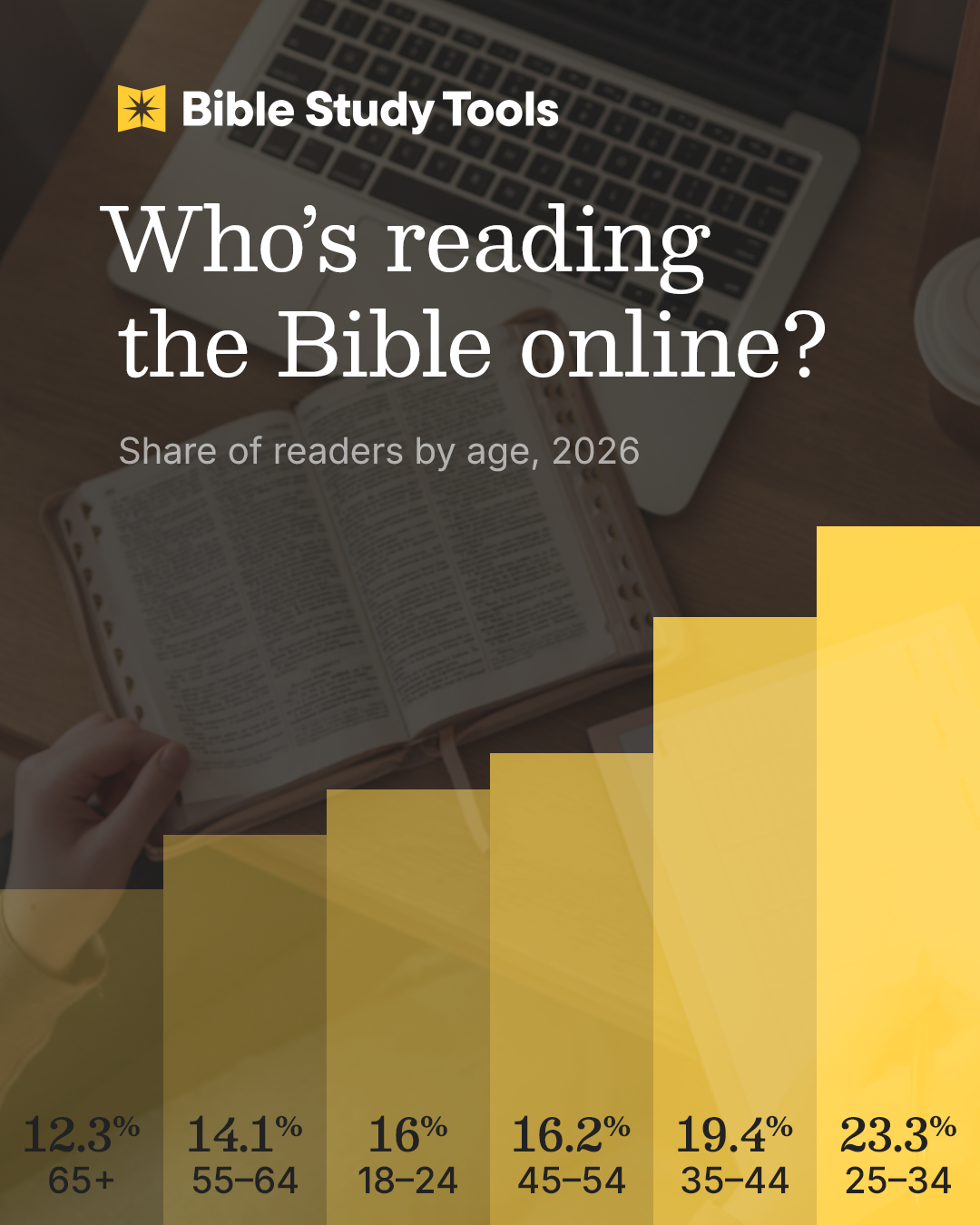
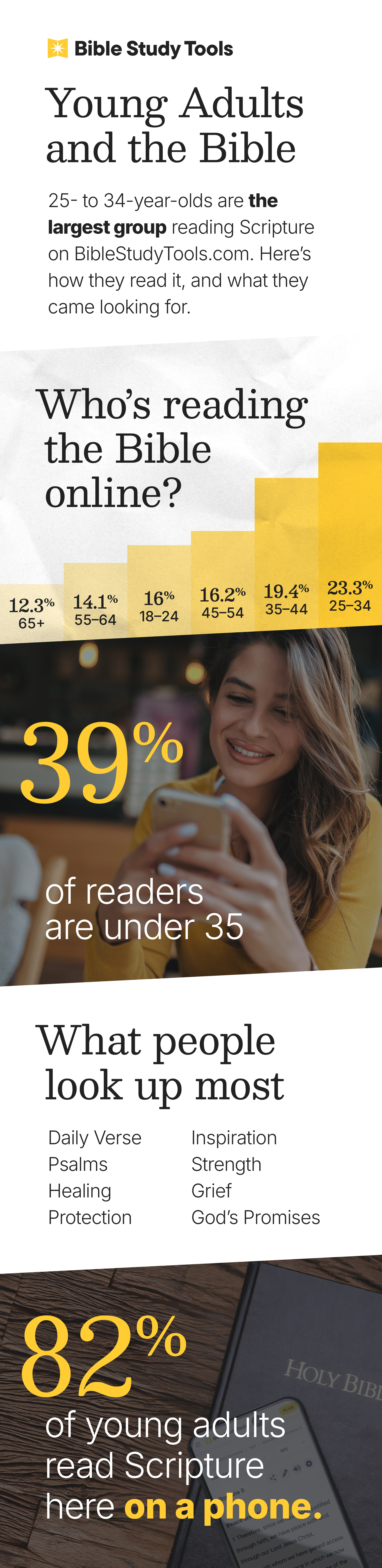
Nearly 4 in 10 of our readers are under age 35. Adults between 25 and 34 are the single largest group of people reading Scripture on BibleStudyTools.com, and they have held that spot for years.
And they aren't reading the way earlier generations did. 82% are on a phone. It's easy to imagine the moments that fits into: a few minutes between meetings, the car before heading inside, or maybe the quiet after the house goes to sleep.
This is Scripture meeting people where they already are, phone in hand, between everything else. And it isn't only our audience. Nationally, Gen Z adults and Millennials are now the first generations to read digital Scripture more than print, according to the American Bible Society. The phone is not where young adults drift from the Bible. It is increasingly where they meet it.
For the team behind BibleStudyTools.com, the numbers put hard data behind something we've long suspected about this generation.
"I love this data because it contradicts many things my social media algorithm wants me to believe, like the idea that all young people are out to disprove the Bible," said Shawn McEvoy, Salem Web Network's Executive Director of Content. "Instead we arrive into a world — including 18- to 34-year-olds — that needs something in which to believe, something beyond their screens that holds true when other things fall apart. They really want and need to know that there are plans from on high to give them, corporately and individually, a future and a hope."
Young adults are searching for healing, not birthdays
Eight years ago, when we last looked closely at this, the topics near the top of the list were about celebration. Here's what young adults looked up most in 2018:
- Encouraging Bible Verses
- Inspirational Bible Verses
- Love Bible Verses
- Bible Verses for Birthdays
- Healing Bible Verses
And here's what they look up most today:
- Healing Bible Verses
- Inspirational Bible Verses
- Bible Verses about Protection
- Strength Bible Verses
- God's Promises in the Bible
Look at what left and what arrived. Encouragement, love, and birthdays, the topics that read like a good season, have dropped off. In their place are protection, strength, and God's promises. And healing, which sat at the bottom of the 2018 list, is now the single most-read topic among young adults in 2026. The one page that was always about hard seasons is the one they reach for first.
There's a second interesting shift here too. Actual study tools have entered the top ten most-visited pages by young adults. Matthew Henry's commentary now sits alongside the topical verse pages. It seems that young adults are not only looking up a verse someone sent them. A growing number are opening the text itself and trying to understand it better.
National data shows the same shift
The American Bible Society's 2026 State of the Bible report found something that lines up closely with what our own numbers show.
Regular Bible reading in the United States dipped slightly this year. But the number of Americans who are open to Scripture, curious about it, and interested in it without being deeply engaged has grown by 9 million people since 2024. That group now accounts for 28% of American adults, and most of the growth came from people who had previously been disengaged entirely.
The report also found that the people who stay engaged with Scripture tend to be the ones who read whole chapters and stories rather than one verse at a time, who build the Bible into a regular schedule, and who follow a reading plan or guide.
What we take from this
If you work with young adults, whether you pastor them, parent them, teach them, or simply love them, there are a few things in this data worth remembering.
They are still reading. Whatever the broader story says, young adults remain the largest group of people opening Scripture on this site, and they have been for years.
The topics suggest they are often reading in hard seasons. Healing, protection, strength, grief. These read less like idle curiosity about religion and more like the searches of people going through something. If you are wondering when a young adult in your life might turn to Scripture, it may well be during their hardest week.
They want help, not just access. Access to the Bible has never been easier. That has not made it simpler to understand. The gap now is not availability. It’s guidance. That is the gap we try to close. A free reading plan turns a good intention into a path you can actually follow, and the national data suggests that a path is often what separates the people who stay with Scripture from the people who mean to. A commentary explains what a difficult passage meant and why it still matters. A Bible dictionary or concordance helps you trace a word or an idea across the whole of Scripture, so a single verse opens into the larger story it belongs to. None of it requires an account, a purchase, or knowing where to start.
This is the generation everyone assumed had walked away. They are still reading, still searching, and still open to help. Our door is open, our tools are free, and you do not have to know where you are going in order to begin.