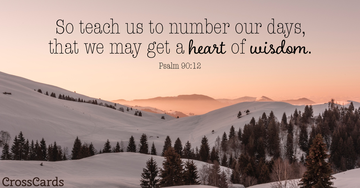
Psalm 90:12 - A Heart of Wisdom

\\<>\\. Here begins the fourth part of the book of Psalms, and with the most ancient psalm throughout the whole book, it being written by Moses; not by one of that name that lived in later times; nor by one of his posterity; nor by some one who composed it, agreeably to his words and doctrines, and called it by his name; but by that Moses by whom the Lord brought the children of Israel out of Egypt, led them through the wilderness to the borders of Canaan's land, and by whom he delivered to them the lively oracles; and who is described as the man of God, a title given to Moses, De 33:1, so called, not as a creature of his make, so all men are; nor as a man of grace, born of God, so is every saint; but a man of more than ordinary gifts received from the Lord, a prophet of the Lord, and the chief of the prophets, and a type of the great Prophet; so inspired men and prophets under the Old Testament bear this name, and ministers of the Gospel under the New, \1Ki 17:18,24 2Pe 1:21 2Ti 3:17\. It is a conceit of Bohlius, that this prayer of his (so it is called, as several other psalms are, see Ps 17:1,86:1,102:1,142:1) was made by him when he was about seventy years of age, ten years before he was sent to Pharaoh, while he was in Midian, which he gathers from Ps 90:10; others think it was written towards the end of his life, and when weary of it, and his travels in the wilderness; but it is more generally thought that it was penned about the time when the spies brought a bad report of the land, and the people fell a murmuring; which provoked the Lord, that he threatened them that they should spend their lives in misery in the wilderness, and their carcasses should fall there; and their lives were cut short, and reduced to threescore years and ten, or thereabout; only Moses, Joshua, and Caleb, lived to a greater age; and on occasion of this Moses wrote this psalm, setting forth the brevity and misery of human life; so the Targum, ``a prayer which Moses the prophet of the Lord prayed, when the people of the house of Israel sinned in the wilderness.'' Jarchi and some other Jewish writers {z} not only ascribe this psalm to Moses, but the ten following, being without a name; but it is certain that Psalm 95 was written by David, as appears from Heb 4:7 and Psalm 96 is his, compared with 1Ch 16:23 and in Psalm 99 mention is made of Samuel, who lived long after the times of Moses.
The Brenton translation of the Septuagint is in the public domain.
This feature is for PLUS subscribers only. Join PLUS today to access these tools and more.
JOIN PLUSThis feature is for PLUS subscribers only. Join PLUS today to access these tools and more.
JOIN PLUSThis feature is for PLUS subscribers only. Join PLUS today to access these tools and more.
JOIN PLUSCreate a free account to start a reading plan, or join PLUS to unlock our full suite of premium study tools.