
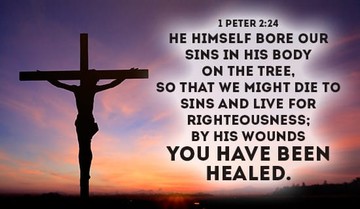
1 Peter 2:24
This chapter consists of exhortations, in general, to a holy life; and, in particular, to obedience to superiors. It begins with an exhortation to lay aside various vices, which were unbecoming regenerate persons, 1Pe 2:1 and, agreeably to their character, as new born babes, to express a desire after the Gospel, which is commended from its nature, being comparable to milk; and from its quality, being reasonable, sincere, and unmixed; and from the end and usefulness of it, a spiritual growth; and the argument engaging to such a desire is the experience they had of the grace of Christ in it, 1Pe 2:2,3 whose excellency is declared, under the metaphor of a stone, said to be living, to be chosen of God, and precious to him, though rejected by men; to whom the saints are encouraged to come, as lively stones built up, a spiritual house, for the exercise of the holy office of the priesthood, by offering up spiritual sacrifices acceptable to God through Christ, 1Pe 2:4,5 and that Christ is such a precious stone, is proved from Isa 28:16 and not only to God, but to all them that believe; though to them that believe not, he is the stone of rejection, stumbling, and offence; to stumble at which, and the doctrine of it, through disobedience, they were of old appointed by God, 1Pe 2:6-8 but the character of the persons the apostle writes to was very different, quite the reverse, being chosen and called, and manifestly the people of God, and sharing in his grace and mercy, 1Pe 2:9,10 and these he exhorts, suitable to their state and condition, to abstain from sin, as an enemy to their souls, and to live an honest life and conversation among the Gentiles, that they, instead of speaking evil of them, might, by beholding their good works, glorify God, 1Pe 2:11,12. And particularly he exhorts them to obedience to civil magistrates, both superior and inferior; partly from the author of them, they being of the Lord; and partly from the usefulness of them to punish wicked men, and to encourage good men; and also from its being the will of God, by such obedience, to silence the cavils of foolish men, 1Pe 2:13-15. And whereas it might be objected, that they were made free by Christ, and therefore should not be the servants of men; it is granted, that they were free; but then it is denied, that they should use their liberty for a cloak of maliciousness: and besides, it should be observed, that they were the servants of God, and therefore ought to do what he enjoined them; and, among other things, yield obedience to civil magistrates, 1Pe 2:16. And to this purpose are various exhortations in 1Pe 2:17, and another particular one is added, which is to servants, to be subject to their masters, and fear them, whether they be good or bad, 1Pe 2:18 and then he comforts such that had bad masters, and encourages them to bear the injuries they received from them patiently; because so to do was grateful to God, and acceptable in his sight; and because they were called unto it by him; and because of the example Christ had left them in suffering for them, 1Pe 2:19-21. And this is further urged from the character of Christ, who was without sin, and yet suffered, and from his conduct, who, when reviled, made no return, but left his cause with God, 1Pe 2:22,23 which leads on the apostle take notice of the nature of Christ's sufferings in his body on the cross, and the ends of them, which were expiation of sin, healing diseases, and holiness of life, as a consequent thereof, 1Pe 2:24 previous to which conversion, which is illustrated by the former state and condition men are in, being as sheep going astray; and by their present one, being returned to Christ, the Shepherd and Bishop of souls, 1Pe 2:25.
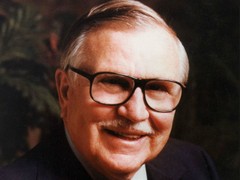
“A godly life speaks louder than any message from the pulpit” is the encouragement we receive from Dr. J. Vernon McGee today. This study from 1 Peter gives us practical help in living the Christian life and teaches us what it takes to be a living witness to the grace of God.

We are not to “ingratiate” ourselves, or “fight fire with fire,” for the sake of others. But rather, “commit ourselves to Him who judges righteously.” When we are committed to Christ, we will naturally reflect God’s love!

God is just. He will settle the score in the end. God sent His Son Jesus Christ to bear our sins with His own body at the cross. Only Jesus could do that. And, only Jesus can redeem us from the curse of the Law. A Law that has no grace, and cannot sacrifice itself in our place.

At various points of our lives, most of us will be in the workforce. And whether you’re a janitor, a doctor, or a school teacher, God wants to use you in a wonderful way! Today on a Daily Walk pastor John Randall will show us how to demonstrate the presence of God in our lives, on the job. It’s a highly practical study framed around First Peter two.
With a name like Nero Claudius Caesar Augustus Germanicus, Nero was a young “egomaniac.” Soon after Peter’s writing he blamed the Christians for the fire in Rome (July 18, 64 A.D.) and put many innocent people to horrible deaths! Peter himself, in 64 A.D. would be put to death by Nero’s command. Foxes Book of Martyrs -crucified upside down – not worthy to be crucified like his Lord. Yet, Peter, despite the corrupt political and moral environment of his day, called believers to exercise spiritual etiquette. Today, God calls us to do the same!
Christ wants us to follow in His footsteps. But, this also holds true in His suffering. We can be in the middle of God’s perfect will, loved by Him with an infinite love, and yet be suffering greatly in a Christ rejecting world.
This feature is for PLUS subscribers only. Join PLUS today to access these tools and more.
JOIN PLUSThis feature is for PLUS subscribers only. Join PLUS today to access these tools and more.
JOIN PLUSThis feature is for PLUS subscribers only. Join PLUS today to access these tools and more.
JOIN PLUSCreate a free account to start a reading plan, or join PLUS to unlock our full suite of premium study tools.