Change Translation
- Recent Translations
- All Translations
1
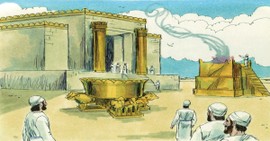
Salomón construye el templo
Salomón comenzó a construir el templo del Señor
en Jerusalén en el monte Moriah, donde el Señor
se le había aparecido a David, su padre. El templo se construyó en el campo de trillar de Arauna
el jebuseo; el sitio que David había elegido.
Salomón comenzó a construir el templo del Señor
en Jerusalén en el monte Moriah, donde el Señor
se le había aparecido a David, su padre. El templo se construyó en el campo de trillar de Arauna
el jebuseo; el sitio que David había elegido.
2
La construcción comenzó a mediados de la primavera,
durante el cuarto año del reinado de Salomón.
durante el cuarto año del reinado de Salomón.
3
Estas fueron las medidas que Salomón usó para los cimientos del templo de Dios (según el antiguo estándar de medición).
Tenía veintisiete metros y medio de largo por nueve metros de ancho.
Tenía veintisiete metros y medio de largo por nueve metros de ancho.
4
La antesala que estaba al frente del templo medía nueve metros
de ancho, coincidía con la anchura total del templo, y medía nueve metros de alto.
Después revistió el interior de oro puro.
de ancho, coincidía con la anchura total del templo, y medía nueve metros de alto.
Después revistió el interior de oro puro.
5
Cubrió el salón principal del templo con paneles de madera de ciprés, luego lo revistió de oro fino y lo decoró con tallas de palmeras y cadenas.
6
Adornó las paredes del templo con hermosas joyas y con oro de la tierra de Parvaim.
7
Revistió de oro las vigas, los umbrales, las paredes y las puertas de todo el templo, e hizo grabar en las paredes figuras de querubines.
8
Hizo el Lugar Santísimo de nueve metros de ancho, igual que la anchura del templo, por nueve metros de profundidad. Revistió el interior con unos veinte mil kilos
de oro fino.
de oro fino.
9
Los clavos de oro que se usaron pesaban quinientos setenta gramos cada uno.
También revistió de oro las paredes de las habitaciones de la planta alta.
También revistió de oro las paredes de las habitaciones de la planta alta.
10
Hizo dos figuras en forma de querubines, las revistió de oro y las colocó en el Lugar Santísimo.
11
La distancia entre las puntas de las alas de los dos querubines que estaban de pie uno al lado del otro, era de nueve metros. Una de las alas de la primera figura medía dos metros con treinta centímetros
de largo, y tocaba la pared del templo. La otra ala, también de dos metros con treinta centímetros, tocaba el extremo del ala del segundo querubín.
de largo, y tocaba la pared del templo. La otra ala, también de dos metros con treinta centímetros, tocaba el extremo del ala del segundo querubín.
12
De la misma manera, la segunda figura tenía un ala de dos metros con treinta centímetros de largo que tocaba la pared opuesta. La otra ala, también de dos metros con treinta centímetros de largo, tocaba el ala de la primera figura.
13
Así que, la distancia entre las puntas de las alas de los dos querubines, uno al lado del otro, era de nueve metros. Estaban de pie con sus rostros hacia el salón principal del templo.
14
En la entrada al Lugar Santísimo colocó de lado a lado una cortina hecha de lino fino decorada con hilo azul, púrpura y escarlata, y bordada con figuras de querubines.
15
Para el frente del templo hizo construir dos columnas que tenían ocho metros de alto,
y encima de cada una puso un capitel que se extendía hacia arriba otros dos metros con treinta centímetros.
y encima de cada una puso un capitel que se extendía hacia arriba otros dos metros con treinta centímetros.
16
Hizo una red de cadenas entrelazadas y la usó para decorar la parte superior de las columnas. También hizo cien granadas decorativas y las sujetó a las cadenas.
17
Luego levantó las dos columnas a la entrada del templo, una hacia el sur de la entrada y la otra hacia el norte. A la del sur la llamó Jaquín, y a la del norte, Boaz.
2 Crónicas 3 Commentary
Chapter 3
The building of the temple.
- There is a more particular account of the building of the ( 1 Kings 6 ) not only which he had purchased, but which he had fixed on by Divine direction. Full instructions enable us to go about our work with certainty and to proceed therein with comfort. Blessed be God, the Scriptures are enough to render the man of God thoroughly furnished for every good work. Let us search the Scriptures daily, beseeching the Lord to enable us to understand, believe, and obey his word, that our work and our way may be made plain, and that all may be begun, continued, and ended in him. Beholding God, in Christ, his true Temple, more glorious than that of Solomon's, may we become a spiritual house, a habitation of God through the Spirit.
Unlock Deeper Insights: Get Over 20 Commentaries with Plus! Subscribe Now
2 Crónicas 3 Commentaries
Chapter Summary
INTRODUCTION TO 2 CHRONICLES 3 & 4
These two chapters give an account of the building of the temple, of the materials, parts, and form of it, and of things belonging to it, and which agrees with 1Ki 6:1-7:51 see the notes there; only here, 1Ch 3:1, mention is made of the particular place where it was built, Mount Moriah; of which see the notes on Ge 22:2, 1Ch 22:1. The dimensions of the house, as the Targum rightly explains, 2Ch 3:3, are said to be after the first measure, either of that of the tabernacle by Moses, or rather of that of the pattern David gave to Solomon, 1Ch 28:11, though some understand it of the greater cubit: the holy place is called the greater house, 2Ch 3:5, being twice as long as the holy of holies; in 2Ch 3:6, we are informed what the precious stones were for, which David and his princes gave for the temple, 1Ch 29:2,8, that they were to decorate the house; and also what sort of gold was used in overlaying it, gold of Parvaim, which some interpret of Peru {h}, in America; but it is a question whether that was then known, or, if it was, must go by another name, since Peru is a late name given by the Spaniards, at their conquest of it. Bochart {i} takes it to be Taprobane, an island in the Indian sea, as if it was Taph Parvan or Provan, the shore of Parvan. Kircher {k} is of opinion it is the same with Javaim, the isles of Java in the same sea, from whence was gold, which is not very likely. Waserus {l} thinks Parvaim is the name of a town which is by Pliny {m} corruptly called Parbacia, which was in the land of Havilah, or the kingdom of the Charazenes, where was the best gold, Ge 2:11,12 though others suppose it to be the same with Ophir, by removing the first letter of the word, to which Pfeiffer {n} inclines, and is as probable as any; and much more probable than what the Jews {o} say, that this gold was so called, because it was red like the blood of "parim", oxen: in 2Ch 3:8, the quantity of gold, with which the most holy place was overlaid, is given, six hundred talents: of which \\see Gill on "1Ki 6:21"\\, In 2Ch 3:9 we read of the nails with which the plates of gold were fastened to the boards, nowhere else mentioned, except in the Vulgate Latin version of 1Ki 6:21, "he fastened the plates with golden nails"; which version perhaps is most correct; the weight of which were fifty shekels of gold; that is, according to the Septuagint and Vulgate Latin versions, each nail weighed so much, which amounted to seventy five pounds of our money {p}. Eupolemus, an Heathen writer {q} speaks of these nails, which he makes to be silver ones; and says they were of the weight of a talent, in the form of a woman's breast, and in number four, with which the plates of gold were fastened, which were of five cubits; I suppose he means there were four of these nails in every plate of five cubits: in 2Ch 4:1 an account is given of an "altar of brass", made by Solomon, we have not elsewhere, only referred to 1Ki 8:64, 9:25 whether this was only covered with brass, as that made by Moses was, as some {r} think; or whether of massy brass, as Dr. Lightfoot {s} because not to be removed as that was, is not certain; the altar of the second temple was of stones unpolished, according to the Misnah {t}, with which agrees
``46 And laid up the stones in the mountain of the temple in a convenient place, until there should come a prophet to shew what should be done with them. 47 Then they took whole stones according to the law, and built a new altar according to the former;'' (1 Maccabees 4)
and so Philo {u}: "twenty cubits was the length thereof, and twenty cubits the breadth thereof, and ten cubits the height thereof"; it was four times as big in its square as that of Moses, and three times higher, and a cubit over, \\see Gill on "Ex 27:1"\\. Hecataeus {w}, an Heathen writer, speaks of this altar as four square, and made of whole and unpolished stones, each side of which was twenty cubits, but the height of it he makes to be twelve cubits, in which he mistakes. It weighed, according to Jacob Leon {x} 7000 arobas of brass, each aroba containing twenty five pounds. The rest of the chapter agrees with the account in the book of Kings.
\\See Gill on "1Ki 6:1"\\ \\See Gill on "1Ki 6:2"\\ \\See Gill on "1Ki 6:3"\\ \\See Gill on "1Ki 6:4"\\ \\See Gill on "1Ki 6:5"\\ \\See Gill on "1Ki 6:6"\\ \\See Gill on "1Ki 6:7"\\ \\See Gill on "1Ki 6:8"\\ \\See Gill on "1Ki 6:9"\\ \\See Gill on "1Ki 6:10"\\ \\See Gill on "1Ki 6:11"\\ \\See Gill on "1Ki 6:12"\\ \\See Gill on "1Ki 6:13"\\ \\See Gill on "1Ki 6:14"\\ \\See Gill on "1Ki 6:15"\\ \\See Gill on "1Ki 6:16"\\ \\See Gill on "1Ki 6:17"\\ \\See Gill on "1Ki 6:18"\\ \\See Gill on "1Ki 6:19"\\ \\See Gill on "1Ki 6:20"\\ \\See Gill on "1Ki 6:21"\\ \\See Gill on "1Ki 6:22"\\ \\See Gill on "1Ki 6:23"\\ \\See Gill on "1Ki 6:24"\\ \\See Gill on "1Ki 6:25"\\ \\See Gill on "1Ki 6:26"\\ \\See Gill on "1Ki 6:27"\\ \\See Gill on "1Ki 6:28"\\ \\See Gill on "1Ki 6:29"\\ \\See Gill on "1Ki 6:30"\\ \\See Gill on "1Ki 6:31"\\ \\See Gill on "1Ki 6:32"\\ \\See Gill on "1Ki 6:33"\\ \\See Gill on "1Ki 6:34"\\ \\See Gill on "1Ki 6:35"\\ \\See Gill on "1Ki 6:36"\\ \\See Gill on "1Ki 6:37"\\ \\See Gill on "1Ki 6:38"\\ \\See Gill on "1Ki 7:1"\\ \\See Gill on "1Ki 7:2"\\ \\See Gill on "1Ki 7:3"\\ \\See Gill on "1Ki 7:4"\\ \\See Gill on "1Ki 7:5"\\ \\See Gill on "1Ki 7:6"\\ \\See Gill on "1Ki 7:7"\\ \\See Gill on "1Ki 7:8"\\ \\See Gill on "1Ki 7:9"\\ \\See Gill on "1Ki 7:10"\\ \\See Gill on "1Ki 7:11"\\ \\See Gill on "1Ki 7:12"\\ \\See Gill on "1Ki 7:13"\\ \\See Gill on "1Ki 7:14"\\ \\See Gill on "1Ki 7:15"\\ \\See Gill on "1Ki 7:16"\\ \\See Gill on "1Ki 7:17"\\ \\See Gill on "1Ki 7:18"\\ \\See Gill on "1Ki 7:19"\\ \\See Gill on "1Ki 7:20"\\ \\See Gill on "1Ki 7:21"\\ \\See Gill on "1Ki 7:22"\\ \\See Gill on "1Ki 7:23"\\ \\See Gill on "1Ki 7:24"\\ \\See Gill on "1Ki 7:25"\\ \\See Gill on "1Ki 7:26"\\ \\See Gill on "1Ki 7:27"\\ \\See Gill on "1Ki 7:28"\\ \\See Gill on "1Ki 7:29"\\ \\See Gill on "1Ki 7:30"\\ \\See Gill on "1Ki 7:31"\\ \\See Gill on "1Ki 7:32"\\ \\See Gill on "1Ki 7:33"\\ \\See Gill on "1Ki 7:34"\\ \\See Gill on "1Ki 7:35"\\ \\See Gill on "1Ki 7:36"\\ \\See Gill on "1Ki 7:37"\\ \\See Gill on "1Ki 7:38"\\ \\See Gill on "1Ki 7:39"\\ \\See Gill on "1Ki 7:40"\\ \\See Gill on "1Ki 7:41"\\ \\See Gill on "1Ki 7:42"\\ \\See Gill on "1Ki 7:43"\\ \\See Gill on "1Ki 7:44"\\ \\See Gill on "1Ki 7:45"\\ \\See Gill on "1Ki 7:46"\\ \\See Gill on "1Ki 7:47"\\ \\See Gill on "1Ki 7:48"\\ \\See Gill on "1Ki 7:49"\\ \\See Gill on "1Ki 7:50"\\ \\See Gill on "1Ki 7:51"\\
{h} Erasm. Schmid. de America Orat. ad Calc. Pindar. p. 261. Montani Phaleg. in Calc. Jac. Capellus in loc. {i} Phaleg. l. 2. c. 27. & Canaan, l. 1. c. 46. col. 692. Braunius de Vest. Sacred. Heb. p. 221. {k} Prodrom. Copt. c. 4. p. 119. {l} De Antiqu. Num. Heb. l. 1. c. 6. {m} Nat. Hist l. 6. c. 28. {n} Difficil. Script. Sacr. cent. 3. loc. 16. p. 247. {o} T. Bab. Yoma, fol. 45. 1. Hieros. Yoma, fol. 41. 4. Shemot Rabba, sect. 39. fol. 136. 4. {p} Brerewood de Ponder. &c. c. 5. {q} Apud Euseb. Praepar. Evangel. l. 9. c. 34. p. 450. {r} Cunaeus de Rep. Heb. l. 2. c. 5. {s} Prospect of the Temple, ch. 34. p. 2029. So Villalpandus. {t} Middot, c. 3. sect. 4. {u} De Victimis, p. 850. {w} Apud Euseb. Evangel. Praepar. l. 9. c. 4. p. 408. {x} Relation of Memorable Things in the Temple, ch. 4. p. 20. 19189-950107-1827-2Ch3.2
Taken from John Gill's Exposition of the Bible
Unlock Deeper Insights: Get Over 20 Commentaries with Plus! Subscribe Now
Related Articles
Esta Biblia es una edición de la Santa Biblia, Nueva Traducción Viviente. La Santa Biblia, Nueva Traducción Viviente, © Tyndale House Foundation, 2010. Todos los derechos reservados. Visite Tyndale en Internet: www.BibliaNTV.com y www.tyndaleespanol.com.
Study Tools
PLUSUnlock Notes
This feature is for PLUS subscribers only. Join PLUS today to access these tools and more.
JOIN PLUSUnlock Highlights
This feature is for PLUS subscribers only. Join PLUS today to access these tools and more.
JOIN PLUSUnlock Bookmarks
This feature is for PLUS subscribers only. Join PLUS today to access these tools and more.
JOIN PLUSTrack Your Reading
Create a free account to start a reading plan, or join PLUS to unlock our full suite of premium study tools.
Already have an account? Sign in