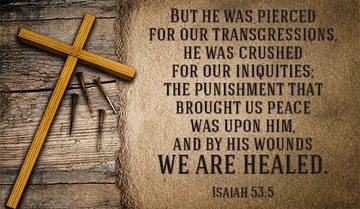
Isaiah 53:5
This chapter treats of the mean appearance of Christ in human nature, his sufferings in it, and the glory that should follow. It begins with a complaint of the small number of those that believed the report concerning him, the power of God not being exerted, Isa 53:1, the reason of this general disbelief was the meanness of his outward circumstances, and the want of comeliness in him; hence he was treated with general neglect and contempt, Isa 52:2,3 was the more unkind and ungenerous, since it was the griefs and sorrows of others he bore, and their sins also, for which he was wounded and bruised, that they might have healing, Isa 53:4-6, yet he took and bore all patiently, like a lamb at the slaughter, and the sheep under the shearer, Isa 53:7, which was the more extraordinary, since he was used, both in life and at death, in so rigorous and barbarous a manner, and all for the sins of others, having been guilty of none himself, Isa 53:8,9, and, what is most amazing, the Lord himself had a hand in grieving and bruising him, Isa 53:10, though for his encouragement, and a reward to him, as man and Mediator, for all his sufferings, it is intimated that he should succeed and prosper, have a numerous issue, should justify many, and have a portion and spoil divided with the great and mighty, Isa 53:10-12.
Our culture lionizes the powerful, the aggressive, and the bold. Meekness is mistaken for weakness, and silence under pressure is seen as defeat. But centuries before the cross, Isaiah described a Servant who would be despised, rejected, and silent—and through whose wounds we would be healed.Pastor Chuck Swindoll opens Isaiah 53:3–7 to show how Jesus fulfilled the portrait of the suffering Servant—the Lamb who went to slaughter in silence, bearing our griefs and carrying our sorrows as our substitute.Find your hope in the Lamb who was slain for you. True strength is not the absence of suffering but the willingness to bear it for others!
Our culture lionizes the powerful, the aggressive, and the bold. Meekness is mistaken for weakness, and silence under pressure is seen as defeat. But centuries before the cross, Isaiah described a Servant who would be despised, rejected, and silent—and through whose wounds we would be healed.Pastor Chuck Swindoll opens Isaiah 53:3–7 to show how Jesus fulfilled the portrait of the suffering Servant—the Lamb who went to slaughter in silence, bearing our griefs and carrying our sorrows as our substitute.Find your hope in the Lamb who was slain for you. True strength is not the absence of suffering but the willingness to bear it for others!
Our culture lionizes the powerful, the aggressive, and the bold. Meekness is mistaken for weakness, and silence under pressure is seen as defeat. But centuries before the cross, Isaiah described a Servant who would be despised, rejected, and silent—and through whose wounds we would be healed.Pastor Chuck Swindoll opens Isaiah 53:3–7 to show how Jesus fulfilled the portrait of the suffering Servant—the Lamb who went to slaughter in silence, bearing our griefs and carrying our sorrows as our substitute.Find your hope in the Lamb who was slain for you. True strength is not the absence of suffering but the willingness to bear it for others!
This feature is for PLUS subscribers only. Join PLUS today to access these tools and more.
JOIN PLUSThis feature is for PLUS subscribers only. Join PLUS today to access these tools and more.
JOIN PLUSThis feature is for PLUS subscribers only. Join PLUS today to access these tools and more.
JOIN PLUSCreate a free account to start a reading plan, or join PLUS to unlock our full suite of premium study tools.