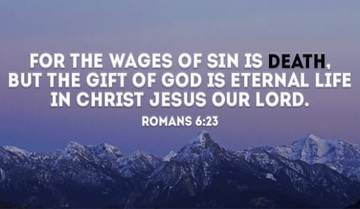
Romans 6:23
The Apostle having finished his design concerning the doctrine of justification, refutes the charge brought against it as a licentious doctrine, and prevents any ill use that might be made of it by men of evil minds, justified persons by the strongest arguments, and with the best of motives to holiness of life and conversation: he saw, that whereas he had affirmed in the preceding chapter, that sin being made to abound by the law, in the condemnation of sinners, the grace of God the more abounded in their justification and pardon; that some would rise up and object, that this doctrine countenances men's continuance in sin, and opens a door to all manner of iniquity; and that others would abuse this doctrine, and encourage themselves in a vicious course of life, upon this mistaken notion, that the grace of God would be the more illustrious by it; all which is suggested in Ro 6:1, to which an answer is returned in Ro 6:2, with an abhorrence of everything of this kind; and by an argument, showing the absurdity and inconsistency of it, seeing persons dead to sin, as justified ones are, cannot live in it: and that they are dead to sin, and under obligation to live unto righteousness, he argues from their baptism into Christ's death, which represents their being dead with Christ, and buried with him, Ro 6:3,4, and likewise the resurrection of Christ from the dead, and theirs by him, whereby they are both fitted and obliged to walk in newness of life; since they are, and should be like him, as in his death, so in his resurrection from the dead: and the rather, as they are implanted in him, as the branches in the vine, Ro 6:4,5, and especially as it was the great end of his death, that by the crucifixion of sin with him, it might so be destroyed, that his people should be no more servants to it, Ro 6:6, this being proved, that justified ones are dead to sin, the apostle argues upon it, that such are freed from sin, Ro 6:7, and therefore ought not, and cannot live in it; for this must be given into as an article of faith, that such as are dead with Christ live, and shall live a life of communion with him, Ro 6:8, which is inconsistent with living in sin: he further argues from the resurrection of Christ, which was not to die more, Ro 6:9, and suggests, that in like manner, those who have been dead and buried, and risen with him, which their baptism signifies, should not live in sin, which is no other than dying again; and to strengthen this, directs to the ends of Christ's death and resurrection, Ro 6:10, the end of the one being unto sin, to finish, make an end of that, and be the death of it, and the end of the other, being living unto God; wherefore in like manner, such who profess to be Christ's, to be justified by his righteousness, to be baptized into his death, and to be risen with him, should account themselves dead unto sin, and so not live in it, and alive to God through the righteousness of Christ, and so live to his honour and glory, Ro 6:11, and having thus answered the objection, and removed the calumny, and set this matter in a clear light, the apostle proceeds to dehort from sinning, and to exhort to holiness of life, Ro 6:12,13, in which he compares sin to a tyrant, the lusts of it to the laws of such an one, and which therefore should not be obeyed; and the rather, as the wages of them are death, and have made the body already mortal; wherefore the members of it should not be employed in such service, but in the service of God: and whereas it might be objected, that sin is too strong and prevalent, and has got the mastery, and will keep its power, the apostle declares it as a promise of grace, that sin shall not have the dominion, Ro 6:14, giving this as a reason, because such as are justified and sanctified, are not under the law, as a covenant of works, but under the covenant of grace, of which this promise is a part; and in order to prevent an ill use of this doctrine, and remove an objection that might be made, that if not under the law, men are under no restraints, but may go on in sin without control, he answers it with his usual detestation, Ro 6:15, and argues the folly and absurdity of living in sin upon such an account, because it would make them servants of sin unto death, Ro 6:16, and so they were before conversion, but now were otherwise, for, which they had reason to be thankful, Ro 6:17, since through the grace of God they had yielded an hearty obedience to the Gospel; wherefore to obey sin would be to return to their former state of bondage; whereas being freed from the power and dominion of sin, they were now the servants of righteousness, and ought to act becoming such a character, Ro 6:18, wherefore it was but acting the part of reasonable men, it was but their reasonable service, to yield themselves servants, not to sin and uncleanness, but to righteousness and holiness, Ro 6:19, in order to engage to which, the apostle puts them in mind of their former state; how that when they were in subjection to sin, they had nothing to do with the exercise of righteousness, Ro 6:20, and therefore as there was an alteration made in them, they ought to be just the reverse in their conduct and conversation; for he appeals to them, that they had no pleasure nor profit in their former course of life; which had brought upon them shame and confusion, and must have ended in death, had it not been for the grace of God, Ro 6:21, but now as they were delivered from the slavery and dominion of sin, they were under a better master, were servants to God; and the fruit of their service was holiness, and the issue of all would be everlasting life, Ro 6:22, which is illustrated by the contrary, Ro 6:23, the wages due from the service of sin, and which only could be expected from it, being death; whereas grace and holiness, the gift of God, issue in eternal life by Christ Jesus; in whose hands it is, and through whom it comes, and is enjoyed.

The Sanctification of the Believer Part 2 od 2

How is it that you would describe yourself? That is what are you? If you answer biblically, you would have to answer this way. I am a slave, that's for certain. The only thing that's in question is this, To whom are you a slave. And there's only two possibilities. You are either a slave to unrighteousness, which means your master is the devil or you are a slave to righteousness. And that means your master is Messiah, Yeshua, Jesus Christ. So ask yourself again, who do I belong to? Am I in a covenantal relationship with God through the perfect work of Messiah? Sure, that has redeemed me and caused me to be a new creation. Well take out your Bible, and look with me if you would to the book of Romans and chapter six, the book of Romans and chapter six. Now we see that Paul begins where we left off last week in verse 12. And he says, Therefore, now we have to ask ourselves, what has he just said in the previous verse, He's revealed something for one who's in that covenant or relationship that is a follower, a disciple, a believer in the gospel, he tells us and its command, he says, Consider yourself dead to sin, but made a life in and through Messiah Yeshua, whereby he now becomes the master of your life. To donate please visit us at: https://www.LoveIsrael.org/donate Checks may be sent to: LoveIsrael.org 6355 N Courtenay Parkway Merritt Island, FL 32953
The Sanctification of the Believer Part # 2 (1 of 2)
This feature is for PLUS subscribers only. Join PLUS today to access these tools and more.
JOIN PLUSThis feature is for PLUS subscribers only. Join PLUS today to access these tools and more.
JOIN PLUSThis feature is for PLUS subscribers only. Join PLUS today to access these tools and more.
JOIN PLUSCreate a free account to start a reading plan, or join PLUS to unlock our full suite of premium study tools.