Sunday School Lesson: Forgiveness
Share

Main Takeaway: We must affirm that sin requires repentance but remember that we all struggle with sin and need God’s gracious gift of forgiveness, which empowers us to forgive others.
Lesson Objective: Students will learn the basics of forgiveness, including the need to seek forgiveness for wronging others and to forgive offenders even if they never ask for it. They will also know the difference between forgiving people for their mistakes and giving unrepentant people endless opportunities to harm others.
Key Verse: If we confess our sins, he is faithful and just to forgive us our sins and to cleanse us from all unrighteousness. (1 John 1:9)
Introduction to Lesson on Forgiveness
We all know that we make mistakes, and if we grew up going to church, we know that the root of our problem is sin. Sins that we need God to forgive us of, and sins that we need to ask others to forgive us for if our sins hurt them.
However, the fact that we all know we need forgiveness does not mean we do not have misconceptions about it. We may have grown up thinking that forgiving others means giving them freedom to harm us all the time, when the Bible offers a more nuanced vision that affirms there are consequences to unrepentance. We may wonder what is the harm of withholding forgiveness, when the Bible affirms there are many consequences when we refuse to give others the forgiveness that God has so freely given us.
Today, let’s take a careful look at what forgiveness is, what it is not, and why it is so relevant to our lives.
Biblical Context for Forgiveness
The Bible speaks about forgiveness in many verses. In fact, the whole Bible may be seen as a guide to forgiveness, which makes it impossible to list every Bible passage about it. However, we can summarize a few clear principles that pop up again and again.
1. First, the Bible is clear that we all need forgiveness because we are all sinners (Romans 3:23). We can try to be perfect all we want, but we all have sinful natures that lead us to commit flawed actions against God and others. The Apostle Paul describes sin as a form of slavery we cannot escape on our own, no matter how holy we try to be (Romans 7:14).
2. Second, the Bible is clear that if we have sinned against others, we should admit our sins to those we offended and seek their forgiveness (Acts 3:19, Matthew 5:23-24). If we are saved in Christ, we know that our sins are forgiven (Ephesians 4:32), no matter whether we see others’ forgiveness or not. But if we seek to be Christlike and to be good witnesses, we will strive to treat others well and make peace with those we have hurt.
3. Third, the Bible affirms that even if people do not apologize for their sins, we are still called to forgive them (Luke 17:3-4). In fact, we are warned that we will not be forgiven if we do not forgive others (Matthew 6:14-15). Lori Hatcher observes that we are also warned in Psalm 66:18 that cherishing sin in our hearts affects how God listens to our prayers. We are also encouraged to avoid bitterness (Ephesians 4:31, Leviticus 19:18).
4. Fourth, the Bible never promises that the process of forgiving others won't be difficult or require something of us. Jesus’ instruction to forgive many times (Matthew 18:21-22) affirms that we will need to forgive others often and sometimes repeatedly. Stories like Joseph’s brothers asking for forgiveness again, years after reconciling with him (Genesis 50:15-21) remind us that pain often lasts long after we have said, “I forgive you.” Because people often cause deep pain with long-lasting consequences, we often find we have to forgive someone regularly.
Fifth, the Bible tells us that we do not forgive out of our own strength, but because we were forgiven ourselves. Verses like Ephesians 4:32 and Colossians 3:13 affirm that we should forgive each other because God forgave us freely through Christ. Verses like Ephesians 1:7 remind us that Christ gives us the strength to forgive and to forgive well.
But as important as it is to remember our call to forgive others, it is equally important that we know forgiveness is not the same thing as letting people abuse us freely.
The Difference Between Forgiveness and Pardon
Forgiveness can be a tough topic for people who grew up in abusive homes or have experienced betrayal by others because they have often seen the phrase being misused. People who hurt others routinely often misquote Bible verses about forgiveness, using them as an excuse to escape consequences for their actions.
Although the Bible makes it clear that, in Christ, our sins are forgiven and that we should always practice mercy toward others, it is also careful not to describe forgiveness as blanket permission to abuse trust. In Matthew 18:15-17, Jesus affirms Christians should experience consequences for not turning from sin. He instructs people that if a fellow Christian is behaving poorly, to talk to them kindly once in private, once in front of a trusted friend, and once in front of Christian community. If the offender never admits mistakes, Jesus says to treat them like “a Gentile or tax collector.” For context, Jewish tax collectors were seen as people who had turned their back on God, because their job (working for ceremonially unclean Romans, helping an invading force dominate God’s chosen people) was seen as betraying their heritage.
New Testament leaders like Paul talk bluntly about how Christians should be expected to model Christlike behavior and experience consequences if they sin and refuse to change. He writes that Christians should not judge non-Christians around them, but they do have the right to call out unrepentant behavior in their churches (1 Corinthians 5:5). In cases where someone claiming to be a Christian refuses to turn from blatantly sinful behavior, Christians even have permission to refuse that person access to their church until they change (1 Corinthians 5:12-13). We need to be discerning before we practice this principle, remembering that we should only “hand someone over to Satan” (in Paul’s words) as a last resort, grieving their behavior and praying for them to return to the church someday.
Given this context, we may say that forgiveness means we refuse to hold onto bitterness, that we pray for people to change and offer them chances to show they have changed, while remembering that forgiveness never means letting abuse run free. People’s choices have consequences. When they break trust by hurting others, they need to regain trust before the relationship can be restored. This is especially true if someone wants to hold an authority position, like a teacher (James 3:1) or a church elder (1 Timothy 3:1-7, Titus 1:6-9). Jesus’ constant rebukes to the Pharisees keep coming back to the fact that they are learned enough to know how to be wise teachers, and choose to be corrupt instead.
But we also see stories about people like Paul, a former Pharisee who admitted he was often arrogant and cruel (Acts 23:6, Philippians 3:5). The fact that someone like Paul can become a Christian highlights that there is always forgiveness for those who turn away from sin.
Activity Ideas for Lesson on Forgiveness
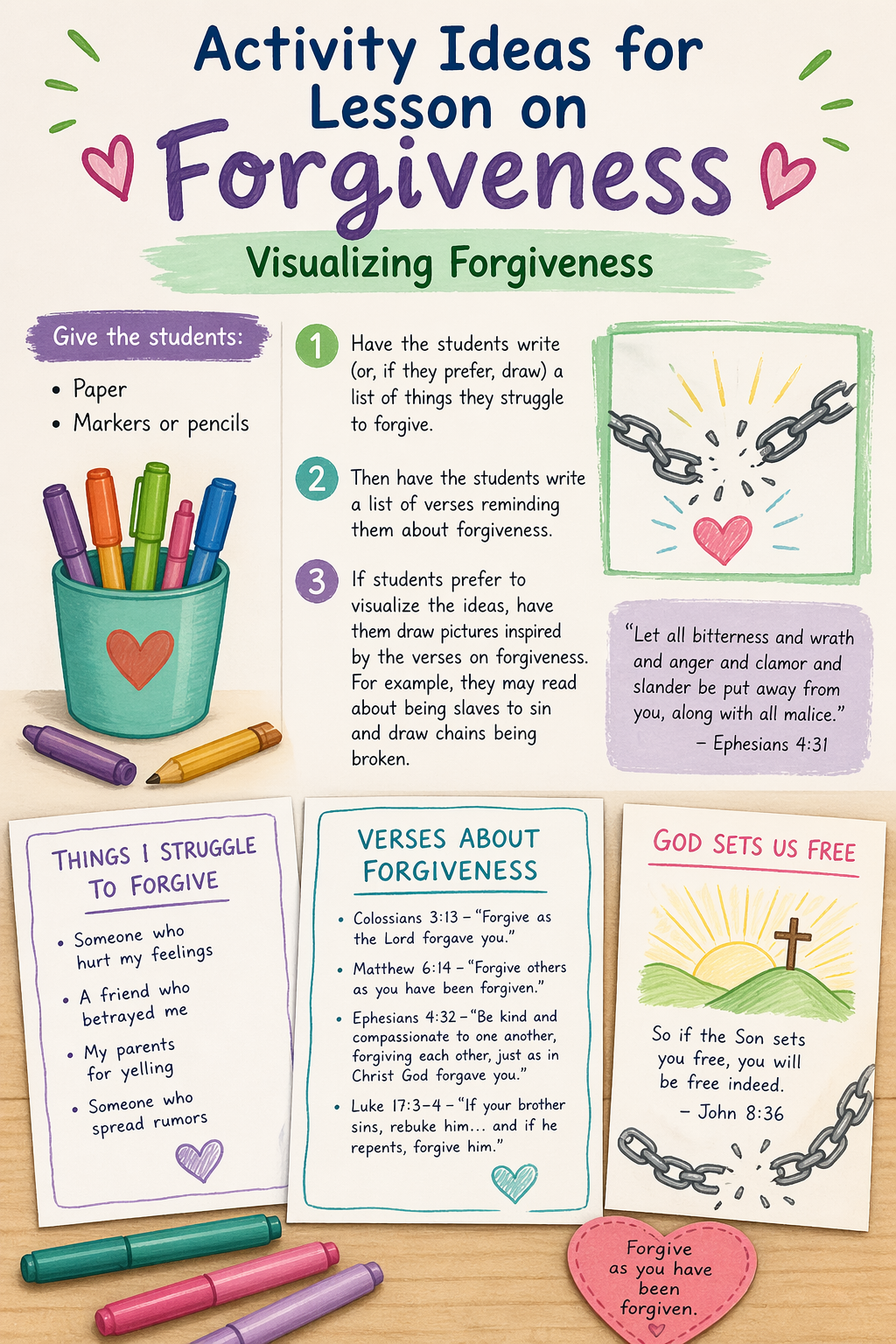
Visualizing Forgiveness
Give the students:
- Paper
- Markers or pencils
Have the students write (or, if they prefer, draw) a list of things they struggle to forgive.
Then have the students write a list of verses reminding them about forgiveness.
If students prefer to visualize the ideas, have them draw pictures inspired by the verses on forgiveness. For example, they may read about being slaves to sin and draw chains being broken.
Prayers of Forgiveness for Sunday School
Prayer for seeking forgiveness:
Jesus,
I have made poor choices and hurt others. I ask for your forgiveness for my mistakes. Help me to learn from my mistakes and give me the bravery to admit those actions, asking others for their forgiveness.
Amen
Prayer for extending forgiveness:
Jesus,
Today I am struggling to forgive others as you have forgiven me. Help me to have your heart for others, to see how you crafted each person and love them even when I struggle to love them. Show me how to forgive each day so I do not fall prey to bitterness. Show me how to love my offenders as well as forgive them, and pray for their wellbeing.
Amen.
Photo credit: Shutterstock/fizkes