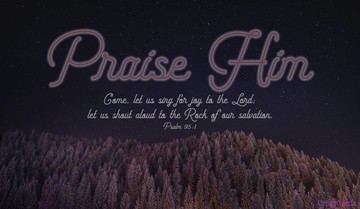
Praise Him
O come, let us sing unto the Lord
To Jehovah the Messiah, the Lord our righteousness; setting forth, in songs of praise, the glory of his person, the riches of his grace, and our thankfulness to him for spiritual mercies by him: Christ is to be the subject of our spiritual songs, and is the person to whose honour and glory they should be directed: in the New Testament we are instructed to sing unto the Lord, the Lord Christ, ( Ephesians 5:19 ) ( Colossians 3:16 ) , and this is what Pliny F1 tells Trajan, the Roman emperor, the Christians in his time did; they sung a hymn to Christ, as to a God:
let us make a joyful noise to the Rock of our salvation;
to Christ, the Rock, ( 1 Corinthians 10:4 ) , a Rock, for height, being higher than the saints, than the kings of the earth, than the angels in heaven, than the heavens themselves; for strength, being the mighty God, and mighty Saviour; for shelter, being the saints security from avenging justice and wrath to come: a Rock, on which the church and all believers are built, and which endures for ever; "the Rock of salvation", being the author of spiritual and eternal salvation, and the strength and security of it; not only is he strong to do it, but, being done by him, it is safe in him; wherefore shouts of joy and songs of praise are due unto him. This shows that vocal singing is meant, singing with an harmonious and musical voice; and that social singing, or singing in concert together, is intended. The Septuagint renders it, "to God our Saviour", ( Luke 1:47 ) ( Jude 1:25 ) .
This feature is for PLUS subscribers only. Join PLUS today to access these tools and more.
JOIN PLUSThis feature is for PLUS subscribers only. Join PLUS today to access these tools and more.
JOIN PLUSThis feature is for PLUS subscribers only. Join PLUS today to access these tools and more.
JOIN PLUSCreate a free account to start a reading plan, or join PLUS to unlock our full suite of premium study tools.