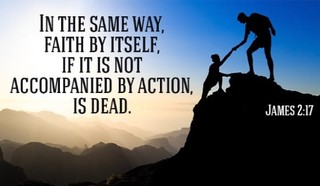
James 2:17
In this chapter the apostle dissuades from a respect of persons, on account of outward circumstances; shows that the law is to be fulfilled, and that mercy is to be exercised, as well as justice done; and exposes the folly of such who boast of faith without works: he dissuades the saints from all partiality to the rich and poor, from their relation to one another, as brethren, and from their common faith, of which Christ, the Lord of glory, is the object, Jas 2:1 supposes an instance of it, either in a court of judicature, or a religious assembly, Jas 2:2,3 and then makes an appeal unto them, and expostulates with them about it, Jas 2:4 and makes use of an argument against it, taken from the divine conduct, and an instance of his grace in the choice of persons to eternal life, Jas 2:5 a conduct very different from some persons here blamed, Jas 2:6, and other arguments follow, dissuading from a respect of persons, taken from the characters of rich men, as oppressors of the poor, litigious and quarrelsome with their neighbours, and blasphemers of the name of God, Jas 2:7 and from the law of God, which requires the love of the neighbour, and which to fulfil is to do well, Jas 2:8 and from the breach of it, by having respect to persons, whereby its penalty is incurred, Jas 2:9 for which a reason is given; because whoever offends in one point of the law, is guilty of the whole, Jas 2:10 as is a clear case, since the same lawgiver that forbids one sin, forbids another; so that he that is guilty of either of them is a transgressor of the law, Jas 2:11 wherefore it is right both to speak and act according to it, since men will be judged by it, Jas 2:12 and he will have no mercy shown him that has shown none to the poor, but merciful ones will escape damnation, Jas 2:13 and then the apostle argues from the unprofitableness of faith itself without works, Jas 2:14 and which he exemplifies in the case of a poor brother or sister who are wished well, but nothing given them; which good words, without deeds, are of no profit, Jas 2:15,16 so in like manner, faith without works is a dead faith, Jas 2:17 nor indeed can it be made out that a man has faith, if he has not works, Jas 2:18 at least such a faith as has justification and salvation connected with it; his faith, at most, is no better than that of the devils, who are damned, Jas 2:19 and that such a faith is a dead faith, Jas 2:2 and that true faith is attended with, and evidenced by works, the apostle proves by two instances; the one is that of Abraham, whose faith appeared to be genuine, and he to be a justified person, by the works he did; particularly by offering up his son Isaac; in which way his faith operated, and showed itself to be sincere and hearty; and the Scripture was fulfilled that Abraham was a believer; and had righteousness imputed to him, and was a friend of God, and a justified person, Jas 2:21-24 and the other instance is that of Rahab, whose faith was also shown by her works, and so a justified person, by receiving the spies with peace, and dismissing them with safety, Jas 2:25, and then the apostle explains what he means, by saying more than once, that faith without works is dead; which he illustrates by the simile of a man's body being dead, without the spirit or soul in it, Jas 2:26.

There are some who say they have faith and others that feel they have faith but then there are those who show their faith. Which one saves? Keep that question in the back of your mind and join us for a Daily Walk with pastor John Randall. We continue in our study verse by verse through the New Testament book of James. It’s there that we’re given insight into what saving faith is and the role of works. And you’re about to see some real living examples from the Old Testament.
We continue in the book of James today with pastor John Randall. Chapter two speaks of faith and works! There’s a long-standing debate of which wars were fought over. It concerns what is saving faith and the role of works in our salvation. Our teacher pastor John enters into this discussion now in part one of Faith that Works!

So you say you have faith and belief in God, that’s great! But today on Light on the Hill we’ll discover that our actions demonstrate if the faith is real or not. In other words if you claim to have faith but your works do not accompany that, your faith is useless and dead.
We continue in the book of James here today on Light on the Hill. Chapter two speaks of faith and works! There’s a long-standing debate which you might be familiar with to some degree. It concerns what is saving faith and the role of works in our salvation. Are we saved by doing good works as some would have you believe? Are we truly born again if we’re not moved to action and live out our faith? Our teacher pastor James Kaddis will help us answer these critical questions right now!
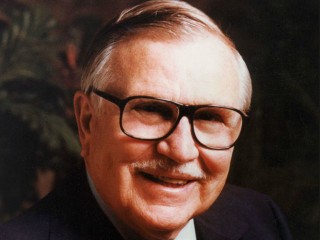
Some critics of the Bible say it contradicts itself, and they point to Paul’s letter to the Romans and the book of James as proof. Dr. J. Vernon McGee explains this apparent contradiction and clarifies how James and Paul really don’t disagree at all.
So you say you have faith and belief in God, that’s great! But today on Light on the Hill we’ll discover that our actions demonstrate if the faith is real or not. In other words if you claim to have faith but your works do not accompany that, your faith is useless and dead. We’ve heard it said, “put your money where your mouth is,” but if you can’t do that, then your words become meaningless and a real change needs to happen.
This feature is for PLUS subscribers only. Join PLUS today to access these tools and more.
JOIN PLUSThis feature is for PLUS subscribers only. Join PLUS today to access these tools and more.
JOIN PLUSThis feature is for PLUS subscribers only. Join PLUS today to access these tools and more.
JOIN PLUSCreate a free account to start a reading plan, or join PLUS to unlock our full suite of premium study tools.