How to Use a Bible Commentary
Share

Bible study is many things: a blessing, instructive, calming, fascinating, exciting, even daunting. What God means for us as we read and study His Word is to know who He is and to know His Son, Jesus Christ and His matchless grace.
Along with that grace and knowledge comes the history of God’s creation and His redemptive history throughout the Old and New Testaments. But we often need help from the scholars who have taken much time and study to bring us Bible commentaries. We, however, have to learn how to use Bible commentaries.
By way of explanation, Bible study should bring us growth in the grace and knowledge of Jesus Christ (2 Peter 3:18). Bible study is one of the ordinary means of God’s grace we treasure within the church and as we live our lives as Christians. Nine Marks explains the word ordinary means, “the divinely ordained, routine methods God uses to communicate the benefits of redemption, nourish faith, and build up the church.”
Understanding God’s Word takes more than just reading through it or even reading a devotional about it. We need to dig in to the Word and see the proper interpretation of what we are examining. And we must remember, there is only one correct interpretation of Scripture. There’s a lot to know about Scripture — much more than we can sort through by ourselves.
What Is a Bible Commentary?
According to Logos, “Bible commentaries contain observations and interpretations surrounding a biblical text, typically organized according to the text’s sequential flow. Many times, commentaries cover a single book of the Bible, but sometimes they focus on a particular section (e.g., the Sermon on the Mount) or they include several books of the same genre (e.g., the Minor Prophets).”
In addition to physical commentaries, you can find many if not all online. You can also regard your pastor as a living, breathing Bible commentary because he expounds the Word of God every time he teaches the church.
Should I Use a Bible Commentary?
Pastors use commentaries all the time to aid their studies and to check if what they are seeing is correct. If they come up with an interpretation or doctrine that hasn’t been discovered before, it’s probably wrong. As the saying goes, “If it’s new, it ain’t true.”
We can say that because for a few thousand years, biblical scholars have been studying the Bible. They’ve plumbed its depths as far as the Spirit allows. We can securely “rest on the shoulders” of the saints and scholars who have gone before and have shared timeless and correct interpretation of Scripture. The confessions and creeds of the faith are a good starting place from which to embark on deep Bible study.
If you take a look at the bibliography of most reputable commentaries, you will find extensive indices of Scripture, contributors, and other commentaries, as well as ancient writings. The listing of other commentaries often ranges in the hundreds, and it’s worthwhile to look into the sources noted and used by that commentary’s author.
How Do I Use a Bible Commentary?
A commentary is organized systematically to cover as much of that section of the Bible as possible. Some commentaries deal with just one book. Some cover the entire Bible. Don’t let the size of a commentary discourage or overwhelm you. Remember that old saying: “How do you eat an elephant? One bite at a time.”
You will find commentaries on:
- Topics dealing with emotions (anxiety, grief, joy, etc.)
- Topics such as the attributes of God, finding the gospel in the Old Testament, Jesus throughout the whole Bible, and others
- Individual books of the Bible
- Genres in the Bible (history, poetry, gospels, etc.)
- The whole Bible
- The Old Testament
- The New Testament
- Systematic Theology (Christian doctrine placed in a logical order, e.g., God, Jesus Christ, the Holy Spirit, etc.)
As you study, choose a few that encompass the passage(s) with which you need help.
Our first and most important stop as Christians is always prayer. Ask the Lord to give you understanding of what you are studying. And as you pray, thank the Lord for His Word, and for the men (pastors and elders) He has called to explain it to the church (2 Timothy 1:3).
Glean as much information from the biblical text as you can using good hermeneutics (the art and science of biblical interpretation). Take good notes and look for as many cross-references as possible (other places in the Bible that have to do with the verses you are studying).
When you are at the point where you start scratching your head, make some more thorough notes with the questions you have regarding the text. Grab a bunch of commentaries and compare what each author has to say on the passage you are studying. Commentaries include chapters that cover specific portions of Scripture. They also have a large index with Scripture verses.
Look up the cross-referenced passages they mention. This is a great way to see how the Bible is the best interpreter of itself.
Once you come to a consensus conclusion about the passage, ask your pastor (or another elder) their thoughts about the passage and about what you have learned from the commentaries you’ve studied.
The Bible Study Tools website offers a wide range of Bible commentaries, including the ESV Study Bible and those written by John Calvin, Matthew Henry, Charles Spurgeon, and C.I. Scofield. Take a look at our list and see which commentary will best help you dive deeper into the Word of God.
3 Closing Tips to Make the Most of Your Study
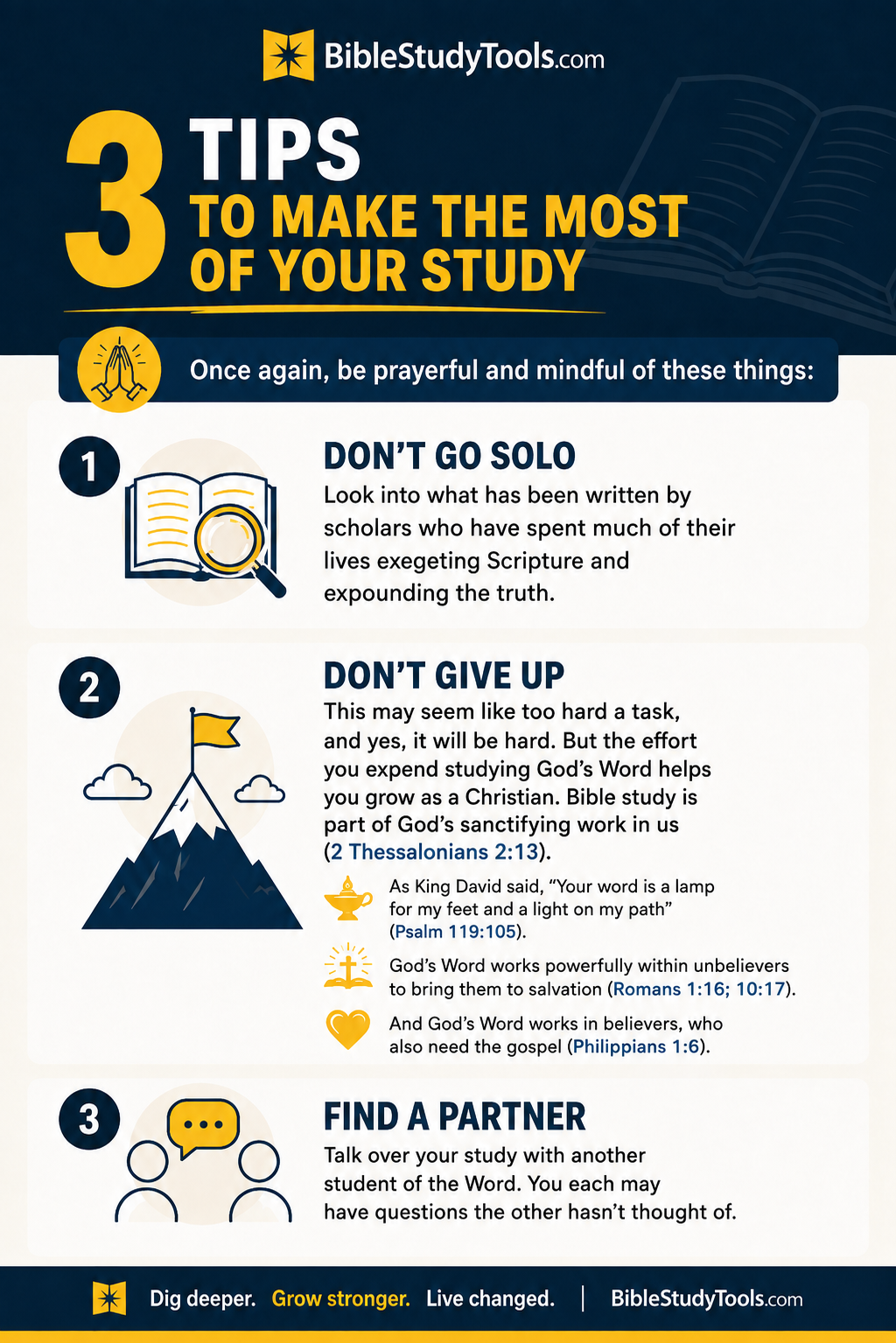
Once again, be prayerful and mindful of these things:
1. Don’t Go Solo
Look into what has been written by scholars who have spent much of their lives exegeting Scripture and expounding the truth.
2. Don’t Give Up
This may seem like too hard a task, and yes, it will be hard. But the effort you expend studying God’s Word helps you grow as a Christian. Bible study is part of God’s sanctifying work in us (2 Thessalonians 2:13). As King David said, "Your word is a lamp for my feet and a light on my path” (Psalm 119:105). God’s Word works powerfully within unbelievers to bring them to salvation (Romans 1:16; 10:17). And God’s Word works in believers, who also need the gospel (Philippians 1:6).
3. Find a Partner
Talk over your study with another student of the Word. You each may have questions the other hasn’t thought of.
Once you open a hefty Bible commentary, my prayer is you will get pure delight from digging deeper into God’s Word. I pray what you learn will give you greater love for our Savior and Lord, Jesus Christ. I also pray you don’t stop at one study, but continue for the rest of the days the Lord gives you here on earth. God bless you.
Photo credit: ©Getty Images/Traitov