What Is a Parallel Bible? How Do You Use One?
Share

Bible study can be daunting, yet it is very fruitful and edifying for Christians. One of the tools we can use when digging deeper into Scripture is a parallel Bible. A parallel Bible provides you with multiple translations in a side-by-side manner for comparison and further clarification of verses and passages.
The translations found in parallel Bibles don’t aim to compete with each other or seek to render a completely different meaning of the text. What they do is bring further illumination to the reader so the text makes as much sense as possible (short of knowing and reading the original languages - Hebrew, Aramaic, and Greek).
When undertaking a study of the bible, always remember this idiom: context rules. What I mean is that we must use good hermeneutics (the study of interpretation) when studying the Bible. No one word, sentence, or phrase will give us the correct meaning of itself by studying just its parts. We must investigate the immediate context and then the context of the chapter, book, testament, and whole Bible. When we scope out the meaning of the entire Bible, we see it unfolds God’s great, unthwartable plan of redemption through the Lord Jesus Christ. All Scripture points to Him (Luke 24:27).
How Do I Use a Parallel Bible?
Parallel Bibles can open a whole world of biblical knowledge to us as we delve into them. We can compare just two Bible translations or we can compare almost every available Bible translation in circulation. A good comparison would be to see the different version types side-by-side. Parallel Bibles serve that purpose.
For our example, we will use two Bible translations—the CSB and the NIV.
The CSB, (Christian Standard Bible) is a medium difficulty formal equivalence translation (along with the KJV, NKJV, and NASB) which balances literal accuracy with everyday readability. The CSB editors state, “The CSB was created using optimal equivalence, a translation philosophy that pursues both linguistic precision to the original languages and readability in contemporary English.”
The NIV (New International Version) is a very popular dynamic equivalence (aka functional) translation that conveys the meaning of the text via the thoughts/ideas it conveys rather than the more formal word-for-word. The NIV intention is to maintain the original intent and context using a more readable text.
Let's walk through an example together.
- Open your online parallel Bible (like this one available from Bible Study Tools).
- A search bar exists under the video on that page where you can enter the verse you’d like to study.
- Type: John 3:16
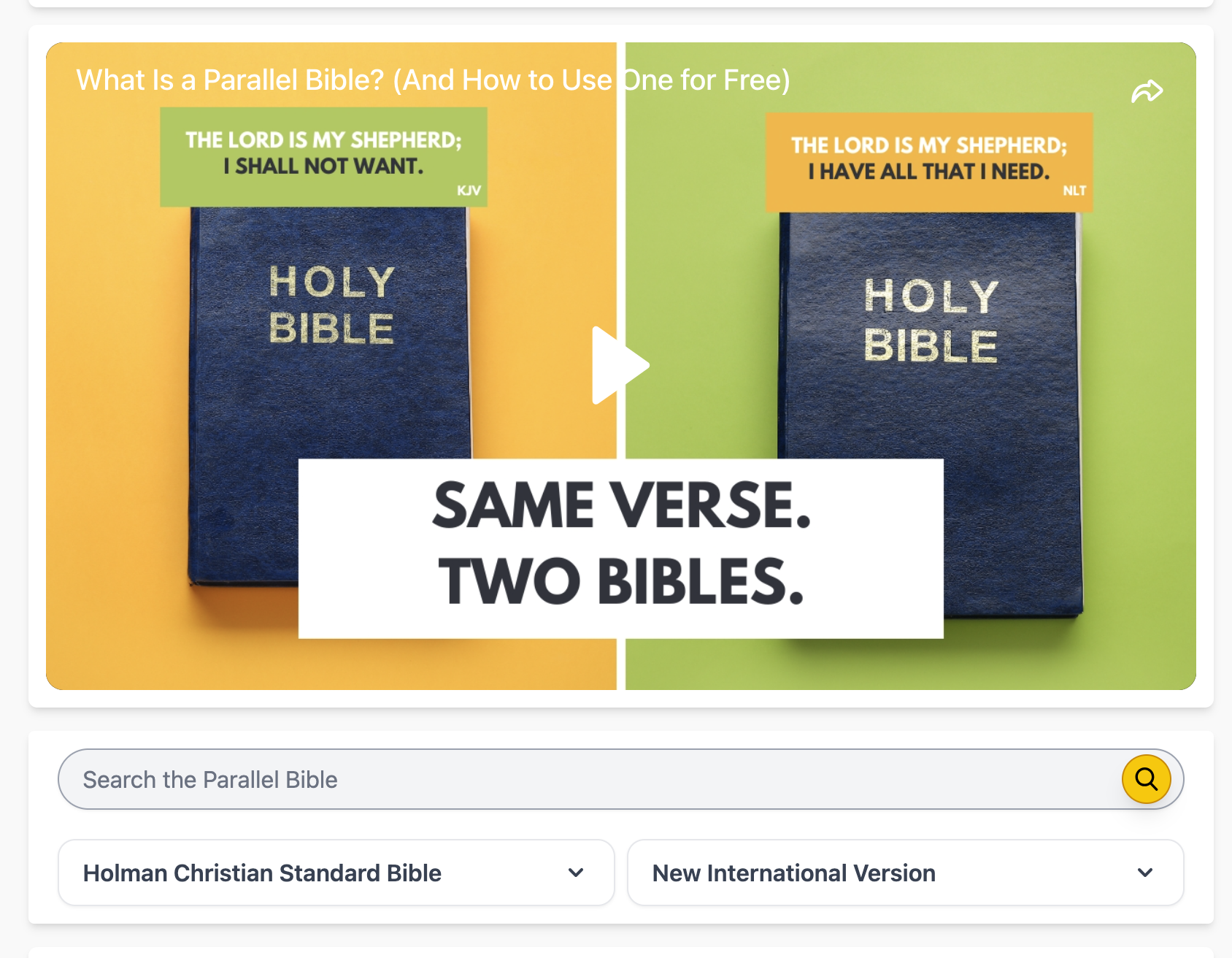
- Under the verse choice are two side-by-side tabs to enter the translations you’d like to compare.
- Click on the first tab and click CSB in the pop-up.
- Do the same on the right tab and click NIV in the pop-up.
- Click the search icon.
- The verse appears under the versions you have chosen.
The CSB translation reads:
"For God loved the world in this way: He gave His One and Only Son, so that everyone who believes in Him will not perish but have eternal life.”
The NIV translation reads:
“For God so loved the world that he gave his one and only Son, that whoever believes in him shall not perish but have eternal life.”
As you compare them, you’ll see the differences are minimal. And both the CSB (on BibleStudyTools.com, it’s the HCSB) and the NIV tell us the same truth about God loving us and sending His Son so that whoever (everyone who) believes in Him won’t perish but will have eternal life.
Looking back at the parallel Bible, we can expand the search to include all Bible translations available on BibleStudyTools.com. Try that and see if you glean any further clarification of the text; e.g., why does the NIV say whoever and the CSB say everyone?
Looking further at the expansion of all the translations, we see the following:
The NASB, NKJV, and Darby say, “only begotten Son.”
The Complete Jewish Bible reads, “For God so loved the world that he gave his only and unique Son, so that everyone who trusts in him may have eternal life, instead of being utterly destroyed.”
Here we get extra insight into what “perish” means—“utterly destroyed.”
Other Helpful Bible Study Tools and Resources
You can see from this short yet substantive verse that it's helpful to use more than one resource for studying the Bible. How did the translators arrive at "perish" and "utterly destroyed"? This is where the other free study tools available on Biblestudytools.com will help you better understand why John 3:16 declares that those who believe in Jesus will have eternal life, while it implies that those who don’t believe will perish (be utterly destroyed). Since the Bible is the best interpreter of itself, the next tool to use to find out where this truth comes from in the Bible is a cross references found alongside Scripture passages. Looking at John 3:16, we see in the Treasury of Scripture Knowledge many references attached to the major words within the verse.
- God
Luke 2:14; Romans 5:8; 2 Corinthians 5:19-21; Titus 3:4; 1 John 4:9 1 John 4:10 1 John 4:19
- gave
John 1:14 John 1:18 Genesis 22:12; Mark 12:6; Romans 5:10; 8:32
- that whosoever
John 3:15; Matthew 9:13; 1 Timothy 1:15 1 Timothy 1:16
Since we don’t have a link in the resource for the word perish, we can look it up in the CSB concordance:
Perish
- If I perish, I perish – Esther 4:16
- one of these little ones perish – Matthew 18:14
- in Him will not perish but have – John 3:16
- Don’t work for the food that perishes – John 6:27
- and they will never perish – John 10:28
- foolishness to those who are perishing – 1 Corinthians 1:18
- not wanting any to perish but all to – 1 Peter 3:9
As you can guess, one form of Bible study aid isn’t sufficient to supply complete knowledge of a verse or passage. You start with your own reading of Scripture, then branch into the many Bible study tools available to help you understand God’s Word better. Remember to always start with prayer and ask the Lord for wisdom as you pray. He never fails to bless us with wisdom when we ask in faith (James 1:5-6).
Parallel Bibles have a host of companions to help you get the most out of your Scriptural studies. Bible study may also involve using:
- a concordance
- an interlinear Bible
- a topical Bible
- commentaries by biblical scholars
- Bible dictionaries
- lexicons
There is no shortage of tools to help you enjoy God’s Word to its fullest as you grow in the grace and knowledge of the Lord Jesus (2 Peter 3:18).
Two other suggestions:
- Ask your pastor if he has preached on the passage you plan to study. He can help steer you. The sermon may also have been streamed and archived, so you may be able to listen and take notes.
- Read the Confessions of the faith to see how your topic is explained.
I pray much fruit for you as you delve into the fascinating world of studying God’s Word.
Reformation Monk Martin Luther said, "I study my Bible as I gather apples. First, I shake the whole tree that the ripest might fall. Then I shake each limb, and when I have shaken each limb, I shake each branch and every twig. Then I look under every leaf.”
May we do the same!
Photo Credit: ©iStock/Getty Images Plus/Khaosai Wongnatthakan