


Loading...

Change Translation

Loading...
  • Recent Translations
  • All Translations

Psalm 16

Listen to Psalm 16
1 Keep me, O Lord; for I have hoped in thee.
2 I said to the Lord, Thou art my Lord; for thou has no need of my goodness.
3 On behalf of the saints that are in his land, he has magnified all his pleasure in them.
4 Their weaknesses have been multiplied; afterward they hasted. I will by no means assemble their bloody meetings, neither will I make mention of their names with my lips.
5 The Lord is the portion of mine inheritance and of my cup: thou art he that restores my inheritance to me.
6 The lines have fallen to me in the best places, yea, I have a most excellent heritage.
7 I will bless the Lord who has instructed me; my reins too have chastened me even till night.
8 I foresaw the Lord always before my face; for he is on my right hand, that I should not be moved.
9 Therefore my heart rejoiced an my tongue exulted; moreover also my flesh shall rest in hope:
10 because thou wilt not leave my soul in hell, neither wilt thou suffer thine Holy One to see corruption.
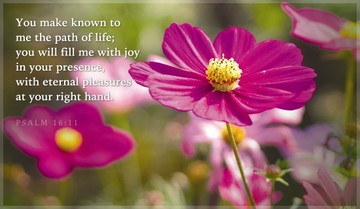
11 Thou hast made known to me the ways of life; thou wilt fill me with joy with thy countenance: at thy right hand there are delights for ever.

Images for Psalm 16

Psalm 16 Meaning and Commentary

Michtam of David. This is a new title, not met with before, though it afterwards is prefixed to "five" psalms running, the fifty sixth, the fifty seventh, the fifty eighth, the fifty ninth, and the sixtieth psalms. Some take the word "michtam" to be the name of a musical instrument, as Kimchi on Psalm 4:1; others the name of one of the tunes, as Jarchi; and others the tune of a song which began with this word, as Aben Ezra observes, to which this psalm was sung; the Septuagint translate it "stelography," or an inscription upon a pillar; such an one as is erected by conquerors, as Theodoret observes, having writing on it declaring the victory obtained; suggesting that the psalm, or the subject of it, the death and resurrection of Christ, was worthy to be inscribed on a pillar of marble; and the Targum renders it, "a right engraving," that deserves to be engraven in a monument of brass: but what seems to be the best sense of the word is, that it signifies a work of gold, and may be rendered, "a golden [psalm] of David"; so called, either because it was a dear and favourite song of his; or from the subject matter, which is more valuable and precious than the most fine gold: the title of it in the Syriac and Arabic versions is, "concerning the election of the church, and the resurrection of Christ;" and certain it is from Psalm 16:10, the resurrection of Christ is spoken of in it, as is clear from the testimonies of two apostles, Peter and Paul, who cite it in proof of it, Acts 2:25; and since there is but one person speaking throughout the psalm, and Christ is he that speaks in Psalm 16:10, and which cannot be understood of David, nor of any other person but Christ, the whole of the psalm must be interpreted of him.
Unlock Deeper Insights: Get Over 20 Commentaries with Plus! Subscribe Now

The Brenton translation of the Septuagint is in the public domain.

Study Tools

PLUS

Unlock Notes

This feature is for PLUS subscribers only. Join PLUS today to access these tools and more.

JOIN PLUS

Unlock Highlights

This feature is for PLUS subscribers only. Join PLUS today to access these tools and more.

JOIN PLUS

Unlock Bookmarks

This feature is for PLUS subscribers only. Join PLUS today to access these tools and more.

JOIN PLUS

Track Your Reading

Create a free account to start a reading plan, or join PLUS to unlock our full suite of premium study tools.

Already have an account? Sign in