The Bible Story of King Saul
Share

Height or Heart
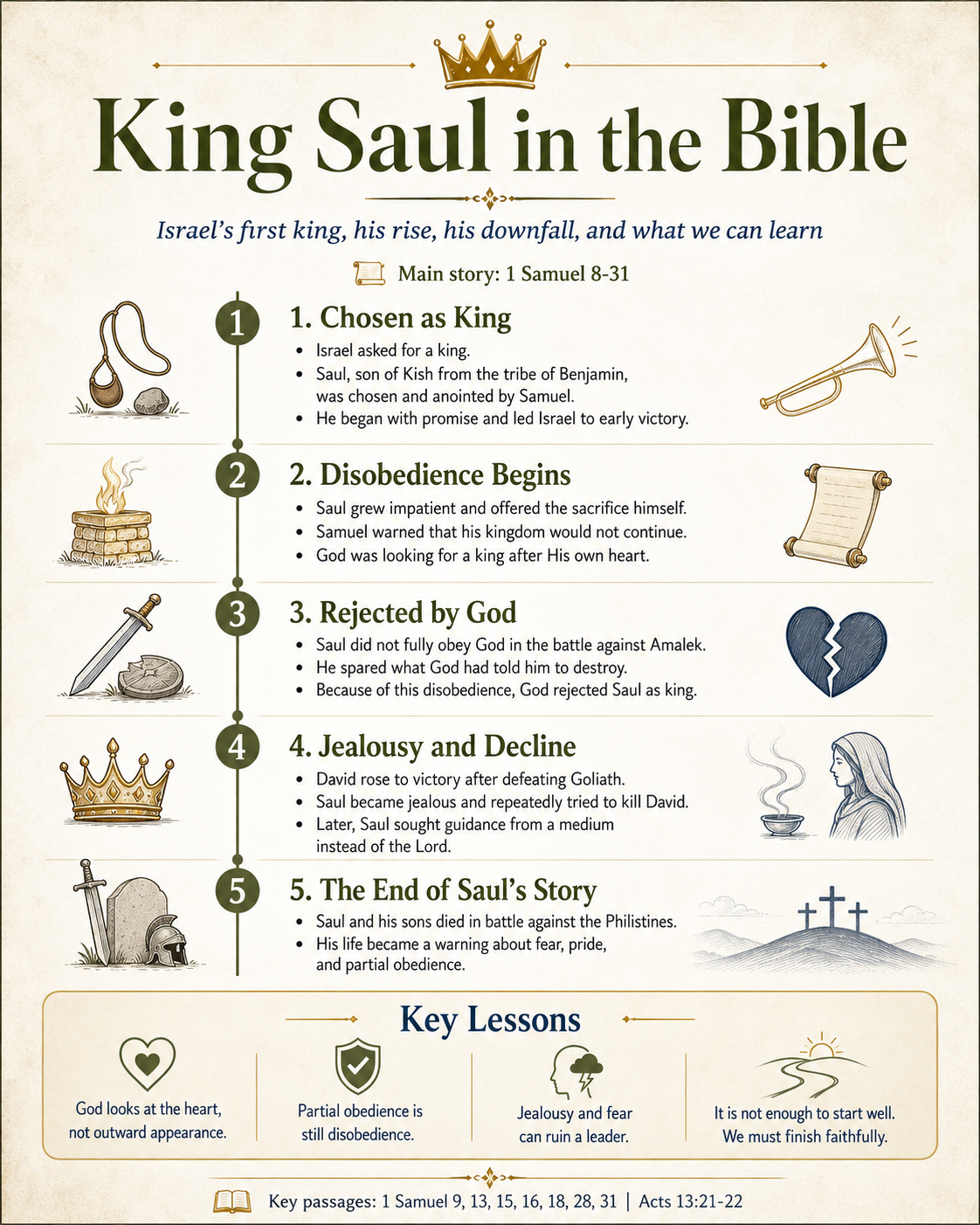
The Bible story of King Saul, Israel’s first king, is not one of glory but of human frailty and choices that end in tragedy. From his appearance, the people saw in Saul the early promise of greatness, but his height and handsome looks (1 Samuel 9:2) could not overcome the cost of his progressive disobedience.
Saul’s life demonstrates how important it is, in the God-following life, to not only start well but also to finish strong. His story also illustrates God’s warning to Samual in choosing Saul’s successor, “But the Lord said to Samuel, ‘Do not look on his appearance or on the height of his stature, because I have rejected him. For the Lord sees not as man sees: man looks on the outward appearance, but the Lord looks on the heart’” (1 Samuel 16:7).
Summing Up Saul’s Story
Most of Saul’s story is contained in the Old Testament, specifically 1 Samuel 8-31, but two other passages contain concise summaries of Saul’s beginning and end.
- 1 Chronicles 10:13–14 ESV, “So Saul died for his breach of faith. He broke faith with the Lord in that he did not keep the command of the Lord, and also consulted a medium, seeking guidance. He did not seek guidance from the Lord. Therefore the Lord put him to death and turned the kingdom over to David the son of Jesse.”
- Acts 13:21-22 ESV, “Then they [the Israelites] asked for a king, and God gave them Saul the son of Kish, a man of the tribe of Benjamin, for forty years. And when he had removed him, he raised up David to be their king, of whom he testified and said, ‘I have found in David the son of Jesse a man after my heart, who will do all my will.’”
Disobedience to Disobedience
The disobedience marking Saul’s reign didn’t begin with him but originated with God’s people. God had delivered Israel from Egypt and through the Wilderness. Then, He brought them into the Promised Land through Joshua’s leadership, a series of judges, and finally through the prophet Samuel. Still, Israel demanded a king.
Samuel tried to reason with the people about their unique situation, but they wouldn’t heed his warnings about the peril of human kings. Samuel turned to the Lord. “And the Lord said to Samuel, 'Obey the voice of the people in all that they say to you, for they have not rejected you, but they have rejected me from being king over them.' According to all the deeds that they have done, from the day I brought them up out of Egypt even to this day, forsaking me and serving other gods, so they are also doing to you. Now then, obey their voice; only you shall solemnly warn them and show them the ways of the king who shall reign over them” (1 Samuel 8:7-9) ESV.
Through a human task (Saul’s father, Kish, sending him to search for lost donkeys) and God’s divine appointment, Saul met Samuel, who recognized him as the man God chose as Israel’s first king (1 Samuel 9). Samuel instructed Saul that he would also receive a sign when he encountered a group of prophets, “Then the Spirit of the Lord will rush upon you, and you will prophesy with them and be turned into another man” (1 Samuel 10:6).
Samuel called the people together at Mizpah and tribe by tribe eliminated each until, by lot, he narrowed the search to the tribe of Benjamin, then the clan of the Matrites, then Saul, the son of Kish. Oddly enough, Saul was missing until God pointed him out, hiding among the baggage. Samuel anointed him king and many Israelites of valor followed him, but there was also, immediately, a contingent who scorned his leadership.
Early Victory and Warning
In those days, Israel was surrounded by enemies. Saul, full of God’s Holy Spirit, gathered an army from among the people and they defeated the Ammonites (1 Samuel 11). At this victory, the people confirmed Saul as their king. In 1 Samuel 12, Samuel gives his official farewell, handing leadership fully over to Saul. At the same time, he warns the people that they demanded a king from evil hearts, but that God will not abandon them. But, if they and their king do not follow the ways of God, they will be “swept away” (v 25).
Following this, Saul and his son, Jonathan, led troops of men against the Philistines, Israel’s greatest enemy, but many lost their nerve and hid in the hills. Saul waited for Samuel to make the appropriate sacrifice prior to battle, but he grew impatient when Samuel was delayed. Saul, against the commands of the Lord, offered the sacrifice himself. When Samuel arrived, he reprimanded Saul for his disobedience.
“‘You have done foolishly. You have not kept the command of the Lord your God, with which he commanded you. For then the Lord would have established your kingdom over Israel forever. But now your kingdom shall not continue. The Lord has sought out a man after his own heart, and the Lord has commanded him to be prince over his people, because you have not kept what the Lord commanded you,'” 1 Samuel 13:13-14 ESV.
The Israelites gained victory over the Philistines at Michmash, but it was because of Saul’s son Jonathan’s faithful actions. The courage of Jonathan inspired even those hiding in the hills to join them, and God provided victory (1 Samuel 14).
Foolish and Costly Decisions
After this, Saul made a foolish vow that nearly cost Jonathan his life and Israel their victory. “Cursed be the man who eats food until it is evening and I am avenged on my enemies,” (1 Samuel 14:24 ESV). Saul’s hunger for victory weakened his troops. Even worse, Jonathan didn’t hear of the command and he tasted honey in the forest.
The people were so weak from hunger after fighting that to appease their ravaged bodies, they sinned by eating the blood of animals. Jonathan was taken for ransom because he’d broken Saul’s vow, but the people paid the ransom out of their devotion to Saul’s son.
After this, and for all of Saul’s reign, he and Jonathan led the armies of Israel constantly against Israel’s many enemies. He fathered children and built up the army. He defended God’s people, but too often, he did it in his way, not God’s.
Partial Obedience
When Israel when up against the Amalekites, recorded in 1 Samuel 15, God commanded them to completely destroy the people and the animals without exception because of the actions of the Amalekites against His people in the Wilderness. “But Saul and the people spared Agag and the best of the sheep and of the oxen and of the fattened calves and the lambs, and all that was good, and would not utterly destroy them. All that was despised and worthless they devoted to destruction,” (1 Samuel 15:9 ESV).
Because of this disobedience, God rejected Saul. He informed Samuel of his rejection and Samuel communicated the same to Saul. Saul then followed through on his obedience but it was too late. Samuel never saw Saul again until the day of his death, but he grieved for him. “And the Lord regretted that he had made Saul king over Israel” (1 Samuel 15:35).
David and Saul
Saul remained in office as king but God instructed Samuel to anoint David, son of Jesse, and when he did, God’s Spirit came upon David and departed from Saul (1 Samuel 16). Saul was tormented then, and his men sent for David to play music that soothed Saul.
The following chapters of 1 Samuel report the interplay between Saul, Jonathan, and David. In chapter 17, we find the armies of Israel (and King Saul) paralyzed for fear of Goliath, the Philistine giant. David offers to face him and rejects Saul’s armor in favor of his sling and stones. David gains the victory for Israel.
Jonathan came to love David, even offering David his robe, armor, sword, and belt in recognition of David’s superiority on the battlefield. David was successful in all he did in service to Saul but Saul grew envious. (1 Samuel 18) Twice, Saul hurled spears at David, trying to kill him. Then, Saul allowed David to marry his daughter Michal, thinking that she would prove a snare, making David a target of the Philistines. “But when Saul saw and knew that the Lord was with David, and that Michal, Saul's daughter, loved him, Saul was even more afraid of David. So Saul was David's enemy continually,” (1 Samuel 18:28-29 ESV).
Throughout chapters 19-27, even as David, Saul, and Jonathan battled the Philistines, David and a band of mighty men constantly fled from Saul’s attempts to kill David. David was sometimes assisted by both Jonathan and Michal. Saul pursued David ruthlessly, at one point ordering the deaths of 85 priests of the Lord believed to have assisted David (1 Samuel 22) along with women, children, and animals living in that city.
Twice during this time, David has opportunity to kill King Saul but instead, respected Saul’s office and refused to take his life. After Samuel died (1 Samuel 25), David even sought refuge in the land of the Philistines to avoid being killed by Saul.
Saul and the Medium of En-Dor
After Samuel’s death, Saul had put all mediums and necromancers out of the land of Israel. But in 1 Samuel 28, when the Philistines encamped against him, Saul grew fearful.
“When Saul saw the army of the Philistines, he was afraid, and his heart trembled greatly. And when Saul inquired of the Lord, the Lord did not answer him, either by dreams, or by Urim, or by prophets. Then Saul said to his servants, ‘Seek out for me a woman who is a medium, that I may go to her and inquire of her.’ And his servants said to him, ‘Behold, there is a medium at En-dor,’” (1 Samuel 28:5-7 ESV). (In contrast, David is continually recorded as “inquiring of the Lord” when faced with battle. 1 Samuel 23:2, 1 Samuel 23:4, 1 Samuel 30:8, 2 Samuel 2:1, to name a few instances.
Saul instructed the medium to conjure the spirit of Samuel. When the spirit of Samuel appeared, he reprimanded Saul and reminded him of the disobedience that had caused the Lord to reject the king. “Because you did not obey the voice of the Lord and did not carry out his fierce wrath against Amalek, therefore the Lord has done this thing to you this day. Moreover, the Lord will give Israel also with you into the hand of the Philistines, and tomorrow you and your sons shall be with me. The Lord will give the army of Israel also into the hand of the Philistines,” (1 Samuel 28:18-19 ESV).
The Death of Saul
1 Samuel 31:3-6 ESV records the death of Saul and his sons at the hands of their enemies the Philistines.
“The battle pressed hard against Saul, and the archers found him, and he was badly wounded by the archers. Then Saul said to his armor-bearer, ‘Draw your sword, and thrust me through with it, lest these uncircumcised come and thrust me through, and mistreat me.’ But his armor-bearer would not, for he feared greatly. Therefore Saul took his own sword and fell upon it. And when his armor-bearer saw that Saul was dead, he also fell upon his sword and died with him. Thus Saul died, and his three sons, and his armor-bearer, and all his men, on the same day together.”
Lessons from Tragedy in the Life of King Saul
Saul’s life demonstrates God’s desire for us to give Him our full hearts and to fear Him above our fear of people and above our love for ourselves. Even in power, we are to please only Him as we serve those we lead.
We also learn, from David’s response to the king’s death (2 Sam. 1:17–27), how to honor those who have served God but fallen short. No matter how we’ve been treated, we can treat others with the dignity and respect God requires.
Read the full text of the Abraham Bible story in the scriptures below and find related articles about Abraham's significance in Christianity:
Photo Credit: © Getty Images/Liudmila Chernetska









.800w.tn.jpg)