The Bible Story of John's Vision in Revelation
Share
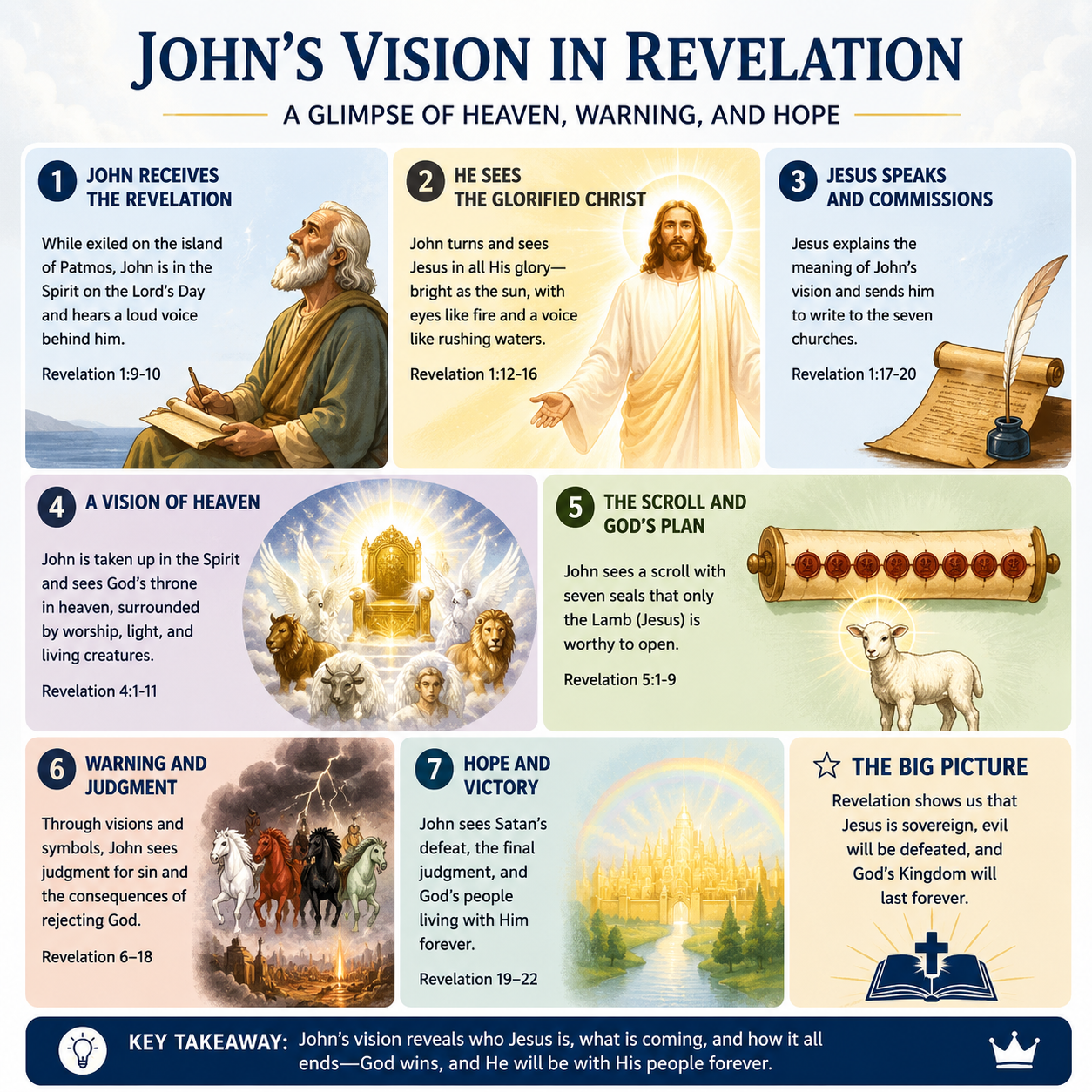
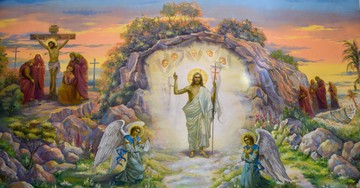
The Apostle John, whose vision became the Book of Revelation, was a fisherman who left his nets on the shores of Galilee to follow Jesus. Son of Zebedee, brother of James, friend of brothers Andrew and Simon Peter, John witnessed the teaching, healings, deliverances, and miracles of Jesus. He stood by the cross as Jesus died, saw the empty tomb after His resurrection, watched Him ascend to heaven, and was present at Pentecost when the Holy Spirit came upon them like tongues of fire.
While every apostle suffered to spread the Gospel, most to martyrdom (according to tradition), John’s ministry led him into exile on the island of Patmos. There, he penned a single unified vision given to him by Jesus Christ, traditionally dated to the reign of Domitian around 95-96 AD.
John recorded the instructions he received when he was “in the Spirit,” (Revelation 1:10 ESV). Revelation 1:11 ESV “Write what you see in a book and send it to the seven churches, to Ephesus and to Smyrna and to Pergamum and to Thyatira and to Sardis and to Philadelphia and to Laodicea,” and 1:19 “Write therefore the things that you have seen, those that are and those that are to take place after this.” Many have found that outline: what John saw, what is now, and what will take place later” as an outline of the vision.
What John Saw in His Vision
The Revelation of Jesus Christ opens with an eight-verse prologue explaining the source of the vision, identifying John as the recorder of the vision, offering a blessing to readers and hearers, followed by greetings to the seven churches and a doxology to Jesus, the Alpha and Omega.
Then, in the remaining verses of chapter one, John describes what he has seen and heard at the start of his vision:
“I, John, your brother and partner in the tribulation and the kingdom and the patient endurance that are in Jesus, was on the island called Patmos on account of the word of God and the testimony of Jesus. I was in the Spirit on the Lord's day, and I heard behind me a loud voice like a trumpet saying, ‘Write what you see in a book and send it to the seven churches, to Ephesus and to Smyrna and to Pergamum and to Thyatira and to Sardis and to Philadelphia and to Laodicea.’ Then I turned to see the voice that was speaking to me, and on turning I saw seven golden lampstands, and in the midst of the lampstands one like a son of man, clothed with a long robe and with a golden sash around his chest.” (Revelation 1:9-13 ESV)
John provides a description of Christ among seven golden lampstands, glorified with white hair, eyes of fire, feet of bronze, and a sword coming from his mouth. In this vision, Jesus identifies Himself as “the first and the last and the living one” holder of the “keys of Death and Hades” (vs 17-18). He explains to John that the seven lampstands are the churches. John writes that, understandably, he fell at Jesus’s feet as though dead (v 17). John had walked with Jesus during His years of earthly ministry but now He saw Him glorified and was overcome.
John's Vision—What Is Now
In Revelation chapters 2 and 3, John records Jesus’s words to each of the seven churches. Each brief letter follows a consistent pattern: commendation, criticism, command, and a promise “to the one who overcomes.”
There are varying theories about the seven churches (which were actual congregations at the time of John’s writing). The Literal-Historical view sees them as relevant only to the churches to which they were addressed at the time. The Spiritual-Devotional theory postulates that they represent churches in different conditions throughout time. The Prophetic or Church Age theory contends that they represent church ages that have come and passed in succession.
The seven churches and the essence of each message are:
- Ephesus: orthodox but has left its first love
- Smyrna: persecuted but faithful; no rebuke given
- Pergamum: tolerating false teaching (Balaam, Nicolaitans)
- Thyatira: tolerating immorality tied to "Jezebel"
- Sardis: appears alive but is spiritually dead
- Philadelphia: faithful despite little strength; open door promised
- Laodicea: lukewarm, self-satisfied, urged to repent
John's Vision—What Will Take Place Later
Chapters 4-22:5 contain the eschatological portion of John’s vision or that which many (though not all) consider as having to do with the end of times, final judgment of humanity, destruction of evil, and eternal redemption of the saints (those who have placed their faith in Jesus Christ).
In chapters 4 and 5, John describes his vision of the throne room of God in heaven, surrounded by 24 elders and four living creatures. In this room, John sees a sealed scroll, but only the Lamb (“the Lion of the tribe of Judah, the Root of David” 5:5) is worthy to open it. All present (thousands upon thousands) fall down and worship the Lamb.
The Sevens in Revelation (6:1-16:21)
In biblical symbolism, the number four represents the earth and seven is God’s number representing completion. In these chapters, John’s vision details four sets of sevens, including:
- The Seven Seals (6:1-8:1)
- The Seven Trumpets (8:2-11:19)
- The Seven Signs (12:1-14:20)
- The Seven Bowls (15:1-16:21)
The Lamb opens each of the seven seals. The first four reveal each of the four horsemen (conquest, war, famine, death) who were given authority over one-fourth of the earth to kill. The fifth seal reveals the souls of martyrs beneath the altar crying out to be avenged. The opening of the sixth seal sparks great natural disasters upon the earth and cosmic upheaval.
There is a pause before the opening of the seventh seal when four angels hold back the four winds of the earth. A fifth angel then delivers God’s seal and seals the 144,000 (12,000 from each of the 12 tribes of Israel). Then John sees a great multitude “from every nation, from all tribes and peoples and languages, standing before the throne and before the Lamb, clothed in white robes, with palm branches in their hands, and crying out with a loud voice, ‘Salvation belongs to our God who sits on the throne, and to the Lamb!’” (Revelation 7:9-10 ESV).
The Lamb opens the seventh seal and there is silence in heaven for about half an hour.
The seven seals are followed by seven angels with trumpets. After each trumpet sounds, a new disaster visits judgement upon the earth.
- Trumpet 1: Hail and fire mixed with blood burning up a third of the earth including one-third of the trees and all the green grass.
- Trumpet 2: Something like a great fiery mountain is thrown into the sea. A third of the sea turns to blood killing a third of the sea creatures and destroying a third of the ships.
- Trumpet 3: A great star named Wormwood falls from heaven and makes bitter a third of the rivers and springs so that many people die from the bitter waters.
- Trumpet 4: A third each of the sun, moon, and stars are darkened. An eagle announces a greater escalation in disaster coming.
- Trumpet 5: A bottomless pit is opened and scorpion-like locusts are given power to torment people who do not have the seal of God. People will seek death but not find it. These demonic locusts are ruled by an angelic being known as Abaddon (Hebrew) or Apollyon (Greek).
- Trumpet 6: Four angels bound at the Euphrates are released and given power to kill one-third of humanity. Following this an angel makes a proclamation from God and John is told to eat the little scroll the angel holds, sweet to taste, bitter to digest. Then he must measure the temple of God and learns about God’s two witnesses, two olive trees, and two lampstands.
- Trumpet 7: At the sound of this trumpet, heaven announces, “The kingdom of the world has become the kingdom of our Lord and of his Christ, and he shall reign forever and ever,” (Revelation 11:15 ESV).
Events Escalate in John's End Times Vision
Following the seventh trumpet sound, there are signs of escalation in the events taking place and there are seven signs. The first is that of a pregnant woman clothed with the sun, the moon beneath her feet, and a crown of 12 stars. The second sign is a red dragon with seven heads, ten horns, and seven diadems awaiting the birth of the woman's child so he can devour him. The womam gives birth to a male child who is to rule the nations with an iron rod and he is caught up to God and to His throne. The woman flees into the wilderness.
There is war in heaven and the archangel Michael casts Satan down to the earth along with his angels. The dragon/serpent goes after the woman, but when he cannot destroy her, he wages war against her offspring.
Next there is a blasphemous beast from the sea who is worshiped by some. The beast wages war against the saints. A second beast appears from the earth, and he deceives many more into worshiping the first beast. Those who will not worship are killed. Those who want to live receive the mark of the beast (666) and agree to worship him.
Then, the Lamb appears on Mount Zion with the 144,000 who were sealed. Three angels make worldwide announcements and then there is a great harvest of souls on the earth. “So the angel swung his sickle across the earth and gathered the grape harvest of the earth and threw it into the great winepress of the wrath of God. And the winepress was trodden outside the city, and blood flowed from the winepress, as high as a horse's bridle, for 1,600 stadia,” (Revelation 14:19-20).
Finally, God’s wrath is poured out on the earth at the appearance of seven angels with seven plagues. These are the seven golden bowls of God’s wrath. These plagues poured out from these bowls include boils/sores, the sea is turned to blood, rivers and springs become blood, the sun scorches humans with fire, darkness covers the earth, the Euphrates River dries up and three demonic spirit frogs appear, and finally, an earthquake so great that mountains fall. Armies of men assemble at Armageddon.
Judgment and Eternal Life
The concluding chapters of John’s vision in Revelation reveal God’s judgment on all who still refuse to repent of their sins. An angel shows John a great harlot who is drunk on the blood of the martyred saints. The angel explains to John the meaning of the imagery for those who refuse to follow Jesus. “Babylon is destroyed and lamented but heaven rejoices and announces the marriage supper of the Lamb.
At this, Christ the conquering King returns on a white horse. He defeats the beast and the false prophet who are cast into the lake of fire. There is mention of Satan bound for 1,000 years while the believers reign with Christ, followed by Satan’s final rebellion and defeat. Then, all souls appear before the Great White Throne judgment where “if anyone's name was not found written in the book of life, he was thrown into the lake of fire,” (Revelation 20:15).
Wonderfully, John is then allowed to see the New Heaven and the New Earth (Revelation 21:1-22:5). New Jerusalem descends, and God makes His dwelling place with His people. John describes the eternal city, the river, and the tree of life. “Behold, the dwelling place of God is with man. He will dwell with them, and they will be his people, and God himself will be with them as their God. He will wipe away every tear from their eyes, and death shall be no more, neither shall there be mourning, nor crying, nor pain anymore, for the former things have passed away,” (Revelation 21:3-4).
Epilogue (22:6-21)
In closing, John affirms the truth and imminence of the vision and warns against tampering with the prophecy. Jesus promises that He is coming soon, and the book closes with an invitation and a benediction.

.800w.tn.jpg)