The Bible Story of Naaman—the Leper Who Had to Learn Humility
Share
Who Was Naaman in the Bible?
During the reign of King Jehoram (or Joram) of Israel, the author of 2 Kings tells the story of a man named Naaman, who was the commander of the Syrian army (2 Kings 5:1). At this time, the prophet Elijah had already “been taken by a whirlwind to heaven” (2 Kings 2:1-15) and was succeeded by his apprentice Elisha, who served as God’s prophet to the nation of Israel (2 Kings 2:16-22). However, the fifth chapter of 2 Kings, perhaps ironically, has little to do with Israel or even one of its kings. Rather, this chapter focuses almost entirely on an outsider and his miraculous encounter with the grace and healing power of the God of Israel, whom he would eventually profess was the one and only God in all the earth (see 2 Kings 5:15).
Of Naaman, whose name in ancient Syrian means “pleasant,” “gracious,” or “fair,” the Bible tells us several things:
1. For one, Naaman is introduced as the “captain (or commander) of the army of the king of Aram” (2 Kings 5:1). The term used here reveals that Naaman was more than a common military officer. Rather, he was the supreme commander, ruler, chieftain, or general of the armies of Syria, the highest-ranking officer of the armies of the king of Aram (see also Genesis 21:22, 39:1; Joshua 5:14; Judges 4:7; 1 Samuel 22:2; 2 Samuel 2:8).
2. Beyond rank, Naaman was also regarded as a “great man with his master.” He was “honorable,” “acceptable,” and “highly respected” in the eyes of the king of Syria, most likely Ben-Hadad or Ben-Hadad II (2 Kings 5:1). “By him the Lord had given victory to Aram” (2 Kings 5:1); and it was this success on the battlefield that had won Naaman the favor of both the king and the nation.
3. Lastly, the Bible tells us that Naaman was “a valiant warrior” (2 Kings 5:1). Other translations say that he was “a mighty man of valor.” This is the same term used in the Old Testament to describe someone of great wealth (see Ruth 2:1) and/or courage (see Judges 6:12).
It goes without saying, therefore, that Naaman was a bit of a celebrity in his time. He was a man of prominence and high social standing. Even the Hebrew author(s) of the book of Kings make note of Naaman’s position and influence in the ancient world. However, the Bible also provides one additional detail about Naaman the Syrian that, in many ways, frames his entire story.
What Condition Did Naaman Suffer From?
Beyond Naaman’s influence and accolades, the Bible tells us that the Syrian commander also suffered from leprosy, a highly contagious, incurable skin disease that plagued the ancient world (2 Kings 5:1). Of course, readers of the Bible will be familiar with leprosy, which shows up on numerous occasions in both the Old and New Testaments.
But how serious was Naaman’s condition and what was the nature of the disease that affected Syria’s most respected and esteemed commander?
Like many occasions where leprosy is mentioned in Scripture, the Bible does not provide details regarding the cause or severity of Naaman’s condition.
Traditionally, leprosy was a highly contagious, painful skin disease marked by a rising or swelling of the skin, blemishing and scabbing, and eventual discoloration or whitening of the infected area. Left unchecked and untreated, it could spread across the entire body.
In most cases, however, leprosy was not fatal, but it was incurable. It also did not fully go away. Symptoms could disappear for a time, then flare up again months or years later. In extreme cases, leprosy might cause irreparable skin damage and disfiguration.
However, the precise definition and nature of leprosy, as described in both the Old and New Testaments, are disputed to this day. Nevertheless, the God of the Bible did provide a clear set of instructions for how the children of Israel were to handle infectious and contagious diseases like leprosy in the aftermath of their exodus from Egypt (see Leviticus 13-14).
Smith’s Bible Dictionary notes that “the sudden and total change of food, air, dwelling and mode of life, caused by the exodus, to this nation of newly-emancipated slaves, may possibly have had a further tendency to produce skin disorders, and severe repressive measures may have been required in the desert-moving camp to secure the public health or allay the panic of infection.”
In the book of Leviticus, God instructed the children of Israel to carefully observe and even isolate those confirmed (or suspected) to have contracted leprosy (see Leviticus 13-14). After a period of isolation, leprous individuals could return to the camp of Israel, but only after they had been carefully examined by a skilled priest, found non-contagious, and performed the proper cleansing rituals and sacrifice.
Practically, this was God’s way of protecting a nomadic people from a devastating outbreak of leprosy or some other infectious epidemic.
Of course, leprosy was one of many conditions that could render someone “unclean” in the eyes of God and the community of Israel. Pastor John MacArthur writes that, “the aim of the laws described in Leviticus 13-14 was to protect the people from disease; but more importantly, to inculcate into them by vivid object lessons how God desired purity, holiness, and cleanness among His people.”
Furthermore, the Bible uses leprosy as one of the most "vivid and graphic physical pictures of the spiritual defilement of sin. Sin is ugly, loathsome, incurable, and contaminating; it separates men from God and makes them outcasts.”
However, as a Gentile (or non-Jew), Naaman was not considered unclean or regarded as an outcast by his own people. We also do not read of Naaman being lame, crippled, deformed, or incapacitated as a result of his condition.
In any case, Naaman’s disease had begun to adversely affect his quality of life. As the renowned commentator Matthew Henry writes, “no man’s greatness, or honour, can place him out of the reach of the sorest calamities of human life.” And in his desperation, the Syrian commander was motivated to seek help and healing from even the most unlikely source, at least for a Gentile.
Naaman and the Servant Girl
To some, the inclusion of Naaman’s story in the book of Kings may seem like a strange interlude in the history of Israel’s kings. Perhaps even more fascinating is the fact that the Bible would choose to focus on not just an outsider but also an adversary of Israel.
We read in 2 Kings that on one of his frequent incursions across the borders of Israel, Naaman had taken captive a young Hebrew girl, whom he used as a servant in his house (2 Kings 5:2). Ironically, it was this same captive girl who first told Naaman’s wife of Elisha the prophet. “If only my master would see the prophet who is in Samaria!” she said, “he would cure him of his leprosy.” (2 Kings 5:3)
Little did Naaman know when he first raided Israel that the very girl whose freedom he had taken would eventually provide the key to his salvation and deliverance. Even in the Old Testament, we see, therefore, that God’s compassion was never limited to Israel.
Rather than seek retribution or remain silent in the face of her captor’s affliction, the Hebrew servant girl told Naaman to seek out the prophet Elisha. Whether from experience or from a steadfast commitment to her faith and the teaching of her people, the girl remembered that healing and salvation come from the Lord. And in an act of compassion, she revealed this to Naaman.
Accordingly, sometimes the greatest miracles and salvation stories in life begin with the simple faith and compassion of those willing to point others to the Lord.
What Happened between Naaman and Elisha?
Desperate for a cure and with nothing to lose, Naaman took the advice of his Hebrew servant and petitioned the king of Aram to seek an audience with the Hebrew prophet. “By all means, go,” the king of Aram replied. “I will send a letter to the king of Israel.” (2 Kings 5:2)
Once again, the favor Naaman had garnered with the king of Aram was on full display. Even the king was willing to send his trusted and beloved commander to a foreign ruler to seek out a prophet of an entirely different God so that he might be healed.
“So Naaman left, taking with him ten talents of silver, six thousand shekels of gold and ten sets of clothing.” (2 Kings 5:5). Naaman also traveled to Israel with a letter from the king of Aram, which read, “with this letter I am sending my servant Naaman to you so that you may cure him of his leprosy.” (2 Kings 5:6)
Upon arriving in Israel, however, Naaman was greeted by a wary King Jehoram, who feared what Ben-Hadad might do if he (Jehoram) was unable to heal his supreme commander. Accordingly, the king of Israel tore his clothes and said, “Am I God? Can I kill and bring back to life? Why does this fellow send someone to me to be cured of his leprosy? See how he is trying to pick a quarrel with me!” (2 Kings 5:7)
When Elisha the prophet heard that Jehoram had torn his clothes in distress, he rebuked the king and called for Naaman to be sent to his home.
The Bible tells us, however, that when Naaman’s chariots arrived at the door of Elisha’s house, the prophet sent a servant instead to the Syrian commander with instructions for him to wash seven times in the Jordan River (see 2 Kings 5:9-10).
Given his standing, Naaman had expected a personal audience with the prophet of Israel. “I thought that he would surely come out to me and stand and call on the name of the Lord his God, wave his hand over the spot and cure me of my leprosy,” he said (2 Kings 5:11).
Surely someone in his position deserved a ceremony worthy of his name and celebrity. Did Elisha not see the bags of silver and gold he had brought with him as payment for his services? Instead, Elisha had given him a simple, straightforward set of instructions for his cleansing. No fanfare. No ceremony. Elisha did not need to be present out of fear that Naaman might attribute his healing to the prophet rather than to God. All that was required was a simple act of faith and obedience.
Unfortunately, Naaman initially scoffed at the idea of bathing in the filthy Jordan River. Surely the Abana and Pharpar, two rivers closer to his home in Damascus, would be cleaner and more appropriate than the muddy, murky waters of Israel?
Accordingly, Naaman expected God to move and act in a certain way: his way. The God of the Bible, however, does things in His way and His timing. The apostle Paul would later write, “God has chosen the foolish things of the world to shame the wise, and God has chosen the weak things of the world to shame the things which are strong.” (2 Corinthians 1:27)
In any case, “he (Naaman) turned and went off in a rage.” (2 Kings 5:12) And yet, this would not be the end of his story.
How Was Naaman Eventually Healed?
With his pride wounded, the Syrian commander left Elisha in anger. However, his servants came to him and said, “if the prophet had told you to do some great thing, would you not have done it? How much more, then, when he tells you, ‘Wash and be cleansed’!” (2 Kings 5:13)
As is true for all seeking salvation, humility and submission are essential. Coming to the end of ourselves is not the mark of failure; it is the beginning of genuine faith and the realization that God alone is sovereign. We are not.
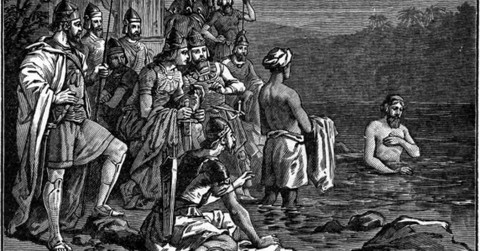
In desperation, Naaman eventually relented and followed Elisha’s instructions, dipping himself seven times in the Jordan River. It is written that, “his flesh was restored and became clean like that of a young boy” (2 Kings 5:14).
Only then did Naaman and his servants return to Elisha. Here, Naaman professed, “Now I know that there is no God in all the world except in Israel. So please accept a gift from your servant.” (2 Kings 5:15)
Initially, Elisha refused Naaman’s offering (2 Kings 5:16).
To this, Naaman replied, “if you will not, please let me, your servant, be given as much earth as a pair of mules can carry, for your servant will never again make burnt offerings and sacrifices to any other god but the Lord.” (2 Kings 5:17)
On the surface, this may have seemed like a strange request. However, in the ancient world, it was believed that a god could only be worshipped on the soil of the nation to which he was bound. In his way, Naaman was genuinely looking for a way to worship the God of Israel at his home in Damascus.
Furthermore, Naaman’s conscience urged him to seek forgiveness from Elisha, as he realized that as a servant of Ben-Hadad, he would be asked to stand beside his master in the future when the king of Aram entered the pagan temple of Rimmon in Syria (2 Kings 2:18).
To Naaman’s requests, Elisha replied in simple grace, “go in peace,” (2 Kings 5:19)
Thus Naaman the Syrian departed from Elisha, having been healed of his leprosy but also cleansed from the inside out. His body had been restored, but his heart had been made new in the healing, cleansing power of the God of Israel, the one and only God in all the earth.
The events of Naaman’s life may have happened a long time ago. His story may include people, places, and events that are far removed from us today. However, the inclusion of this small yet miraculous chapter in the chronicles of Israel’s kings provides valuable insight into the heart and character of the God of the Bible, who is sovereign, compassionate, and ultimately invested in the healing and salvation of His creation.
Photo credit: Wikimedia Commons/Public Domain Image










.800w.tn.jpg)