The Writing on the Wall: The Bible Story of Belshazzar's Feast in Daniel 5
Share
The story of Belshazzar’s feast, recorded in Daniel 5, could be taught in church school or in a high school history class. It would be equally at home as a scene in a horror movie, a sermon on Daniel, or as an English lesson on the origin of the phrase, “The writing is on the wall.” Whether history or horror, literature or spiritual lesson, what happened at Belshazzar’s feast tells the true tale of what happens when kings (or other leaders) fall subject to pride and vainglory.
It’s a brief but breathtaking story to tell, but first, a little background.
The Background of King Belshazzar
Belshazzar was the grandson of one of the greatest Babylonian kings, King Nebuchadnezzar. Belshazzar was co-regent with his father Nabonidus over the Babylonian Empire in 539 B.C. The text refers to Nebuchadnezzar as Belshazzar’s father, but that should be understood more as ancestor or predecessor (as it would have meant both in the original language). The term' father' is most likely used to emphasize the connection between the two kings, for reasons that will become painfully clear as we dive into the story.
The book of Daniel takes place during the time of the Exile when the sins of the Israelites had grown so vast the Lord allowed them to be overtaken by their enemies, the Babylonians (Chaldeans). These invaders destroyed Jerusalem and pillaged the temple, killing many and enslaving the rest in lands far from home.
Daniel and his friends (probably adolescents at the time) were set apart to serve King Nebuchadnezzar and assimilate to Babylonian culture. The four resisted any pressure to adopt the idol worship of their captors, and three of them found themselves in a fiery furnace (although delivered through the fire without even a hint of smoke on them (Daniel 3). Daniel continued to remember and keep the ways of his people, and by the time of Belshazzar, Daniel was an older man—tested and respected for his devotion to the God of Israel and his ability to interpret dreams and signs.
The Babylonian Empire was extensive and powerful, but what’s important to note as you read the story of Belshazzar’s feast is that the Persian King Cyrus (also known as Cyrus the Great) and his forces are literally waiting just outside the city to overthrow this mighty kingdom, even as they eat, drink, and celebrate themselves.
The Significance of the Feast
Daniel 5:1 ESV opens with this line, “King Belshazzar made a great feast for a thousand of his lords and drank wine in front of the thousand.” The writer says so much with that introduction about the mindset of conceit and misplaced confidence of this king and his leaders.
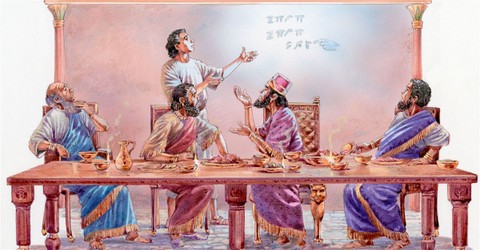
When Belshazzar tasted the wine, he called for the sacred gold and silver vessels pillaged from the temple in Jerusalem to be brought out. These were not simply tableware. These items were specifically crafted vessels consecrated to God and previously used only in His holy temple. At this feast, Belshazzar "and his lords, his wives, and his concubines drank from them. They drank wine and praised the gods of gold and silver, bronze, iron, wood, and stone (vs 3-4).
This was a supreme affront to the Living God, using His holy instruments as common service-ware and offering praise to idols instead of to Him. What an extreme act of pride and vainglory!
Belshazzar would have known well how his grandfather, Nebuchadnezzar, had grown so prideful that the Lord punished him by forcing him to lose his senses so that he ate grass in the fields on all fours like an ox (Daniel 4). When Nebuchadnezzar eventually humbled himself, God restored him to his right mind and to his throne. Even knowing this history, however, Belshazzar defies the God of Israel.
As the people toasted their idols, suddenly, mid-feast, a human hand appeared and wrote words in the plaster on the wall of the palace. The king watched as the words were written and it terrified him so much he was near physical collapse. He called for the wisest of Babylon’s enchanters to read and interpret the message but they could not. The queen (or queen mother) remembered the prophet of Israel who had served Nebuchadnezzar.
“There is a man in your kingdom in whom is the spirit of the holy gods. In the days of your father, light and understanding and wisdom like the wisdom of the gods were found in him, and King Nebuchadnezzar, your father—your father the king—made him chief of the magicians, enchanters, Chaldeans, and astrologers, because an excellent spirit, knowledge, and understanding to interpret dreams, explain riddles, and solve problems were found in this Daniel, whom the king named Belteshazzar. Now let Daniel be called, and he will show the interpretation,” (Daniel 5:11-12).
The Prophet Daniel Interprets the Message
Daniel appeared before the gathering, and the king explained that none of the Babylonian wise men could decipher the writing on the wall. He promised Daniel that if he is successful, the king will reward Daniel by clothing him with purple, awarding him a chain of gold, and proclaiming him the third ruler in the kingdom (v 16).
Daniel refused any hint of a bribe. “Then Daniel answered and said before the king, ‘Let your gifts be for yourself, and give your rewards to another. Nevertheless, I will read the writing to the king and make known to him the interpretation’” (v 17).
The prophet then recounted to Belshazzar the story of his grandfather’s pride and the lesson Nebuchadnezzar learned from the God of Israel. He scolded the king for not learning the lesson against pride and instead, committing a great offense against the Living God at the feast. Then, he delivered the interpretation of the writing on the wall. Belshazzar’s judgement shall be greater than his ancestor’s because he should have learned from his own family history and apparently did not. Daniel’s indictment is found in verse 22, “And you his son, Belshazzar, have not humbled your heart, though you knew all this.”
Daniel announced: “Then from his presence the hand was sent, and this writing was inscribed. And this is the writing that was inscribed: Mene, Mene, Tekel, and Parsin. This is the interpretation of the matter: Mene, God has numbered the days of your kingdom and brought it to an end; Tekel, you have been weighed in the balances and found wanting; Peres, your kingdom is divided and given to the Medes and Persians,” (vs 25-28).
God’s judgment against Belshazzar and the Babylonian (Chaldean) kingdom was precise and unavoidable. That very night, Belshazzar was killed in a raid and his kingdom given to Darius the Mede. (vs 30-31) The time of the Medo-Persian Empire began. Daniel received his reward, but under King Darius, there was still a lion’s den in the prophet’s future.
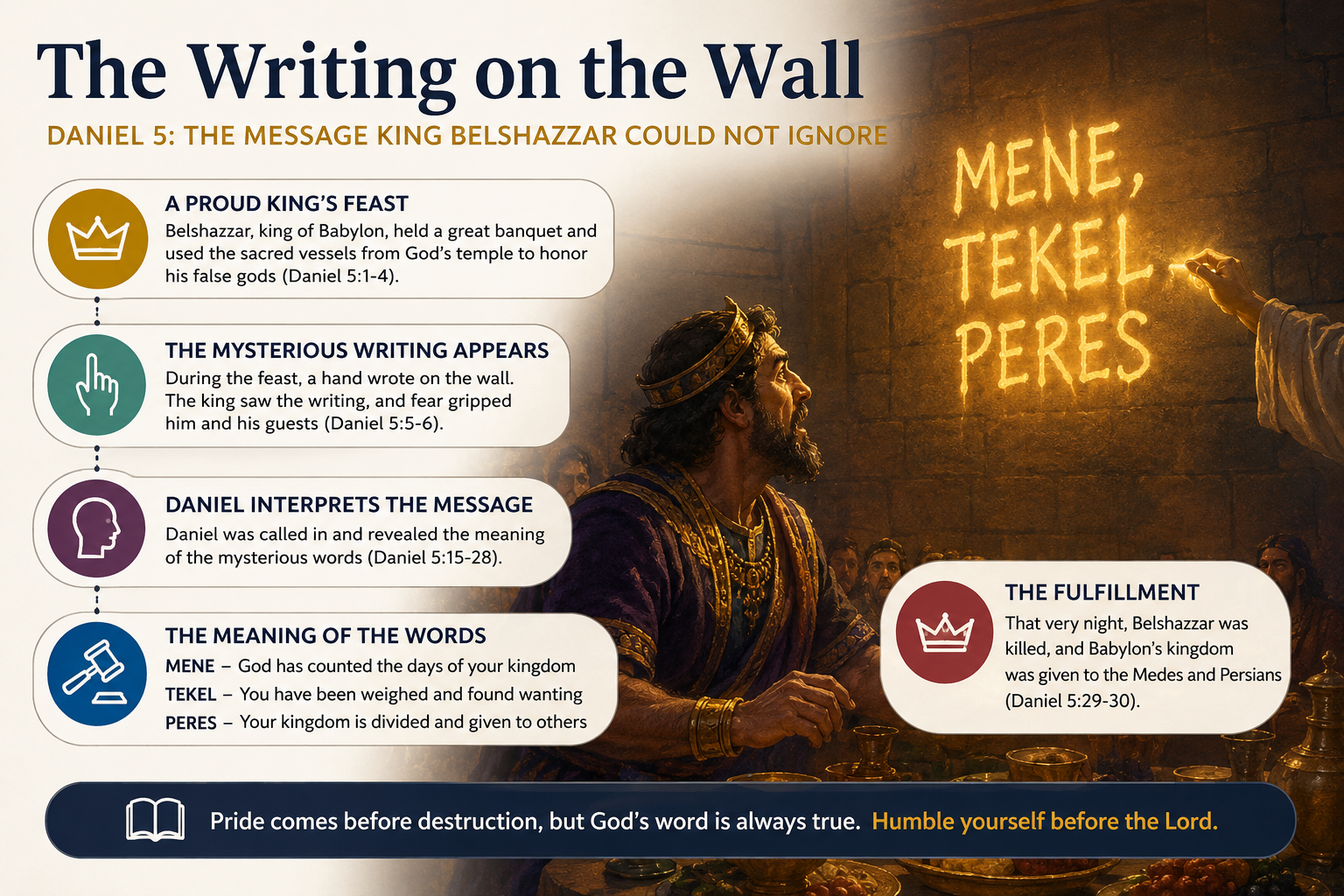
What Can We Learn from the Story of Belshazzar's Feast?
There are many lessons Christians can draw from this story, and most are reflected in the wisdom of the Proverbs, the prophets, or the letters of the apostles.
- “Pride goes before destruction, and a haughty spirit before a fall,” (Proverbs 16:18)
- “But he gives more grace. Therefore it says, “God opposes the proud but gives grace to the humble,” (James 4:6).
- “Woe to those who are wise in their own eyes, and shrewd in their own sight! Woe to those who are heroes at drinking wine, and valiant men in mixing strong drink,” (Isaiah 5:21-22).
- “It is not for kings, O Lemuel, it is not for kings to drink wine, or for rulers to take strong drink,
lest they drink and forget what has been decreed and pervert the rights of all the afflicted,” (Proverbs 31:4-5). - “And do not get drunk with wine, for that is debauchery, but be filled with the Spirit,” (Ephesians 5:18).
- “For all that is in the world—the desires of the flesh and the desires of the eyes and pride of life—is not from the Father but is from the world,” (1 John 2:16).
We have the entirety of God’s Word, the history of the church, and the indwelling of the Holy Spirit. What do we know that should be informing the way we conduct ourselves in our times?
If a hand appeared on the wall of a gathering you were hosting tonight, what would be the message God might write?
Photo credit: Peter Dennis


.800w.tn.jpg)