The Bible Story of Rahab

Contributing Writer
The Bible Story of Rahab

Genealogies aren’t most readers’ favorite part of the Bible. But sometimes, a genealogy offers a surprising connection that changes the way we understand the Bible. In Matthew’s genealogy of Jesus, no name is more surprising—or unlikely—than Rahab.

First, Rahab was a woman. Genealogies traced the male lineage, so a reference to a mother in the lineage is unexpected and rare.

Second, Rahab was a Canaanite. She was an enemy of Israel, a member of a culture so evil that God sentenced them to destruction. Israel was expressly prohibited from intermarrying Canaanites because such intermarriage would influence Israel towards pagan practices (idol worship, cultic prostitution, child sacrifice, etc.). Rahab was disqualified from the Messiah’s lineage from the start.

Third, Rahab was a prostitute. She didn’t have a track record of following God’s laws—she lived in sexual sin like many other Canaanites. Not exactly strong grounds for an exception to the rule!

Yet Rahab did become an ancestor of the Messiah, and is consistently lifted up as an example of faith we should all learn from. So, how did a Canaanite prostitute become one of the heroes of the Bible?

Spies and Lies

Rahab lived in Jericho, a prominent, well-fortified city. Jericho’s walls were so large and sturdy that many people—including Rahab’s family—lived in homes within the walls themselves.

Despite this impressive line of defense, Rahab and her neighbors lived in fear. A new nation, Israel, had arisen from the land of Egypt, and Israel’s God had proved his power. This God miraculously dried up the Red Sea so his people could cross, and when the Amorite kings Sihon and Og brought the full force of their armies against Israel, Israel completely destroyed them. Now, Israel was poised to cross the Jordan, and Jericho was next in their line of conquest. Little did Rahab know she would play a crucial role in that conquest.
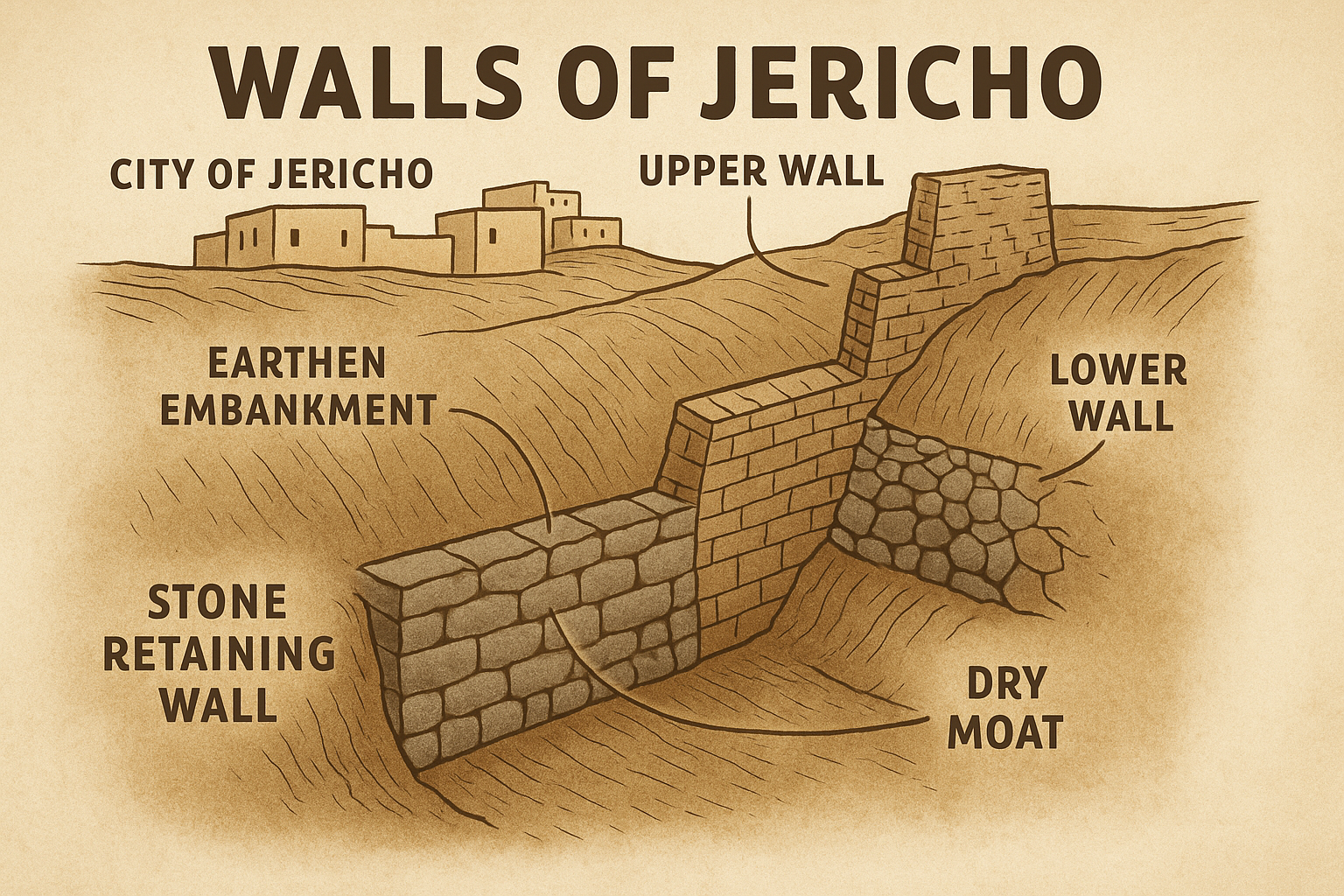
Walls of Jericho infographic, illustration of how the city of Jericho may have looked.

One day, two Israelite spies entered the city of Jericho, scouting out the land for Israel’s leader, Joshua. At the time, many brothels also served as inns, and the spies intended to spend the night at Rahab’s house. However, the spies had not gone undetected, and the King of Jericho soon traced them to Rahab’s home.

That’s when Rahab faced the choice of her life.

Here were the king’s men, declaring that the men staying in her home were spies from the feared nation of Israel. The obvious choice was to obey the king and turn them in. But Rahab didn’t do that. Instead, she hid the men beneath stalks of flax drying on the roof, then went to the king’s men and spun a convincing lie: “Yes, the men came to me, but I did not know where they had come from. At dusk, when it was time to close the city gate, they left. I don’t know which way they went. Go after them quickly. You may catch up with them” (Joshua 2:4-5, NIV).

If the spies had been discovered, Rahab and her family would have doubtlessly been executed. Why did Rahab take such a risk? Because she wanted to be on the winning side—God’s side. Here’s what Rahab says to the spies:

“I know that the Lord has given you this land and that a great fear of you has fallen on us, so that all who live in this country are melting in fear because of you. . . . for the Lord your God is God in heaven above and on the earth below. Now then, please swear to me by the Lord that you will show kindness to my family, because I have shown kindness to you. Give me a sure sign that you will spare the lives of my father and mother, my brothers and sisters, and all who belong to them—and that you will save us from death” (Joshua 2:9-13, NIV).

Notice how Rahab says, “The Lord your God.” She recognizes she is an outsider, that the Lord is not the God of her people—but she also recognizes the Lord is greater than all the gods of Canaan. She knows God and his people will defeat Jericho. And she realizes her only hope is for these men to promise in the name of this great God that she will be spared.

But Rahab doesn’t stop with bartering for her own life. She isn’t simply “looking out for number one.” Rahab also barters for the lives of her entire family—her father, mother, brothers, sisters, and their families, too.

The spies agree, and they take the oath seriously. But they set the condition that they will only save Rahab and her family if Rahab hangs a red cord from her window to indicate her house, and only the people within that house will be spared.

Rahab agrees, then offers the spies clever advice on how to evade the king’s manhunt. Now, all that’s left is the waiting.

The Conquest of Jericho

We don’t know much about Rahab’s family. Did she take a great risk in bringing them to her home, knowing that any one of them could betray her to the king? Or was her entire family also confident in Israel and Israel’s God? Scripture is silent on that. However, Joshua 6:23-25 indicates that all of Rahab’s family was present on the day Jericho’s walls came crashing down.

What was that like? Rahab’s family literally lived inside the wall itself. Did their part of the wall collapse when the trumpets blew one final time? Presumably not. The Israelite army only needed enough of a breach in the wall to enter the city. But even if most of the wall was destroyed, God could have intentionally spared Rahab’s house and family—and her family was indeed spared.

The book of Joshua concludes Rahab’s story with these words: “But Joshua spared Rahab the prostitute, with her family and all who belonged to her, because she hid the men Joshua had sent as spies to Jericho—and she lives among the Israelites to this day” (Joshua 6:25, NIV).

However, that’s not quite the end of Rahab’s story...

Rahab’s Legacy

Rahab was accepted into the people of Israel—she even married an Israelite, Salmon (Matthew 1:5). One of Rahab and Salmon’s descendants, Boaz, would also marry a foreigner—Ruth the Moabitess. The stories of Rahab and Ruth both echo the same truth of God’s mercy.

Many people look at the Old Testament and cringe at the harsh passages commanding the complete destruction of the Canaanites and the prohibitions against intermarriage. Some critics of Christianity even accuse the Bible of promoting genocide. While these passages are harsh, and God’s judgment of the Canaanites is thorough, God clearly offered grace when individual Canaanites genuinely turned to him in faith. Rahab is a prime example of that kind of faith—as evidenced by the New Testament.

In James 2, Rahab is used as an example of sincere, saving faith. “In the same way, was not even Rahab the prostitute considered righteous for what she did when she gave lodging to the spies and sent them off in a different direction? As the body without the spirit is dead, so faith without deeds is dead” (James 2:25-26, NIV).

Notice how James highlights two key facts about Rahab’s faith. First, Rahab had not achieved righteousness through living a perfect life—she’d been a prostitute. She was considered righteous by faith, not through achieving it on her own. Second, Rahab’s faith was proven real by the risk she took in protecting the spies. She risked her life by putting her faith in God rather than in the king of Jericho or the gods of Canaan. She truly lived by faith!

Hebrews 11 is the famous “Hall of Faith,” a chapter that highlights some of the most inspirational heroes of the Old Testament—and Rahab is honored as one of those heroes: “By faith Rahab the prostitute did not perish with those who were disobedient, because she had given a friendly welcome to the spies” (Hebrews 11:31, ESV).

As Christians, most of us are Gentiles. Many of us grew up as unbelievers in cultures that were far from Christian. Many of us have shameful pasts. But Rahab’s story reminds us that, no matter our past, God loves us and has a purpose for our lives. If we follow him in faith, he will work through us in ways we cannot begin to imagine—just as he worked through Rahab.

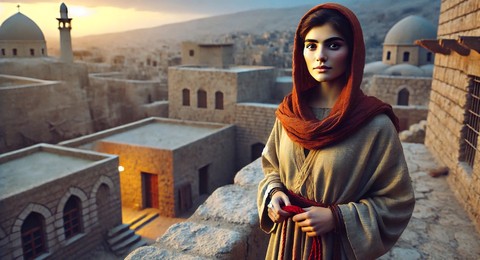
Image created using AI technology and subsequently edited and reviewed by our editorial team.

Tim PietzTim Pietz is an editor, publicist, and sometimes, a writer (when he stops self-editing long enough to reach his word count). Tim’s editing business, InkSword Editing, serves a variety of fiction and nonfiction authors, and his blog offers free tips and tricks on navigating the publishing industry. In his free time, Tim enjoys roleplaying games, ultimate frisbee, and cheering on his favorite football team, the perpetually heartbreaking Minnesota Vikings. 

Joshua 2:4-8

4 But the woman had taken the two men and hidden them. She said, “Yes, the men came to me, but I did not know where they had come from.
5 At dusk, when it was time to close the city gate, they left. I don’t know which way they went. Go after them quickly. You may catch up with them.”
6 (But she had taken them up to the roof and hidden them under the stalks of flax she had laid out on the roof.)
7 So the men set out in pursuit of the spies on the road that leads to the fords of the Jordan, and as soon as the pursuers had gone out, the gate was shut.
8 Before the spies lay down for the night, she went up on the roof

Joshua 2:9-21

9 and said to them, “I know that the LORD has given you this land and that a great fear of you has fallen on us, so that all who live in this country are melting in fear because of you.
10 We have heard how the LORD dried up the water of the Red Sea for you when you came out of Egypt, and what you did to Sihon and Og, the two kings of the Amorites east of the Jordan, whom you completely destroyed.
11 When we heard of it, our hearts melted in fear and everyone’s courage failed because of you, for the LORD your God is God in heaven above and on the earth below.
12 “Now then, please swear to me by the LORD that you will show kindness to my family, because I have shown kindness to you. Give me a sure sign
13 that you will spare the lives of my father and mother, my brothers and sisters, and all who belong to them—and that you will save us from death.”
14 “Our lives for your lives!” the men assured her. “If you don’t tell what we are doing, we will treat you kindly and faithfully when the LORD gives us the land.”
15 So she let them down by a rope through the window, for the house she lived in was part of the city wall.
16 She said to them, “Go to the hills so the pursuers will not find you. Hide yourselves there three days until they return, and then go on your way.”
17 Now the men had said to her, “This oath you made us swear will not be binding on us
18 unless, when we enter the land, you have tied this scarlet cord in the window through which you let us down, and unless you have brought your father and mother, your brothers and all your family into your house.
19 If any of them go outside your house into the street, their blood will be on their own heads; we will not be responsible. As for those who are in the house with you, their blood will be on our head if a hand is laid on them.
20 But if you tell what we are doing, we will be released from the oath you made us swear.”
21 “Agreed,” she replied. “Let it be as you say.” So she sent them away, and they departed. And she tied the scarlet cord in the window.

Joshua 6:23-27

23 So the young men who had done the spying went in and brought out Rahab, her father and mother, her brothers and sisters and all who belonged to her. They brought out her entire family and put them in a place outside the camp of Israel.
24 Then they burned the whole city and everything in it, but they put the silver and gold and the articles of bronze and iron into the treasury of the LORD’s house.
25 But Joshua spared Rahab the prostitute, with her family and all who belonged to her, because she hid the men Joshua had sent as spies to Jericho—and she lives among the Israelites to this day.
26 At that time Joshua pronounced this solemn oath: “Cursed before the LORD is the one who undertakes to rebuild this city, Jericho: “At the cost of his firstborn son he will lay its foundations; at the cost of his youngest he will set up its gates.”
27 So the LORD was with Joshua, and his fame spread throughout the land.

James 2

1 My brothers and sisters, believers in our glorious Lord Jesus Christ must not show favoritism.
2 Suppose a man comes into your meeting wearing a gold ring and fine clothes, and a poor man in filthy old clothes also comes in.
3 If you show special attention to the man wearing fine clothes and say, “Here’s a good seat for you,” but say to the poor man, “You stand there” or “Sit on the floor by my feet,”
4 have you not discriminated among yourselves and become judges with evil thoughts?
5 Listen, my dear brothers and sisters: Has not God chosen those who are poor in the eyes of the world to be rich in faith and to inherit the kingdom he promised those who love him?
6 But you have dishonored the poor. Is it not the rich who are exploiting you? Are they not the ones who are dragging you into court?
7 Are they not the ones who are blaspheming the noble name of him to whom you belong?
8 If you really keep the royal law found in Scripture, “Love your neighbor as yourself,” you are doing right.
9 But if you show favoritism, you sin and are convicted by the law as lawbreakers.
10 For whoever keeps the whole law and yet stumbles at just one point is guilty of breaking all of it.
11 For he who said, “You shall not commit adultery,” also said, “You shall not murder.” If you do not commit adultery but do commit murder, you have become a lawbreaker.
12 Speak and act as those who are going to be judged by the law that gives freedom,
13 because judgment without mercy will be shown to anyone who has not been merciful. Mercy triumphs over judgment.
14 What good is it, my brothers and sisters, if someone claims to have faith but has no deeds? Can such faith save them?
15 Suppose a brother or a sister is without clothes and daily food.
16 If one of you says to them, “Go in peace; keep warm and well fed,” but does nothing about their physical needs, what good is it?
17 In the same way, faith by itself, if it is not accompanied by action, is dead.
18 But someone will say, “You have faith; I have deeds.” Show me your faith without deeds, and I will show you my faith by my deeds.
19 You believe that there is one God. Good! Even the demons believe that—and shudder.
20 You foolish person, do you want evidence that faith without deeds is useless ?
21 Was not our father Abraham considered righteous for what he did when he offered his son Isaac on the altar?
22 You see that his faith and his actions were working together, and his faith was made complete by what he did.
23 And the scripture was fulfilled that says, “Abraham believed God, and it was credited to him as righteousness,” and he was called God’s friend.
24 You see that a person is considered righteous by what they do and not by faith alone.
25 In the same way, was not even Rahab the prostitute considered righteous for what she did when she gave lodging to the spies and sent them off in a different direction?
26 As the body without the spirit is dead, so faith without deeds is dead.

James 2:25-26

25 In the same way, was not even Rahab the prostitute considered righteous for what she did when she gave lodging to the spies and sent them off in a different direction?
26 As the body without the spirit is dead, so faith without deeds is dead.

Hebrews 11

1 Now faith is confidence in what we hope for and assurance about what we do not see.
2 This is what the ancients were commended for.
3 By faith we understand that the universe was formed at God’s command, so that what is seen was not made out of what was visible.
4 By faith Abel brought God a better offering than Cain did. By faith he was commended as righteous, when God spoke well of his offerings. And by faith Abel still speaks, even though he is dead.
5 By faith Enoch was taken from this life, so that he did not experience death: “He could not be found, because God had taken him away.” For before he was taken, he was commended as one who pleased God.
6 And without faith it is impossible to please God, because anyone who comes to him must believe that he exists and that he rewards those who earnestly seek him.
7 By faith Noah, when warned about things not yet seen, in holy fear built an ark to save his family. By his faith he condemned the world and became heir of the righteousness that is in keeping with faith.
8 By faith Abraham, when called to go to a place he would later receive as his inheritance, obeyed and went, even though he did not know where he was going.
9 By faith he made his home in the promised land like a stranger in a foreign country; he lived in tents, as did Isaac and Jacob, who were heirs with him of the same promise.
10 For he was looking forward to the city with foundations, whose architect and builder is God.
11 And by faith even Sarah, who was past childbearing age, was enabled to bear children because she considered him faithful who had made the promise.
12 And so from this one man, and he as good as dead, came descendants as numerous as the stars in the sky and as countless as the sand on the seashore.
13 All these people were still living by faith when they died. They did not receive the things promised; they only saw them and welcomed them from a distance, admitting that they were foreigners and strangers on earth.
14 People who say such things show that they are looking for a country of their own.
15 If they had been thinking of the country they had left, they would have had opportunity to return.
16 Instead, they were longing for a better country—a heavenly one. Therefore God is not ashamed to be called their God, for he has prepared a city for them.
17 By faith Abraham, when God tested him, offered Isaac as a sacrifice. He who had embraced the promises was about to sacrifice his one and only son,
18 even though God had said to him, “It is through Isaac that your offspring will be reckoned.”
19 Abraham reasoned that God could even raise the dead, and so in a manner of speaking he did receive Isaac back from death.
20 By faith Isaac blessed Jacob and Esau in regard to their future.
21 By faith Jacob, when he was dying, blessed each of Joseph’s sons, and worshiped as he leaned on the top of his staff.
22 By faith Joseph, when his end was near, spoke about the exodus of the Israelites from Egypt and gave instructions concerning the burial of his bones.
23 By faith Moses’ parents hid him for three months after he was born, because they saw he was no ordinary child, and they were not afraid of the king’s edict.
24 By faith Moses, when he had grown up, refused to be known as the son of Pharaoh’s daughter.
25 He chose to be mistreated along with the people of God rather than to enjoy the fleeting pleasures of sin.
26 He regarded disgrace for the sake of Christ as of greater value than the treasures of Egypt, because he was looking ahead to his reward.
27 By faith he left Egypt, not fearing the king’s anger; he persevered because he saw him who is invisible.
28 By faith he kept the Passover and the application of blood, so that the destroyer of the firstborn would not touch the firstborn of Israel.
29 By faith the people passed through the Red Sea as on dry land; but when the Egyptians tried to do so, they were drowned.
30 By faith the walls of Jericho fell, after the army had marched around them for seven days.
31 By faith the prostitute Rahab, because she welcomed the spies, was not killed with those who were disobedient.
32 And what more shall I say? I do not have time to tell about Gideon, Barak, Samson and Jephthah, about David and Samuel and the prophets,
33 who through faith conquered kingdoms, administered justice, and gained what was promised; who shut the mouths of lions,
34 quenched the fury of the flames, and escaped the edge of the sword; whose weakness was turned to strength; and who became powerful in battle and routed foreign armies.
35 Women received back their dead, raised to life again. There were others who were tortured, refusing to be released so that they might gain an even better resurrection.
36 Some faced jeers and flogging, and even chains and imprisonment.
37 They were put to death by stoning; they were sawed in two; they were killed by the sword. They went about in sheepskins and goatskins, destitute, persecuted and mistreated—
38 the world was not worthy of them. They wandered in deserts and mountains, living in caves and in holes in the ground.
39 These were all commended for their faith, yet none of them received what had been promised,
40 since God had planned something better for us so that only together with us would they be made perfect.