The Bible Story of Moses and the Exodus

Share
Moses and the Exodus is one of the most well-known stories of the Bible and has even been made into movies. However, Hollywood and novelists often take artistic license with stories for their own purposes. This is why it is important to go back to the original source, the Bible, to not only get the facts but to find out what it says about God and what God wants us to learn from this moment in time so that we can apply it to our own lives. The story of Moses and the Exodus shows how God hears His people, calls flawed servants, delivers with power, and teaches us to trust and obey Him even when the way forward feels impossible.
Moses' Calling and Preparation
The book of Exodus picks up after the death of Joseph and his generation, when a new king of Egypt took the throne who didn’t know Joseph (Exodus 1:8). Because of this and the growing number of the children of Israel, the new king enslaved the Israelites out of fear and ordered the midwives to kill any boy babies of the Hebrew women. Yet Moses was saved, adopted by Pharaoh’s daughter, and raised as a prince with all the education and training that came with that position. Even as a child, God was preparing Moses for the role of leader and diplomat.
As a young man, Moses killed an Egyptian in an impetuous moment and hid the body. When he realized that there were witnesses, Moses fled the wrath of Pharaoh and escaped to Midian, where he married and worked as a shepherd for his father-in-law Jethro (Exodus 2:11-22).
While Moses was living in the wilderness, God did not forget His people. God calls an older and wiser Moses through the burning bush to lead God's people out of slavery and into a land promised to Abraham and his descendants:
"Now therefore, behold, the cry of the children of Israel has come to Me, and I have also seen the oppression with which the Egyptians oppress them. Come now, therefore, and I will send you to Pharaoh that you may bring My people, the children of Israel, out of Egypt." (Exodus 3:9-10 NKJV)
Moses gives a list of questions and excuses why he can’t do the job:
- Who am I to go to Pharaoh?
- What shall I say when they ask your name?
- They will not believe me.
- I am slow of speech and tongue.
When he finally accepts God’s calling, God almost strikes him down because Moses had not circumcised his son. God calls Aaron and tells him to meet his brother in the wilderness, and Moses tells him all that God has said. Aaron then goes to the elders of the children of Israel and gives them the message.
Moses Confronts Pharaoh
When Moses and Aaron went before Pharaoh to tell him to let the Israelites go and hold a feast unto the Lord in the wilderness, the Pharaoh increased the burden of the people by requiring them to gather their own straw to make bricks. Moses and Aaron go back and demand the people’s release, throwing down the rod that turned into a serpent, which ate the serpents that Pharaoh’s magicians created. Yet, Pharaoh’s heart was hardened as the Lord had told Moses it would be, so God sent ten plagues on Egypt:
- River turned to blood (Exodus 7)
- Frogs (Exodus 8:1-15)
- Dust becomes lice (Exodus 8:16-19)
- Swarms of flies (Exodus 8:20-32)
- Animals destroyed (Exodus 9:1-7)
- Ashes causes boils (Exodus 9:8-12)
- Fiery hailstorm (Exodus 9:13-35)
- Locusts (Exodus 10:1-20)
- Three days of darkness (Exodus 10:21-29)
- Death of firstborn (Exodus 11-12)
Pharaoh’s heart remained hardened throughout each of the plagues until the death of the firstborn in every family of the Egyptians.
Then he called for Moses and Aaron by night, and said, "Rise, go out from among my people, both you and the children of Israel. And go, serve the Lord as you have said. Also take your flocks and your herds, as you have said, and be gone; and bless me also." (Exodus 12:31-32 NKJV)
God had already given Moses instructions for how to prepare and keep a feast that would come to be known as Passover, as God passed over the houses of the children of Israel when they placed the sacrificial blood of animals over their dwellings, while he killed the firstborn of the Egyptians (Exodus 12). So, the Israelites were prepared to leave at a moment’s notice, traveling from Ramses to Succoth. There were 600,000 men besides the women and children and all their animals. After 430 years, the Israelites finally left Egypt, headed for the land God had promised Abraham.
Moses and the Israelites at the Red Sea
God told Moses to encamp by the sea at Pi-hahiroth so that the Egyptians would think the Israelites were trapped. When the Israelite people realized that the Egyptians were coming after them, they began to complain, so Moses cried out to God who gave him this answer:
And Moses said to the people, "Do not be afraid. Stand still, and see the salvation of the Lord, which He will accomplish for you today. For the Egyptians whom you see today, you shall see again no more forever. The Lord will fight for you, and you shall hold your peace." And the Lord said to Moses, "Why do you cry to Me? Tell the children of Israel to go forward. But lift up your rod, and stretch out your hand over the sea and divide it. And the children of Israel shall go on dry ground through the midst of the sea. And I indeed will harden the hearts of the Egyptians, and they shall follow them. So I will gain honor over Pharaoh and over all his army, his chariots, and his horsemen. (Exodus 14:13-17 NKJV)
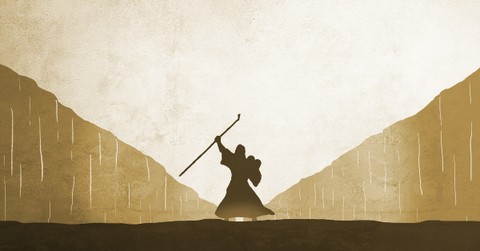
Moses held up his rod and the waters parted so that the children of Israel crossed on dry land. The Egyptians followed after them, and when all of the army was in the riverbed, God let the waters loose and drowned the entire army.
Moses and the Israelites in the Wilderness
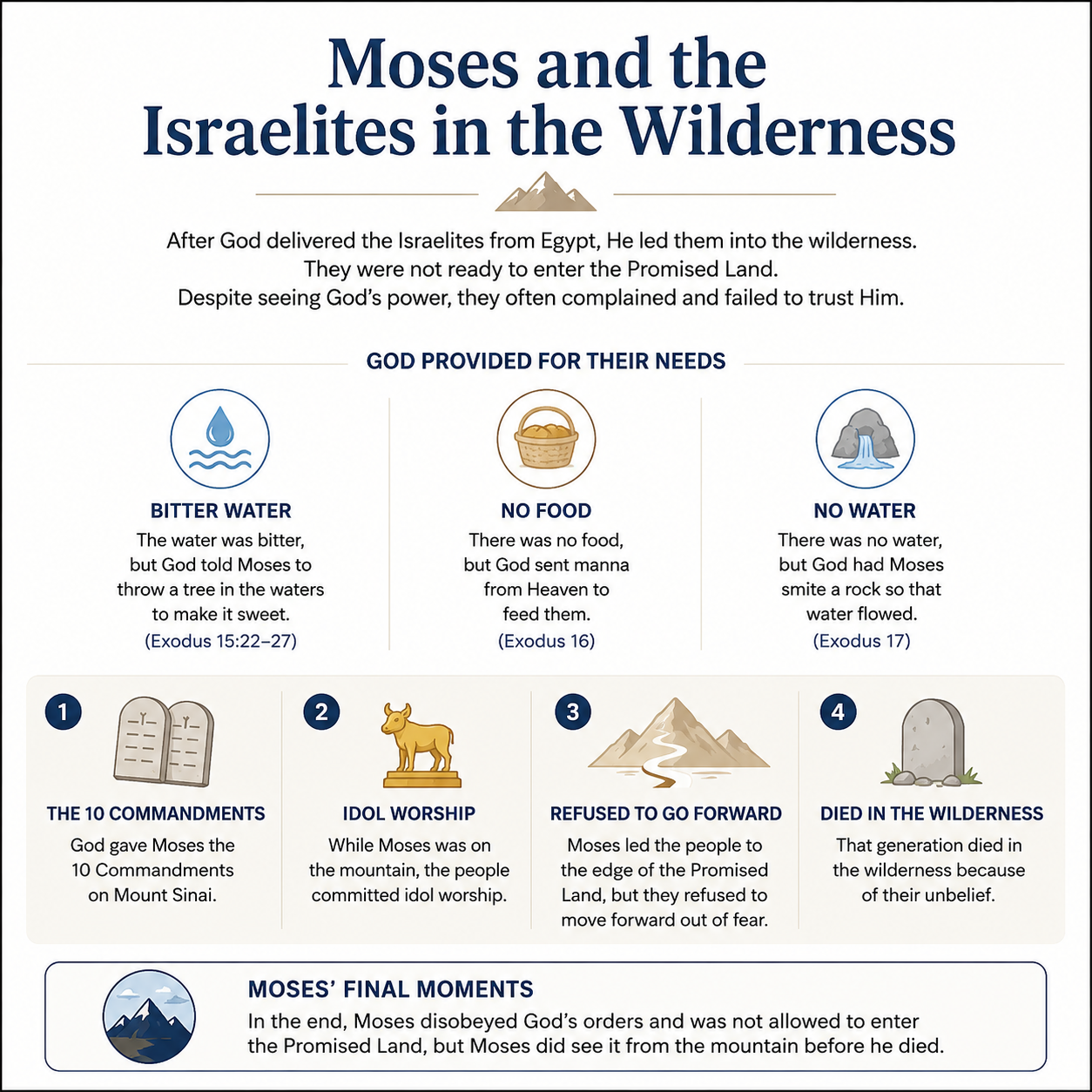
Just as God sent Moses into the wilderness to learn and grow, God sent the Israelites into the wilderness. They were not ready to take the Promised Land. They had been living as slaves all of their lives. Despite all of the signs and wonders they had seen God perform, the Israelites were constantly complaining and failing to trust God:
- The water was bitter, but God told Moses to throw a tree in the waters to make it sweet (Ex. 15:22-27).
- There was no food, but God sent manna from Heaven to feed them (Ex. 16).
- There was no water, but God had Moses smite a rock so that water flowed (Ex. 17).
Then God gave Moses the 10 Commandments, and they committed idol worship while he was on the mountain. Moses led the people to the edge of the Promised Land, but they refused to move forward out of fear, and that generation died in the wilderness because of it. In the end, Moses disobeyed God’s orders and was not allowed to enter the Promised Land, but Moses did see it from the mountain before he died.
What Can We Learn from the Story of Moses and the Exodus?
There is a lot we can gain from studying the life of Moses during the Exodus:
- Moses was flawed, but God still used him.
- God hears the cries of His people.
- God equips those whom He calls.
- Disobedience comes with consequences.
Throughout the story of the Exodus, the people constantly complained and were afraid despite all the signs and wonders God showed them. We may be quick to judge them, but we are all guilty of this at some point in our lives. Like Moses, we too have moments of disobedience. No one is perfect, but God will use you and me if we are willing to accept God’s assignment and follow in obedience. We just have to be courageous and say yes, knowing that God will prepare us, equip us, and lead us as we go forward in faith.
Photo credit: Pixabay/jeffjacobs1990
Linda Lyle is a writer, teacher, knitter, and unintentional collector of cats. She has written articles for the Alabama Baptist, Open Windows, Refresh, as well as multiple novels and novellas. Her newest book, 5-Minute Prayer Plan for When Life Is Overwhelming, is set to release in October. She spins yarns on her blog The End of My Yarn at lindalyle.com.


.800w.tn.jpg)